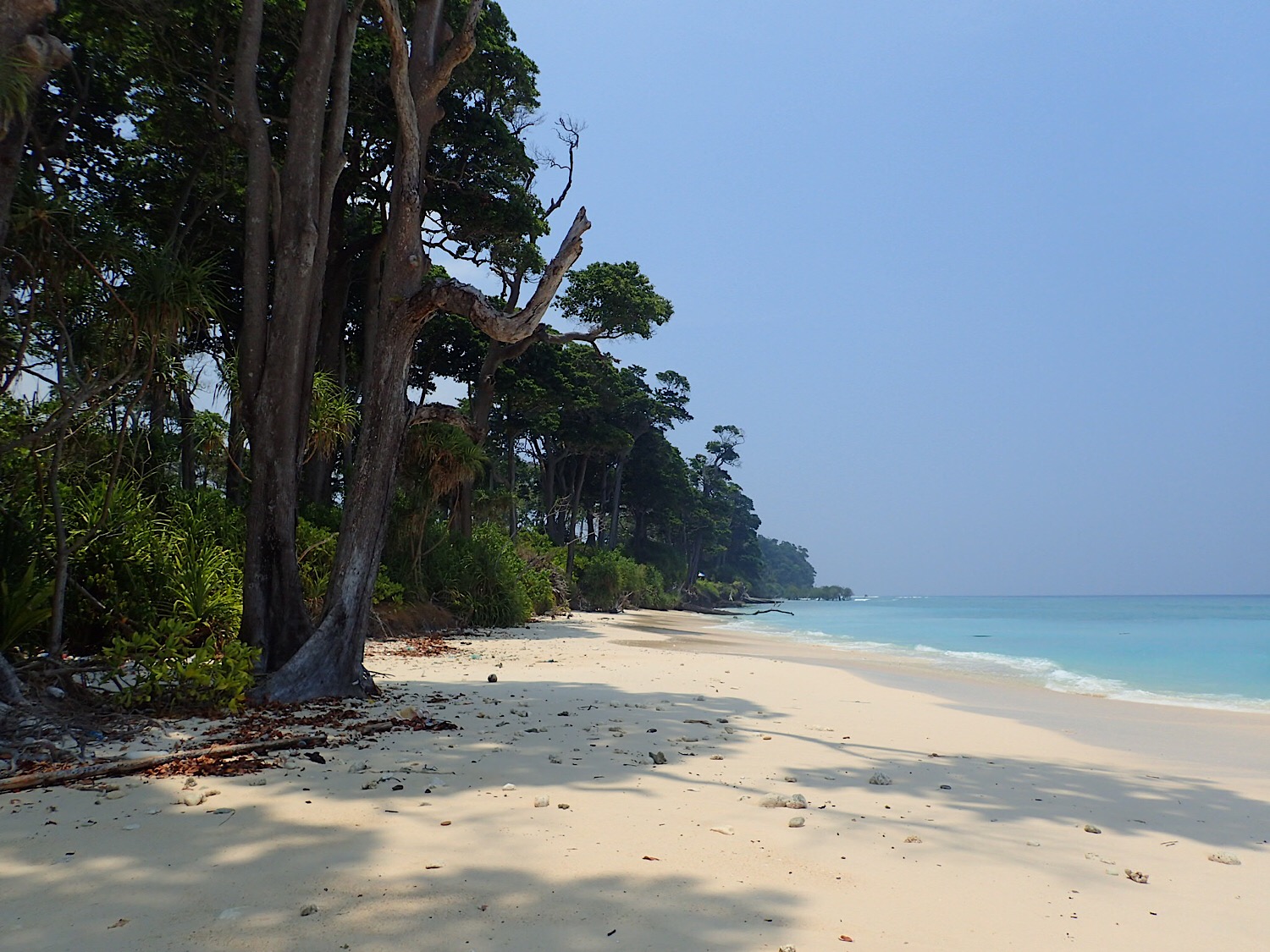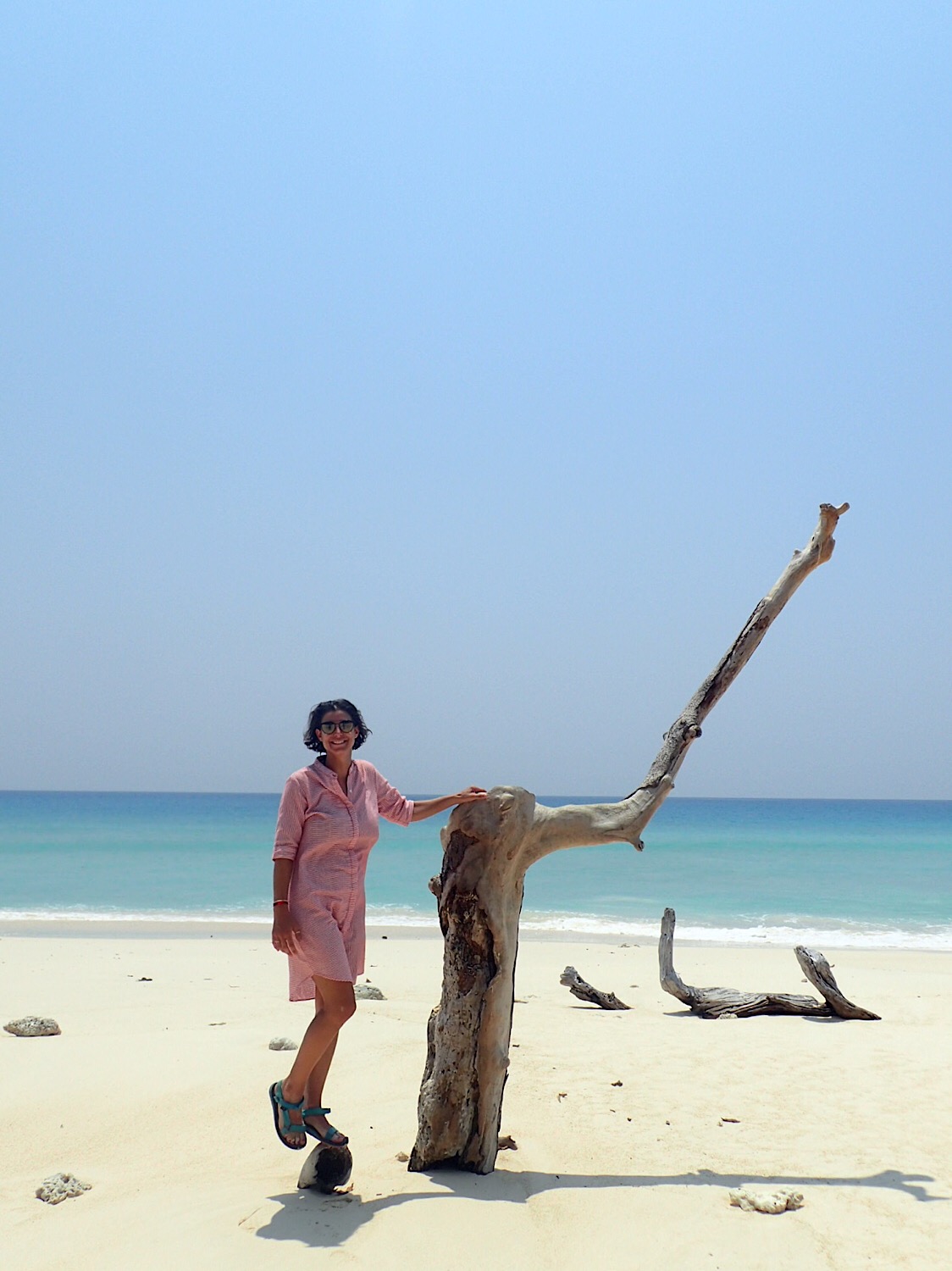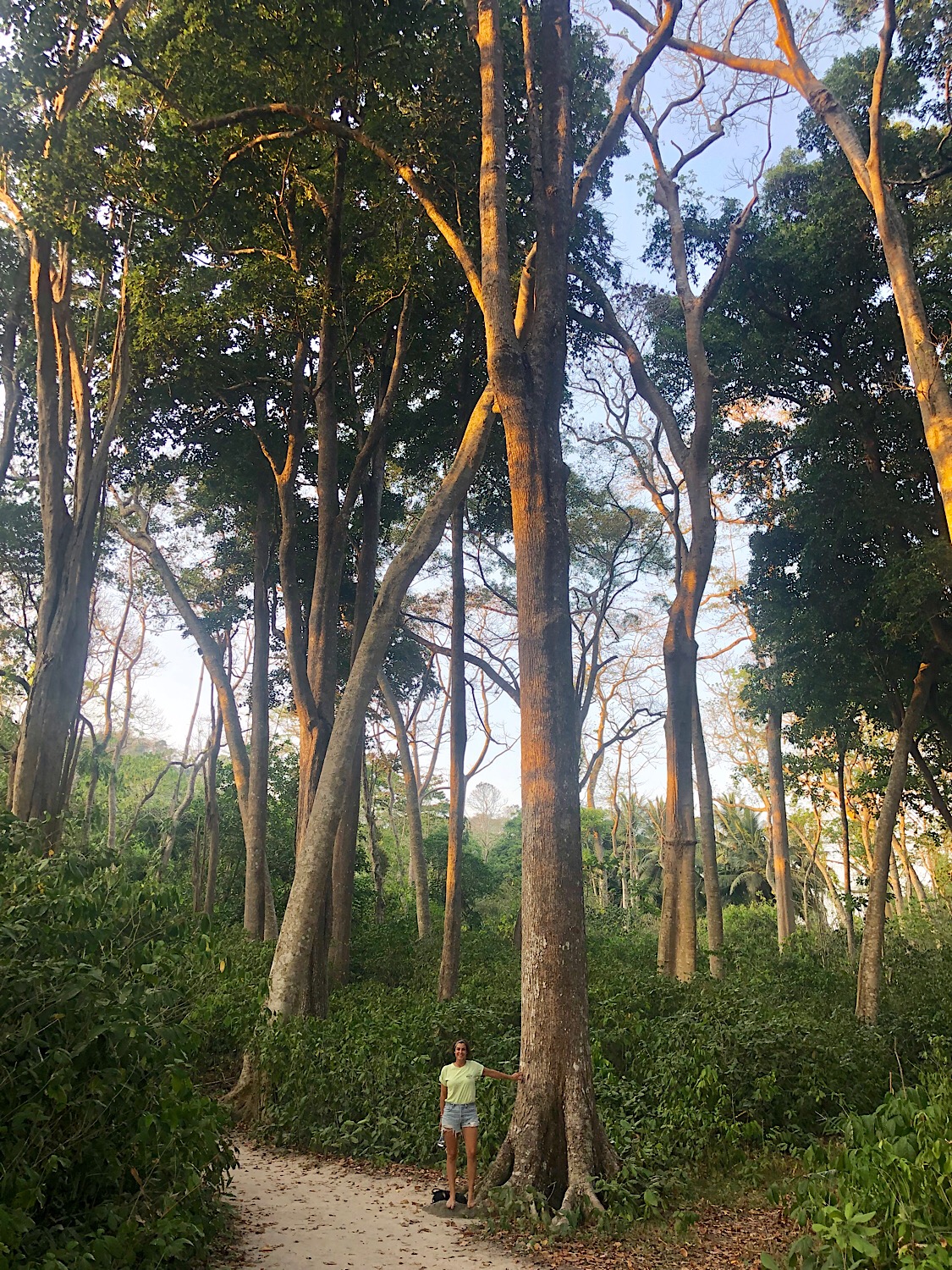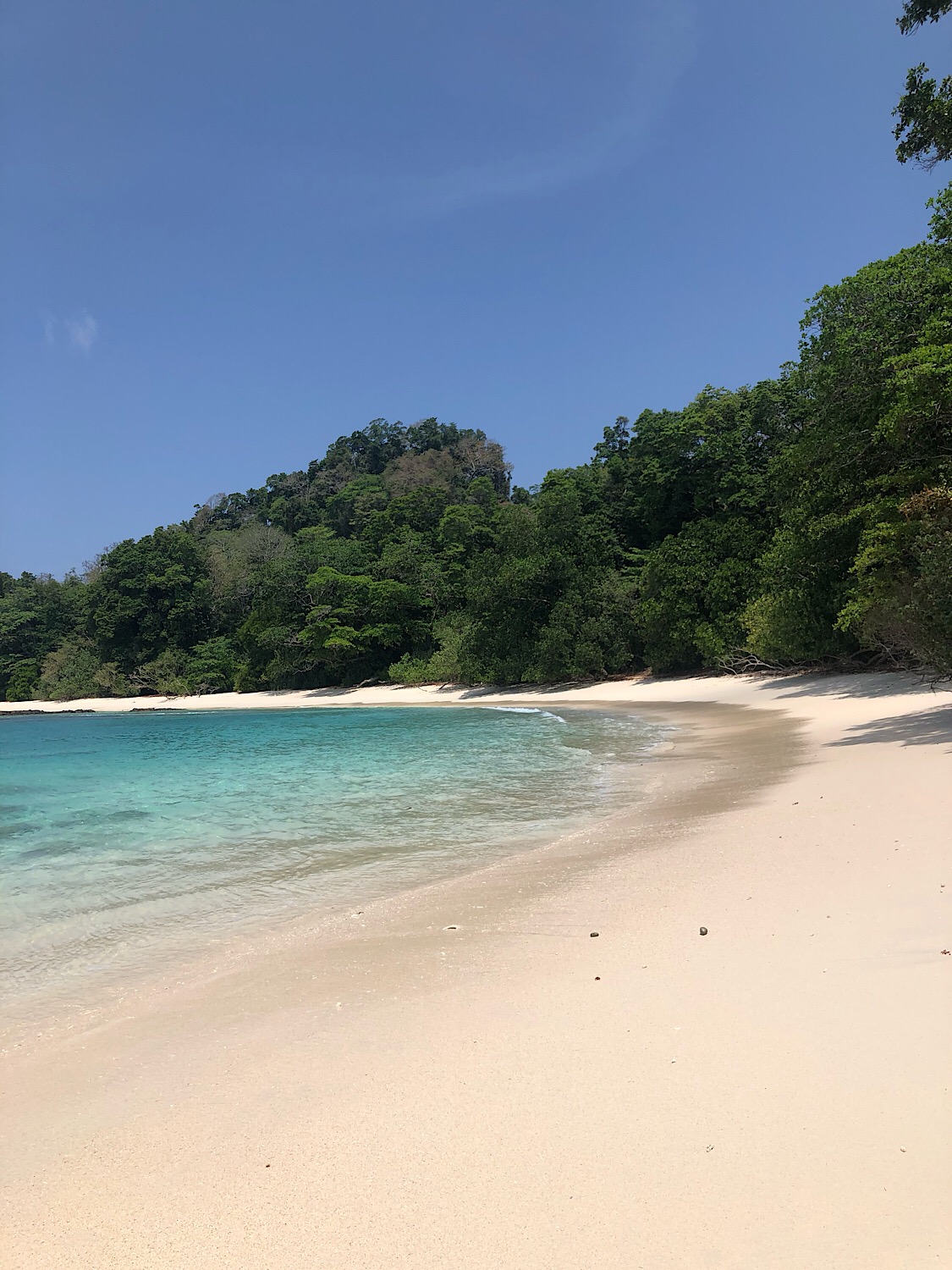
Leg 4 – Rattling through roasting Royal Rajasthan all the way up to Dizzying Darjeeling

Hello Peahead here! I’m finishing this post in the most glorious spot overlooking Tofo Beach in Mozambique as we are now actually in Africa (as we have been for months) on the last few weeks of our mega trip (😢) and we have been having such a blast we are way behind on the blog, but never fear I’m here to recount what we got up to in the second half of our trip in India.

—————

Our Indian odyssey continued with a couple of flights north from Port Blair to Kolkata then up to Jaipur – The Pink City the first stop on our magical mystery tour of Rajasthan is Northern India. The first thing that hit us was the heat, we’d expected it to be hot and having dismissed the advice of our native friends, decided to visit at the start of summer when it would be roasting. But it was bloody hot, and humid, like 40 degrees hot. I’d like to say we got used to the heat it but we didn’t really. We did however see so many breathtaking historical sites, learnt so much and ate so much delicious food that it was totally worth bearing the heat for.
Those Maharajah were so totally EXTRA

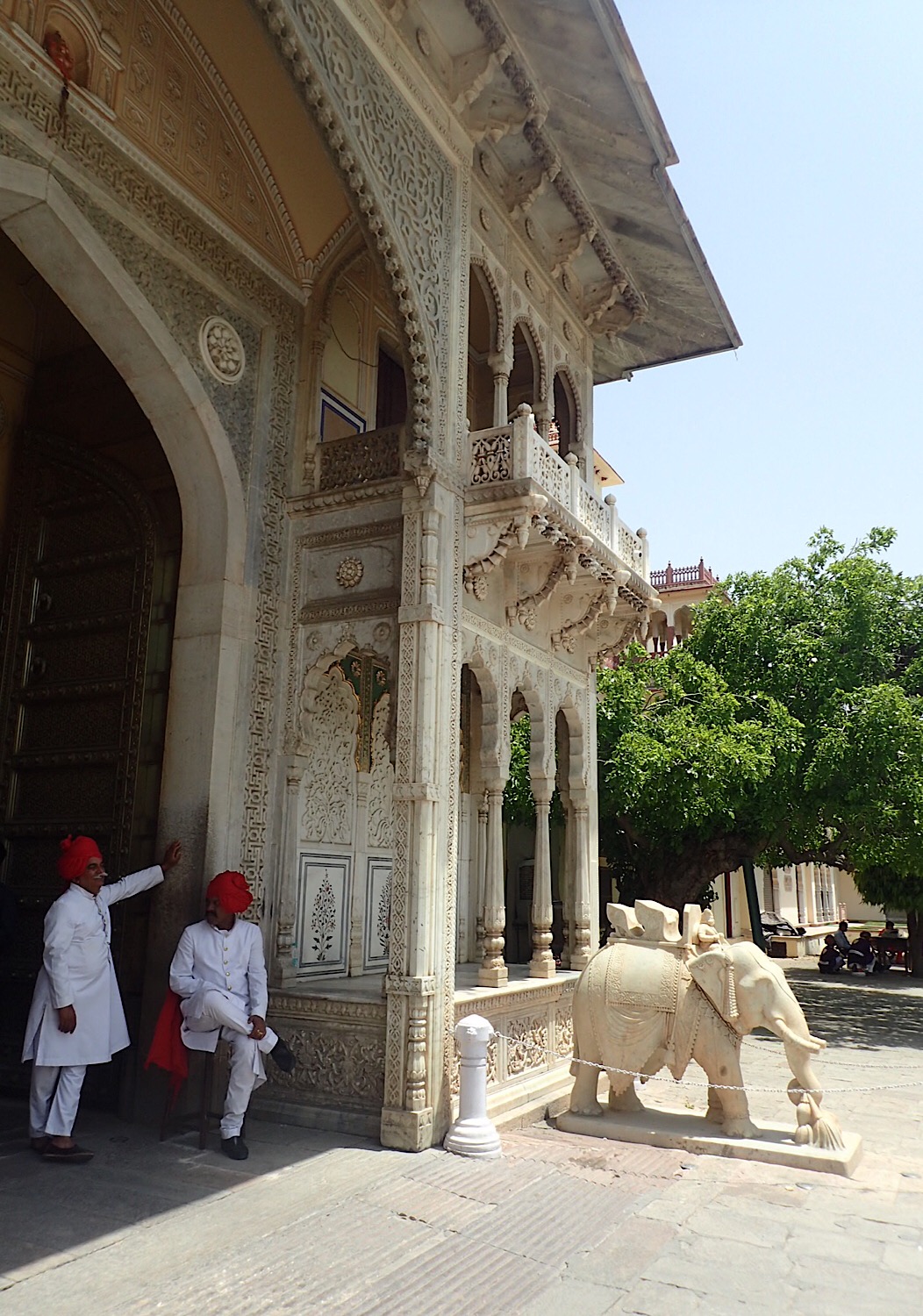
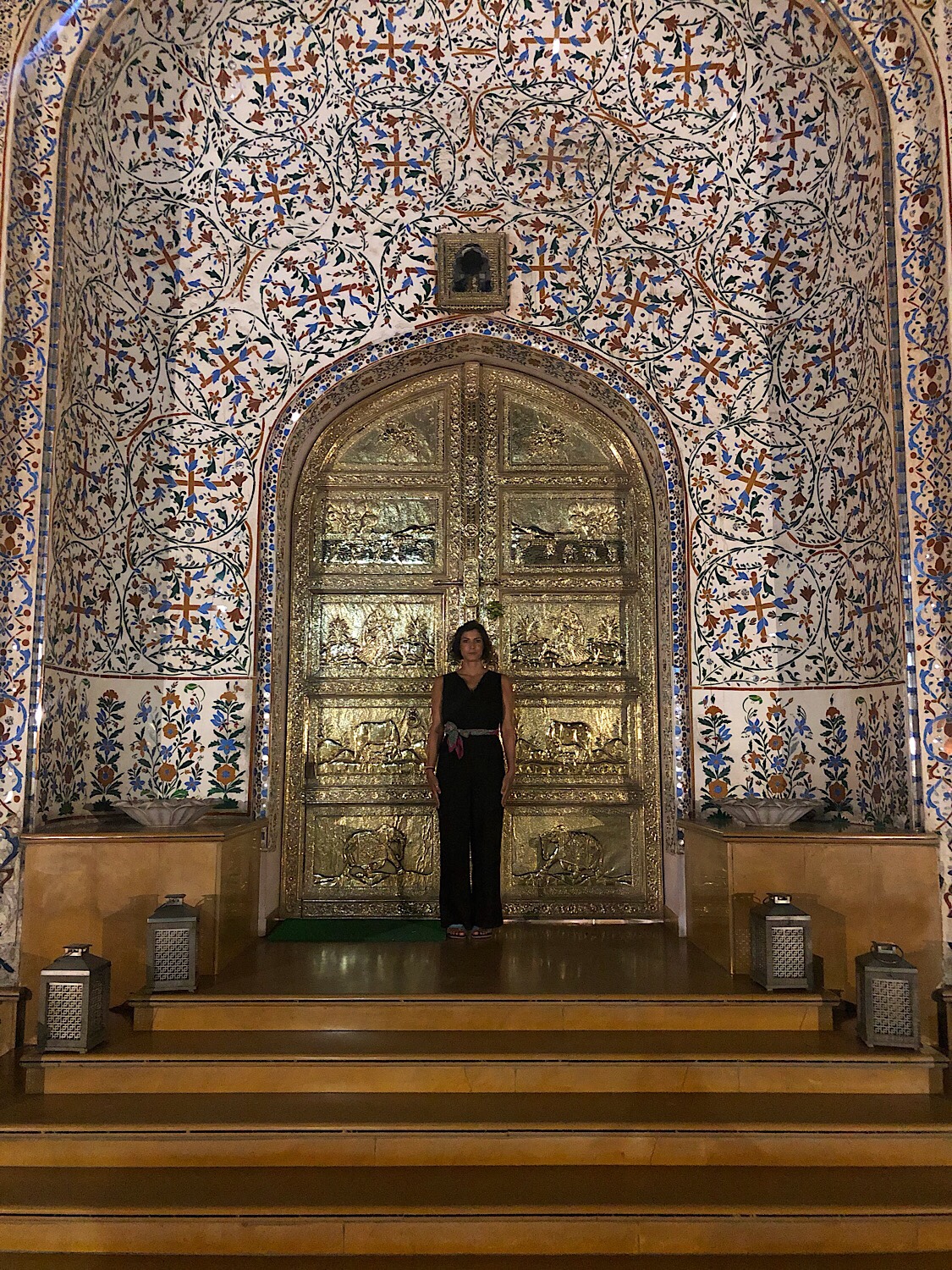
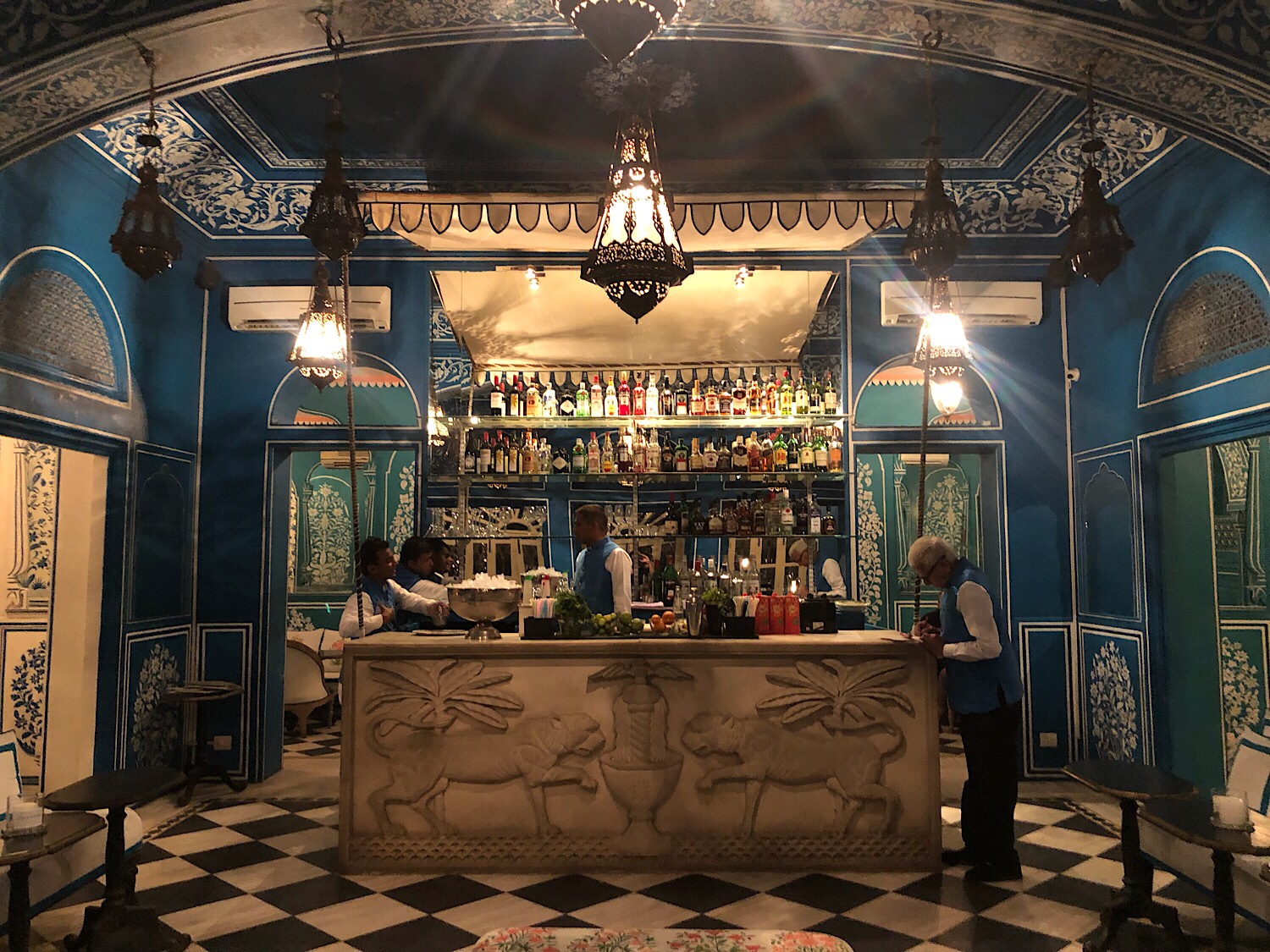
So Jaipur the pink city is actually more terracotta than pink but that doesn’t detract from how wonderfully chaotic and brilliant it is! After a very dusty drive from the airport we arrived at our hotel – the Umaid Mahal Heritage Palace Hotel that I’d chosen since it was really over the top on the decor front – right up my street, huge golden doors greeted us upon arrival and the inside didn’t disappoint either. We had a lovely sunset jar on the roof terrace overlooking the city before heading to Bar Palladio for a delicious Italian supper and cocktails. Bar Palladio is a gorgeous Art Deco meets colonial villa style bar/restaurant with epic royal blue and white decor, a seriously impressive bar and an atmospheric garden with covered chaise longues and sofas – definitely worth a visit if you ever find yourself in Jaipur and need to escape the chaos.
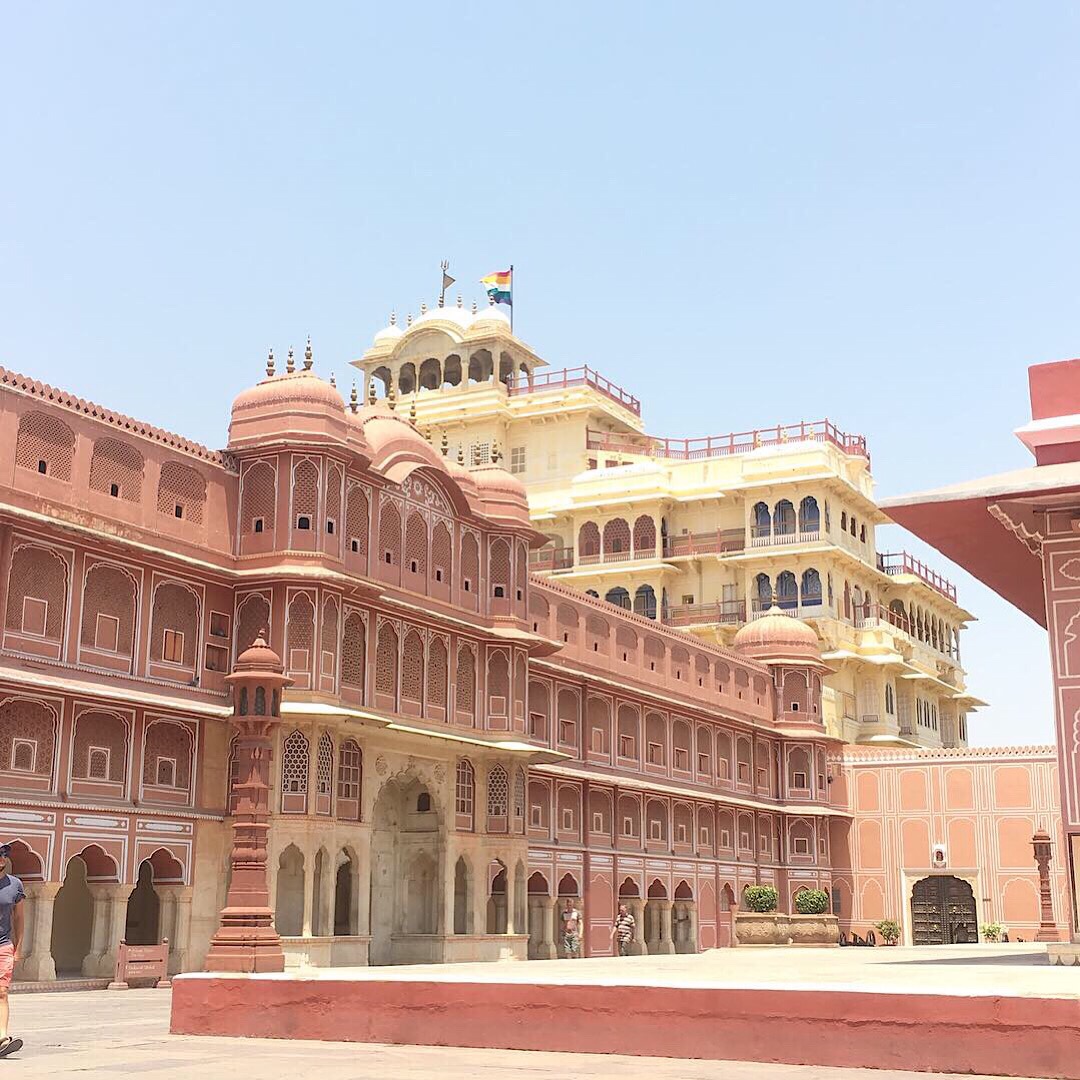
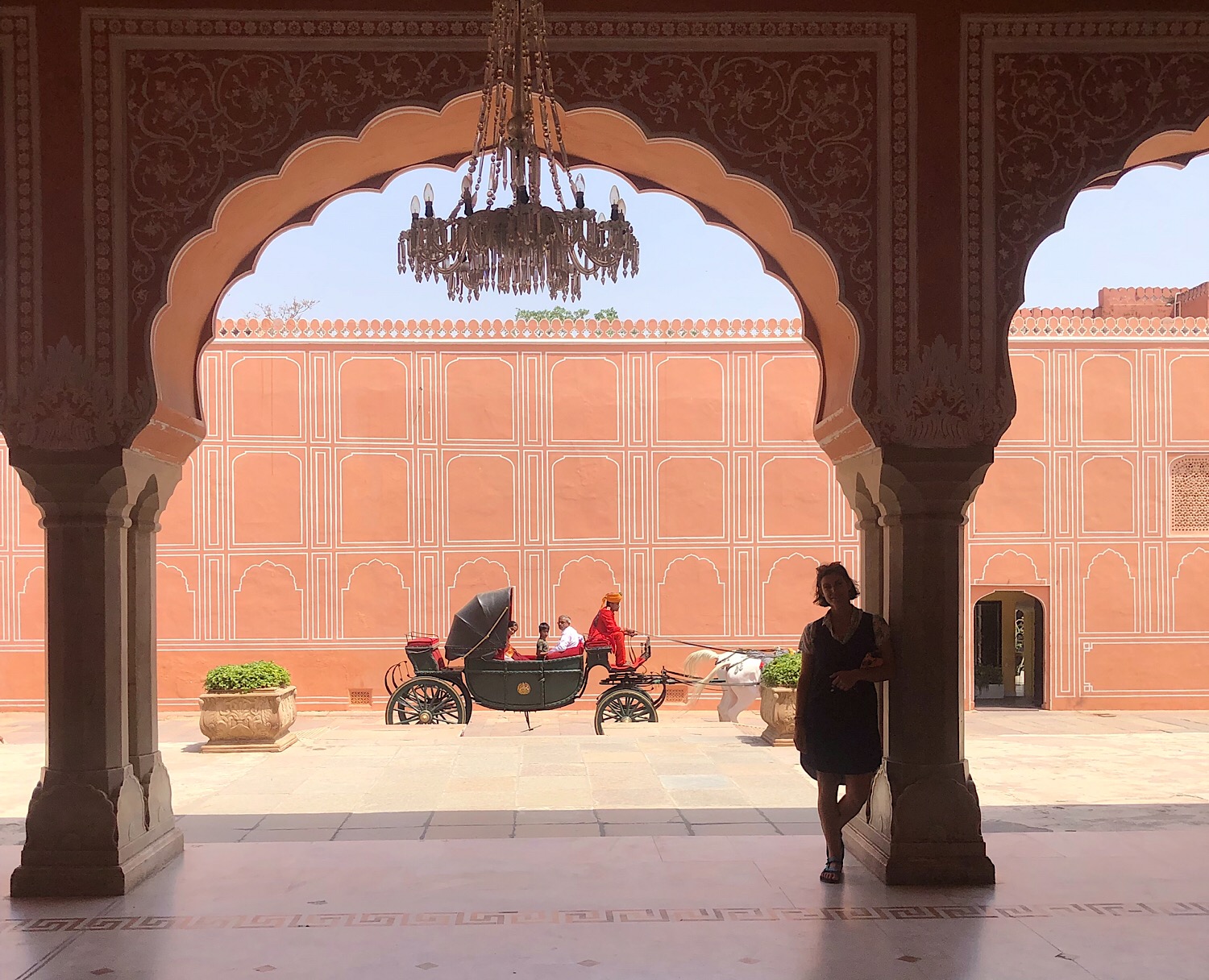
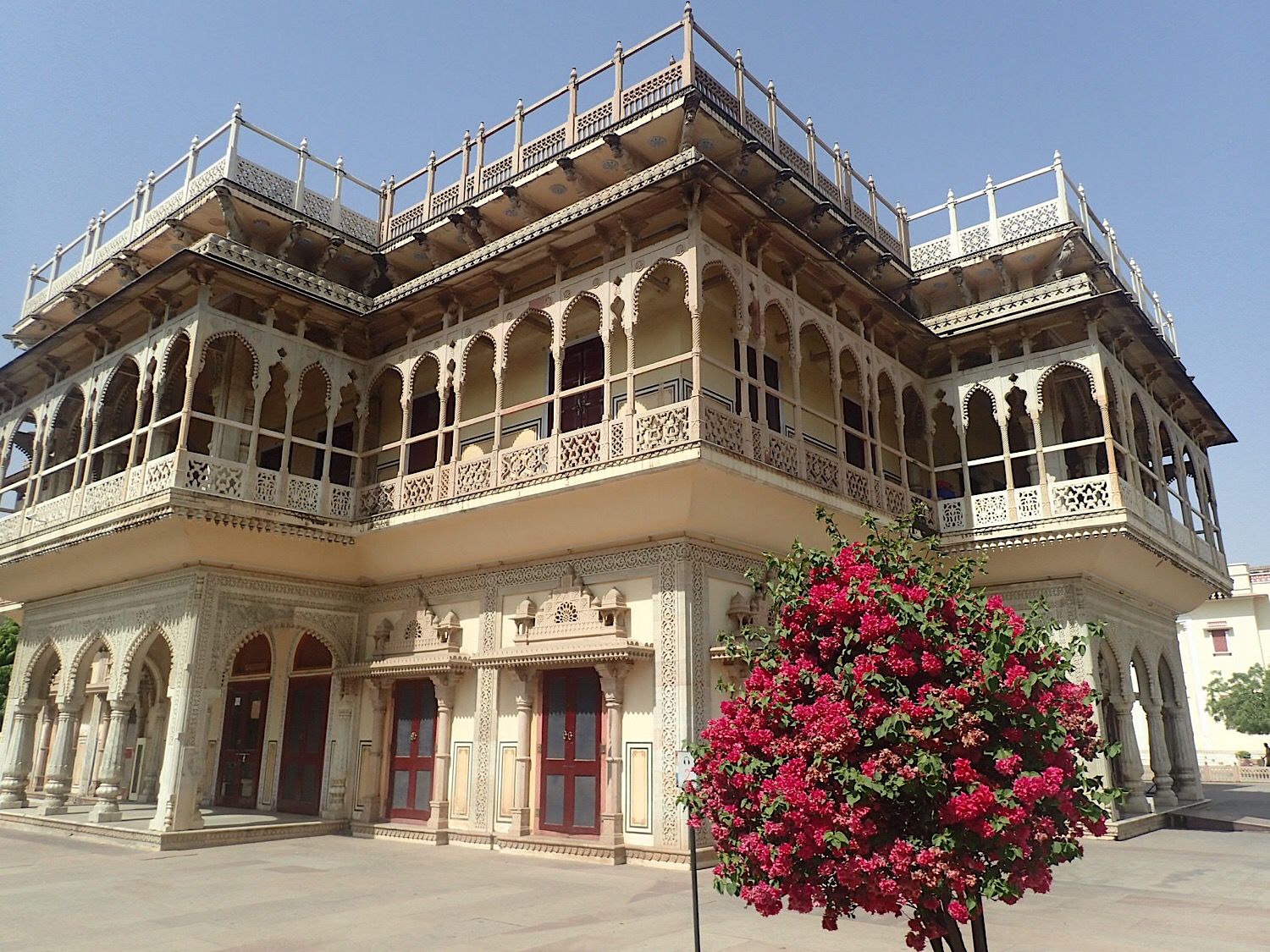
On our first night we happened to hail down an extremely enterprising Tuk tuk driver called Roshan who also offered to be our guide for our time in Jaipur, and after reading through some very effusive comments from previous clients in his guest book we agreed to have him show us around the city for the next few days. First we took in the City Palace – a wonderful pink complex where the Jaipur Royal Family still reside today (although they don’t actually have any power they still have a lush manor). This was our first encounter with an audio tour and we loved it particularly since they all seem to be narrated by an extremely well spoken Indian chap who’d clearly learnt to speak English from the BBC World Service circa 1940. We learnt lots about how the royal Rajasthani’s lived including their love for Polo, which the women also loved to play but since they weren’t allowed to flaunt themselves in broad daylight playing such a scandalous game they had to play at night. ‘But how would they ever see the ball?’ I hear you cry. Well the ingenious solution was a metal gyroscope ball which had a candle inside it so the lovely ladies could actually see what they were trying to whack! As the chap on the audio guide exclaimed “how cool is that?”
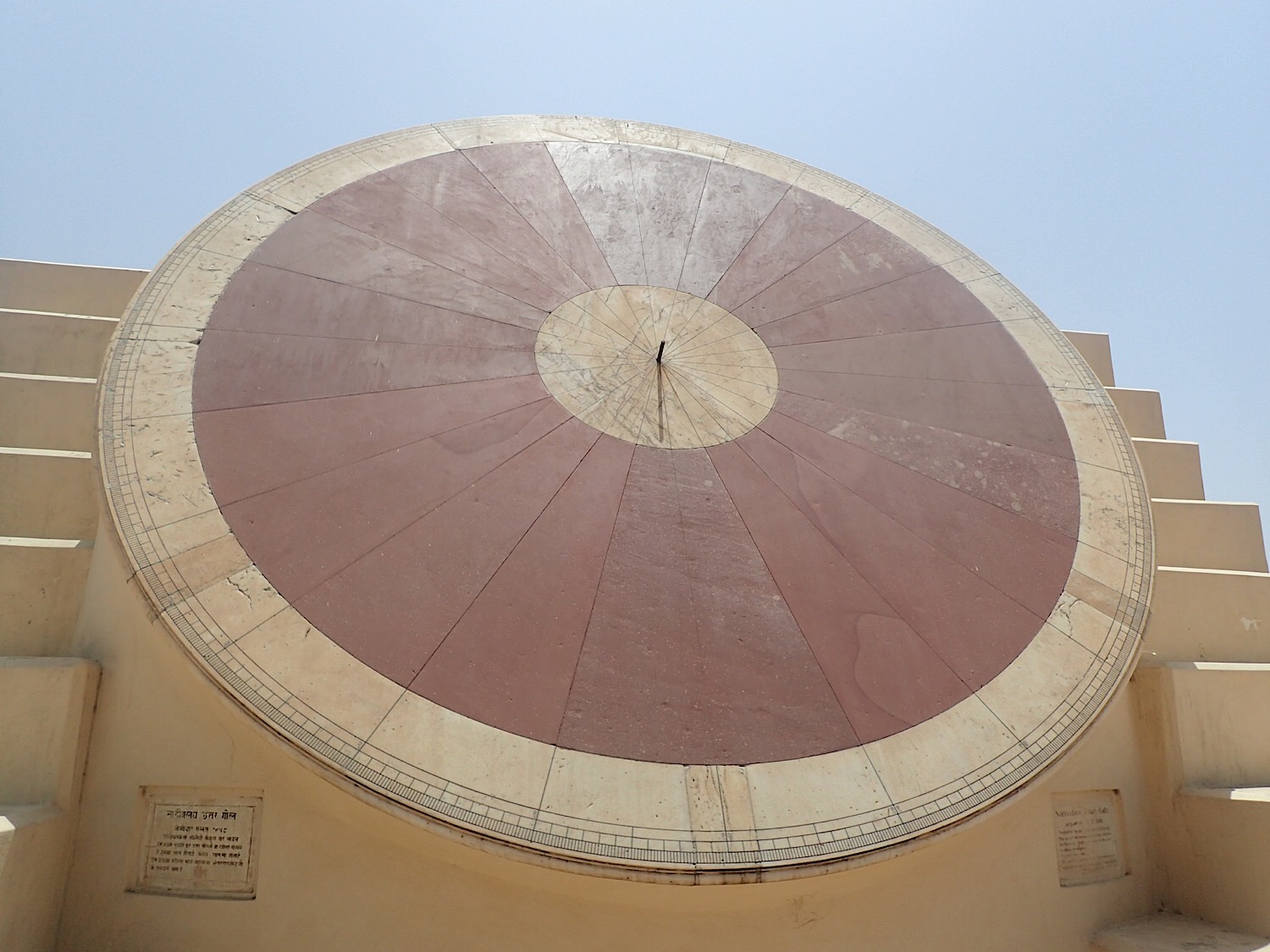
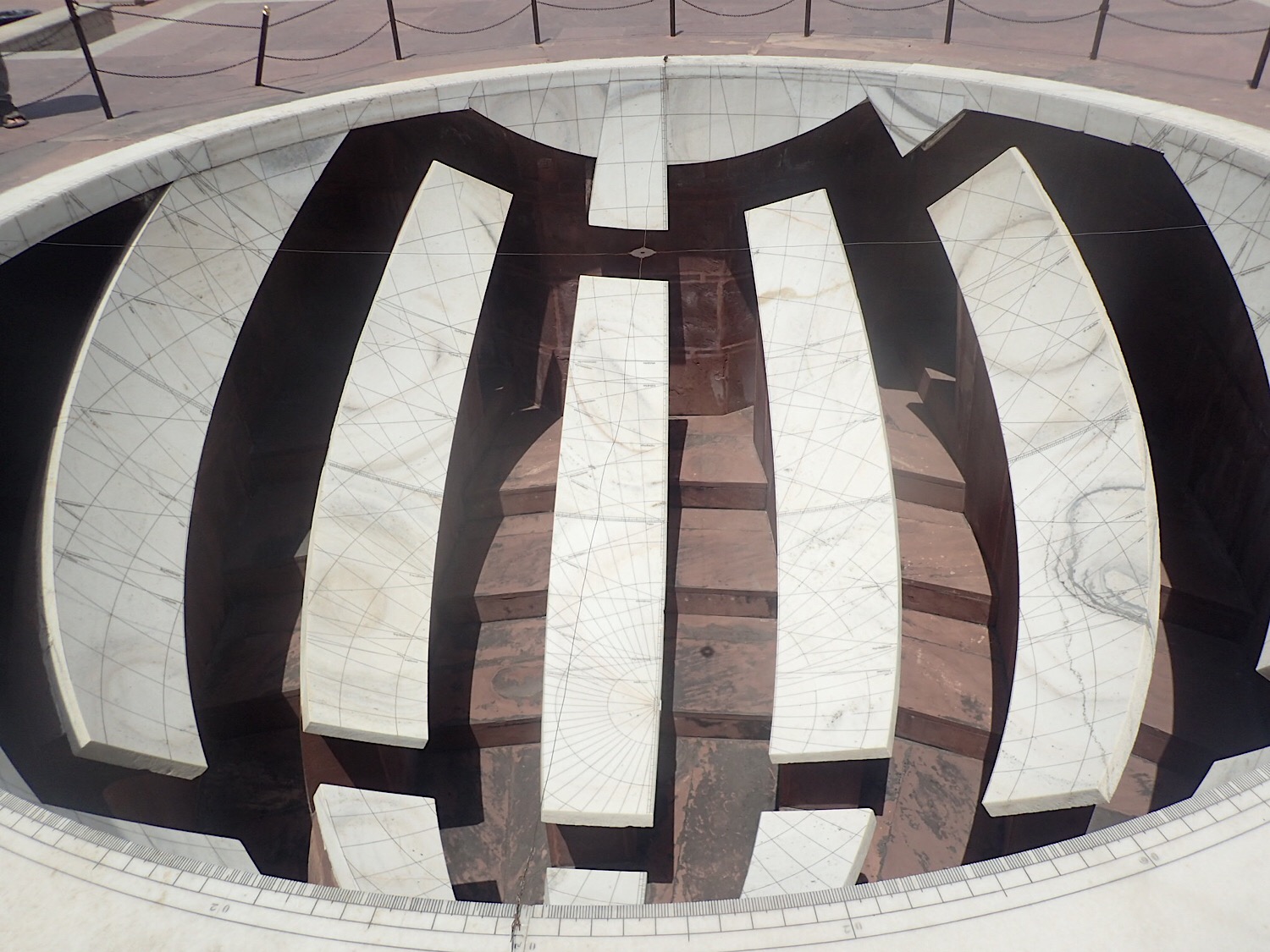
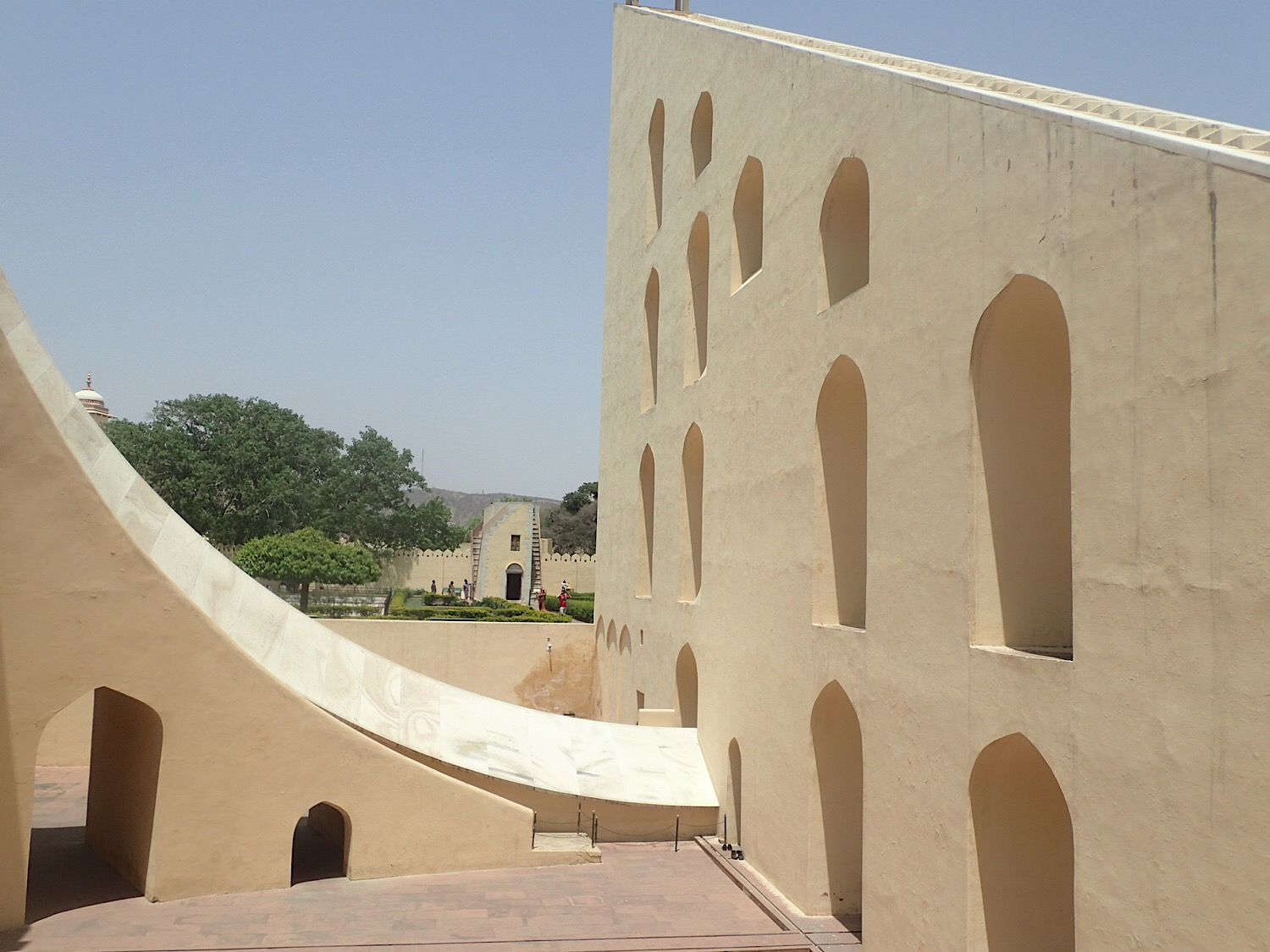
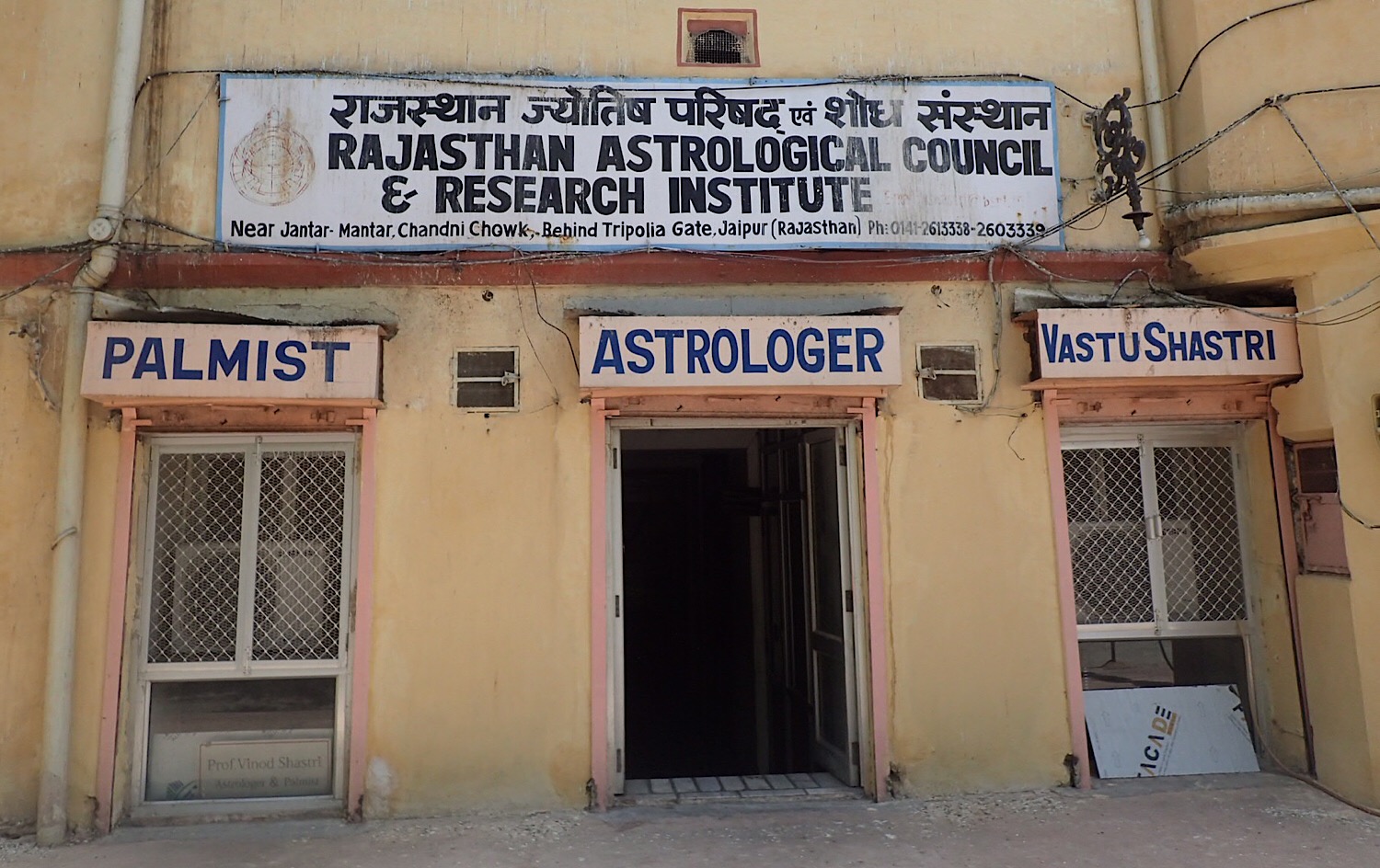
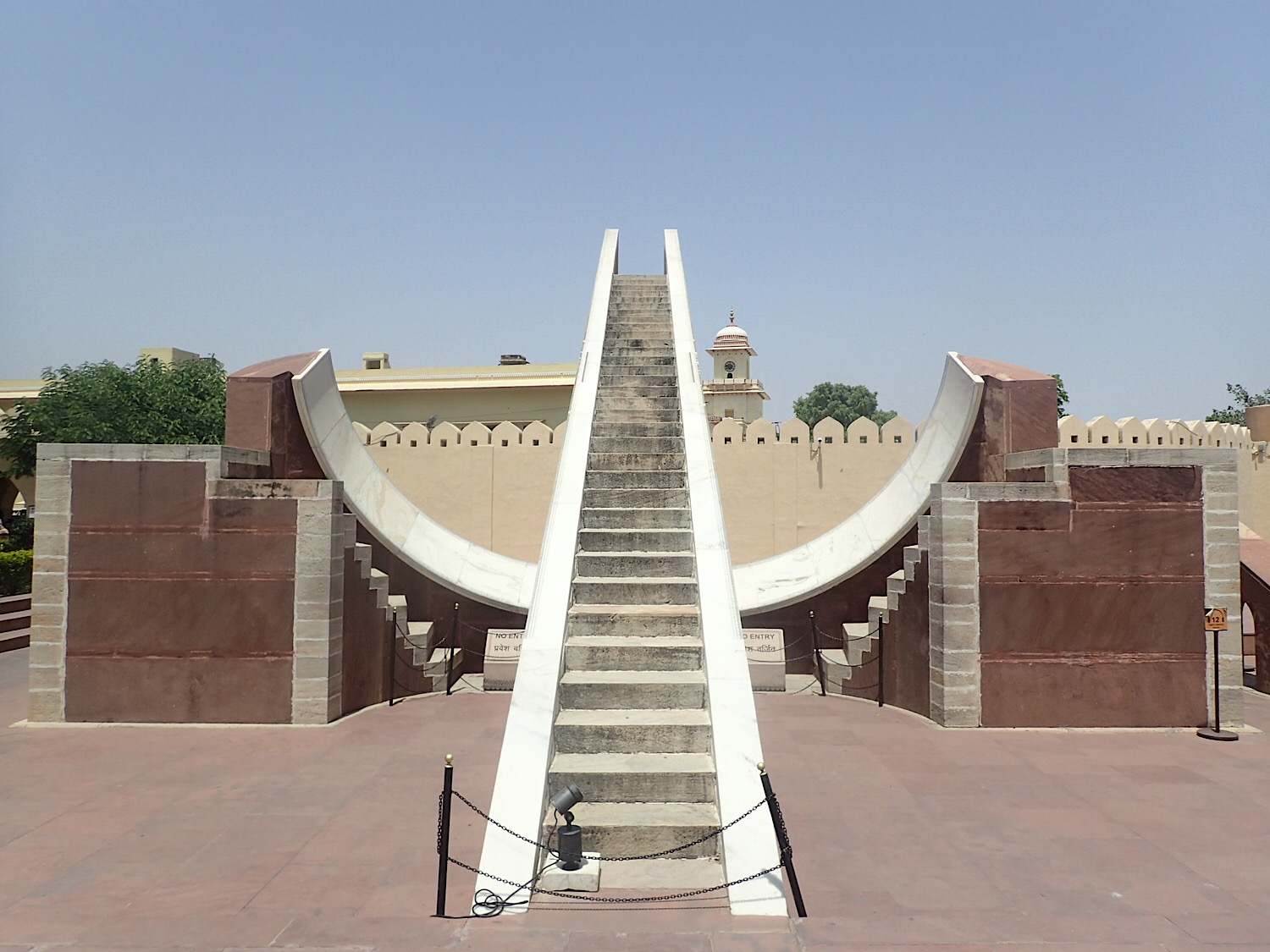
We also fell in love with the art of Rajasthani miniature painting thanks to an excellent gallery and photography exhibition. The ancient artworks range from incredibly intricate, tiny postcard-sized images through to huge tapestry-scale depictions of daily royal court life and religious scenes with fascinating mythical creatures plus some naughtier karma sutra vibes (oooo-errr). After a scrummy lunch at a local joint we hot-footed it to Jantar Mantar which translates literally into ‘instrument of measurement’ and is a wonderful collection of huge astrological and mathematical instruments including the world’s largest sun dial that is accurate to two seconds. The Rajasthani royals (and I imagine the general public) had an obsession with astrology and horoscopes hoping they would be able predict the good fortunes of their regal offspring.
We also partook in some classic ripoff tourist shopping for silver and textiles. Apparently every single tourist that visits Jaipur buys a bedspread, we almost did too given the power of the sales patter the shop keeper exhibited but we stayed strong and only came away with four bespoke items(!)

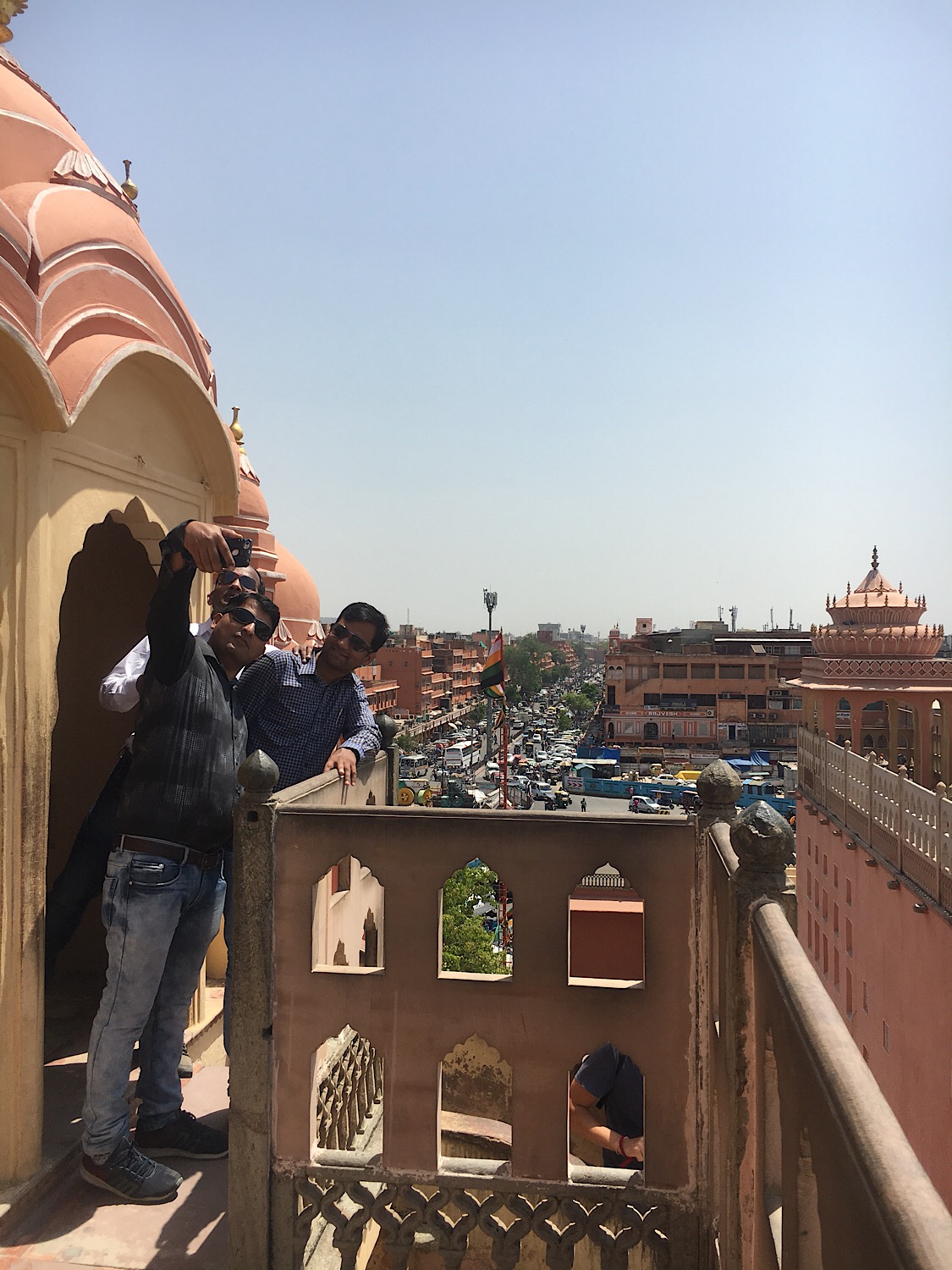
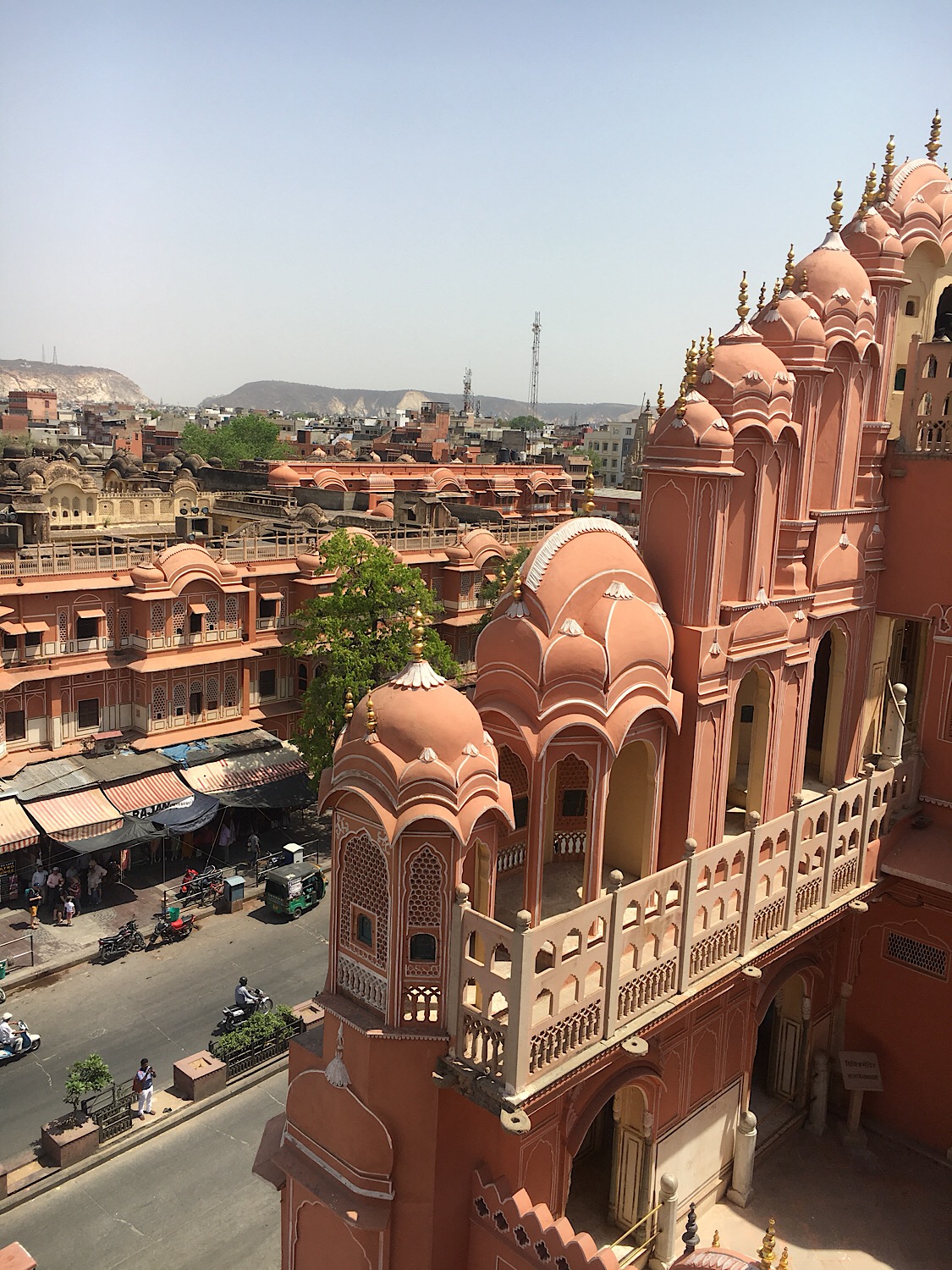
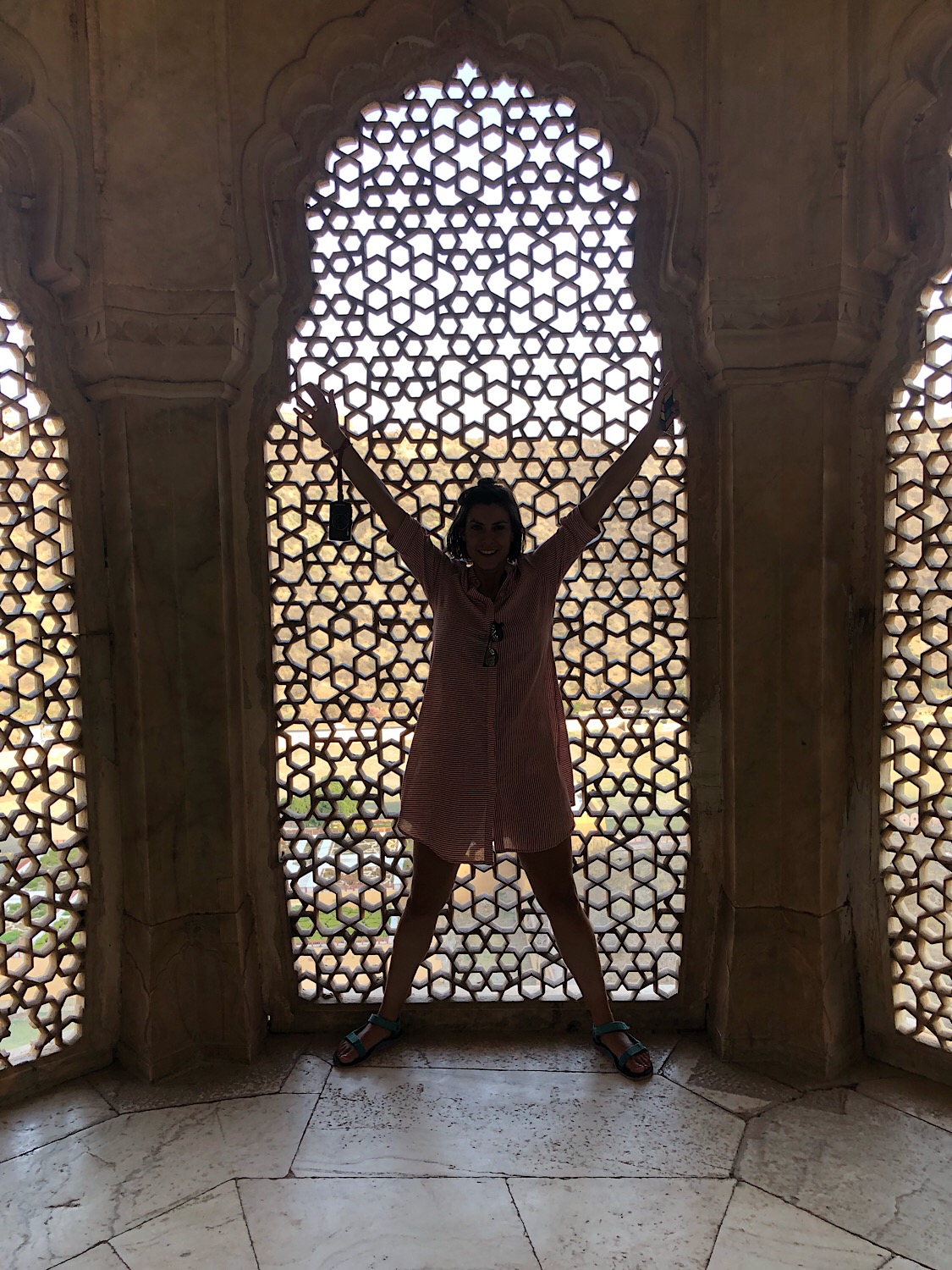
Another big hitter on the Jaipur ancient sites circuit is the Hawa Mahal or ‘Palace of Wind’, not of the flatulent variety but after the breeze that bluew through the stone carved screens. It’s another architectural wonder designed with lots of small rooms and turrets, with screens facing out to the bustling streets below. Designed so the royal women who had to obey the strict rules of Purdah – which forbade them from appearing in public without face coverings could watch the daily goings on without exposing themselves.
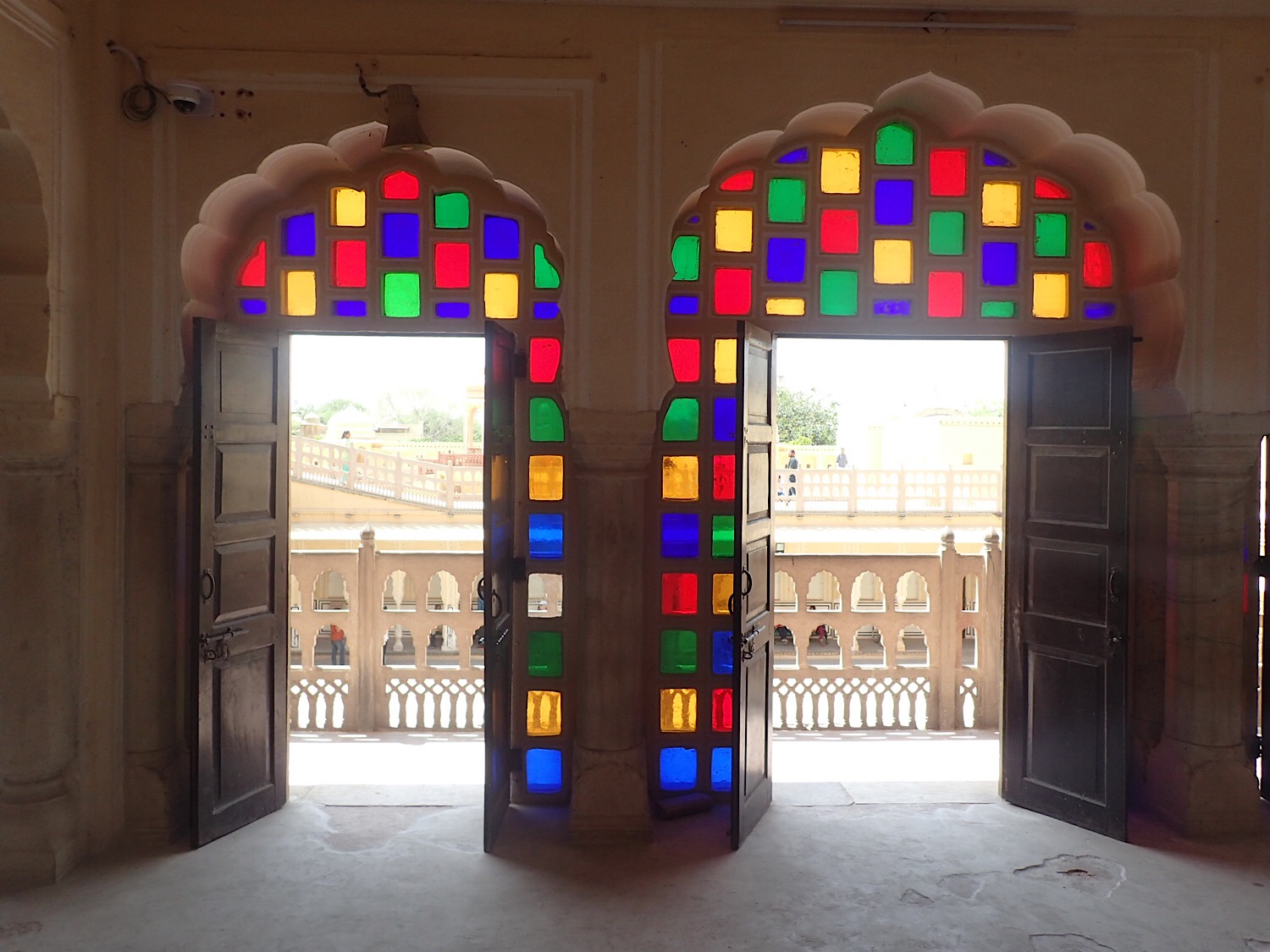
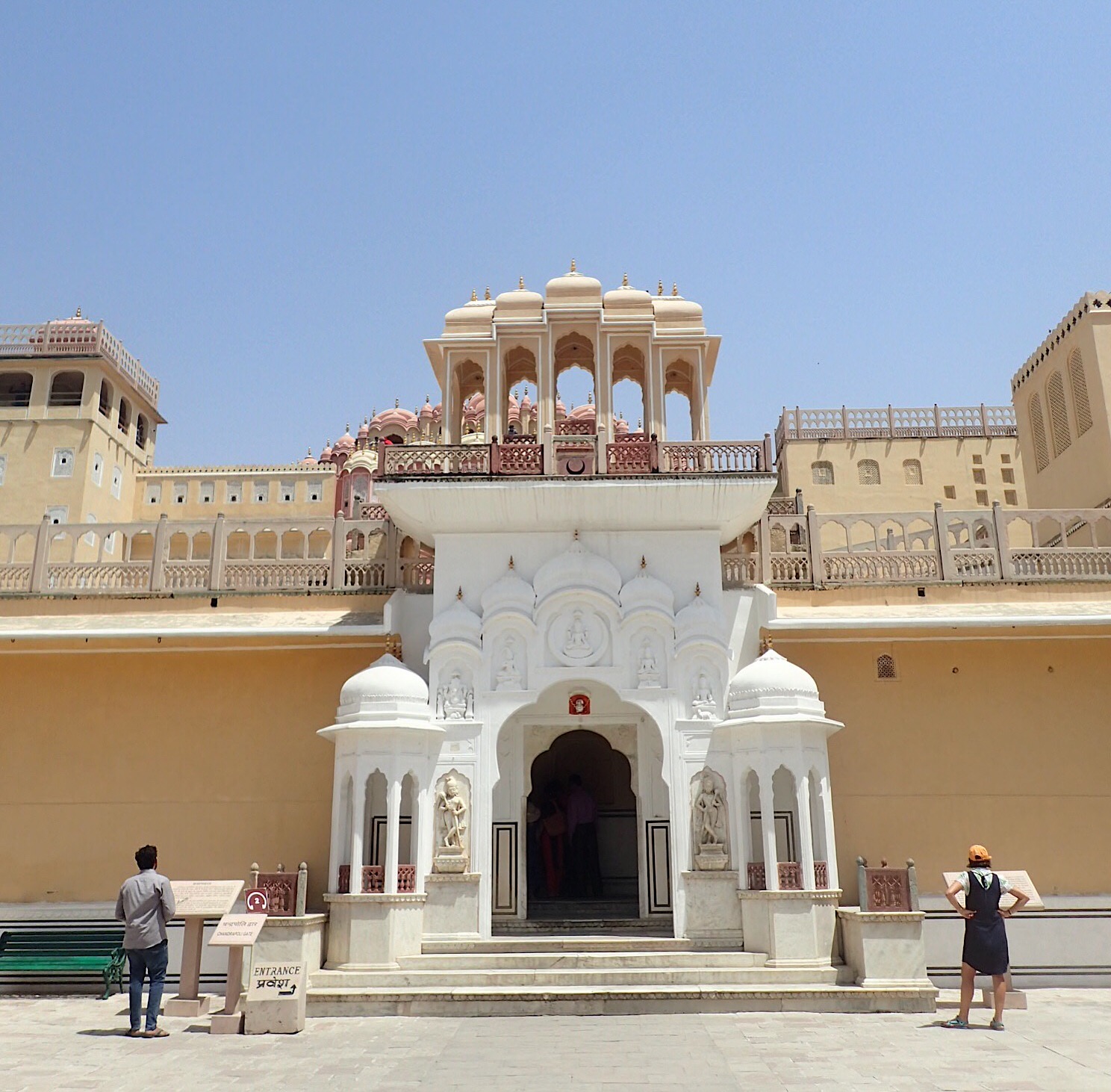
Unfortunately one of our few unpleasant experiences happened in Jaipur, and has come to be known as Post Office Gate. We wanted to send a small gift home and when we two Goras wandered up to the post office we were pounced on immediately by an extremely ‘helpful’ chap who, in cahoots with one of the staff, tried to rip us right off by charging a heavily inflated rate to post a very small package to the UK. Luckily Fred’s “consumer rights champion mode” kicked in and he refused to pay the sum. In the end Roshan came to our rescue and once we’d found out from the parcel wrapping guy there was a bit of a racket going on, we just bought some stamps instead and the drama was over.

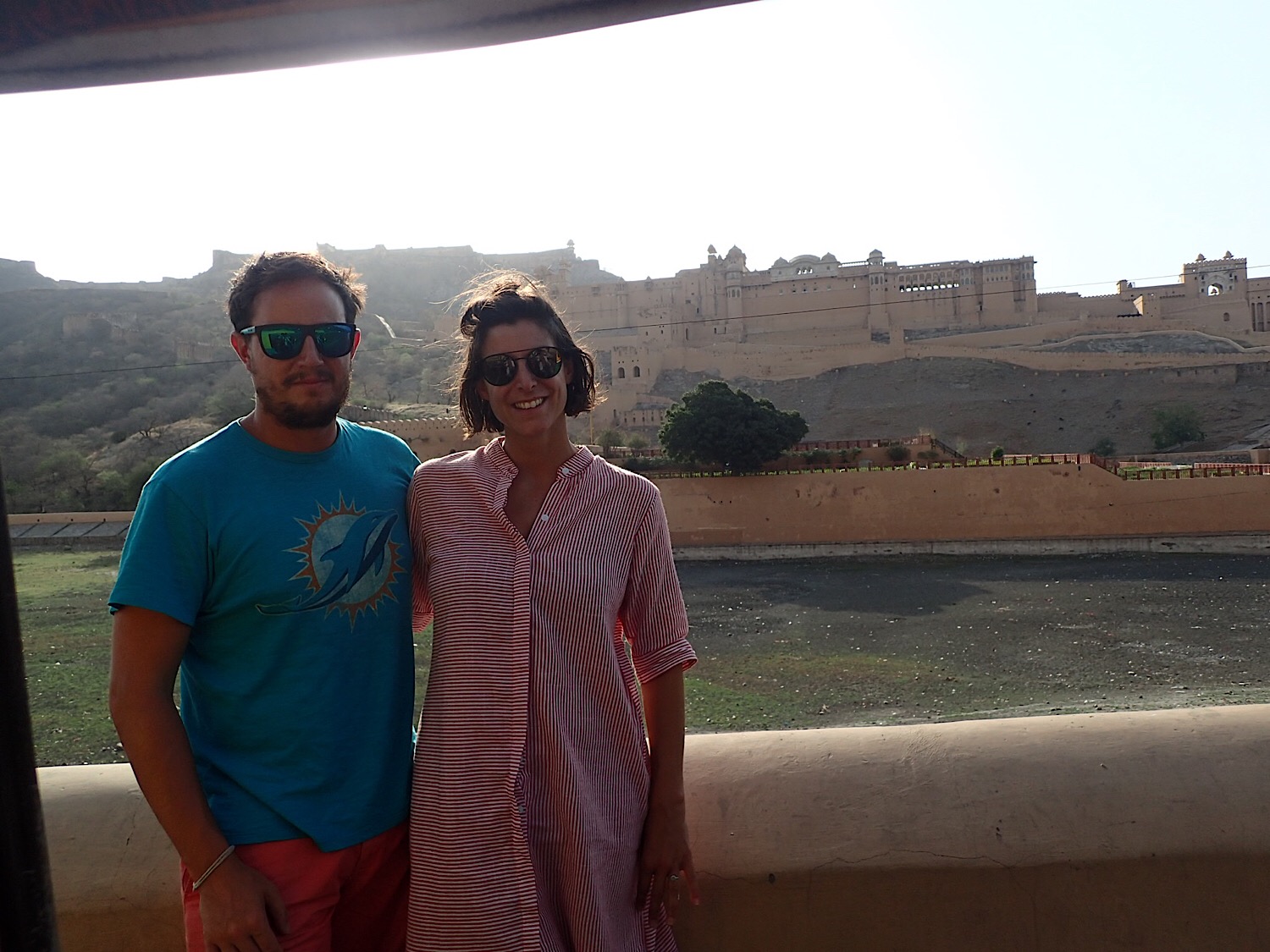
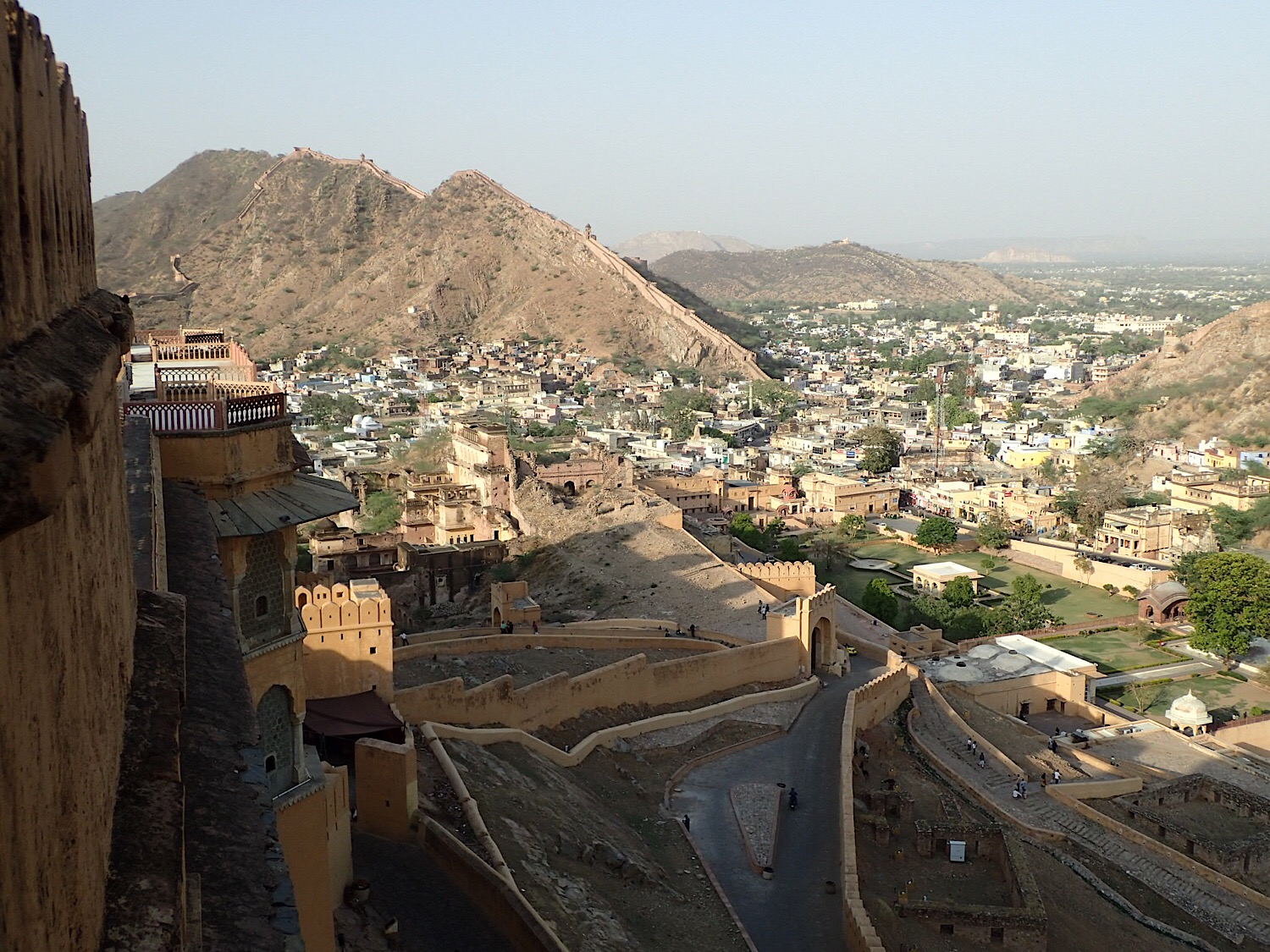
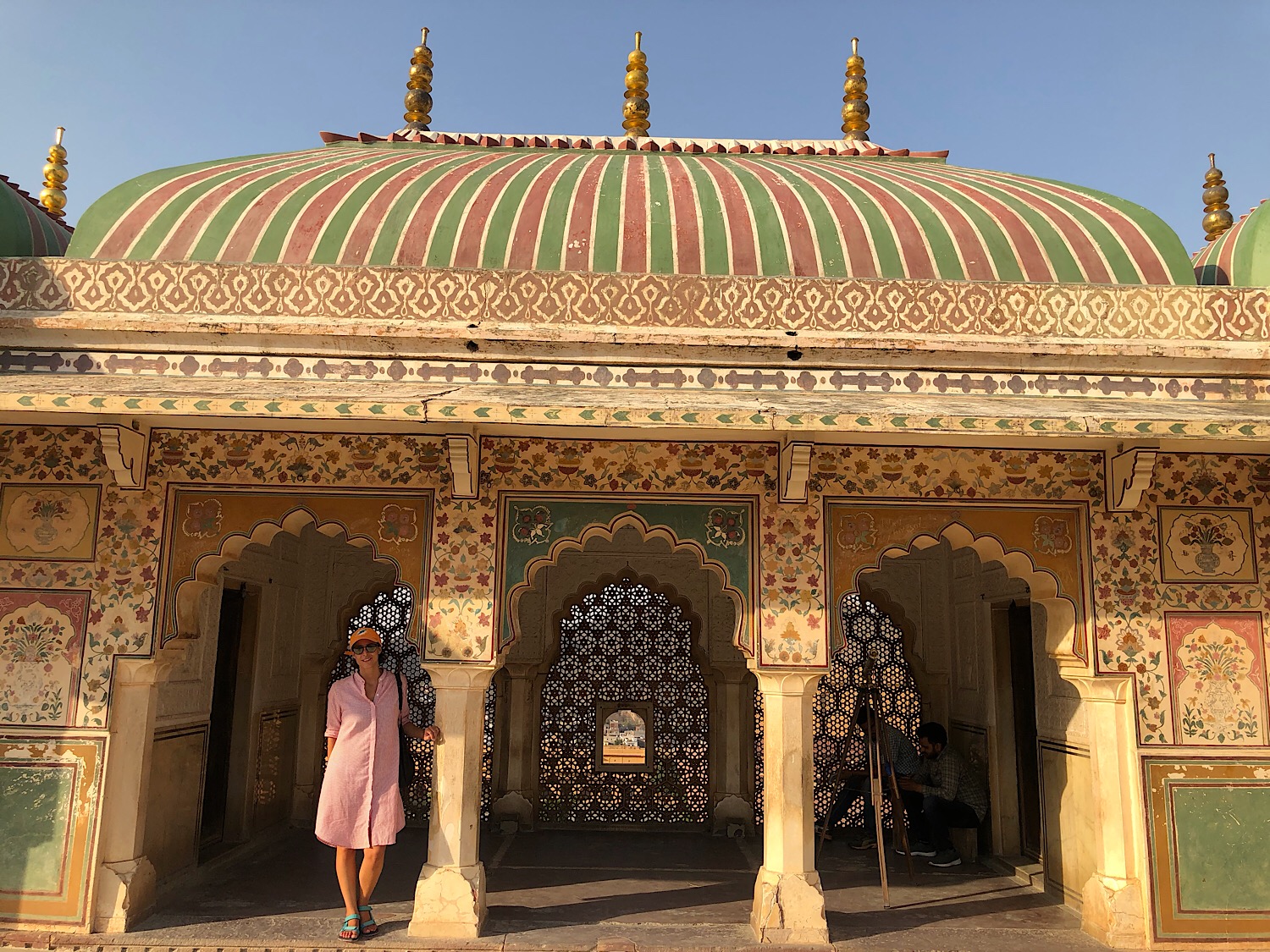
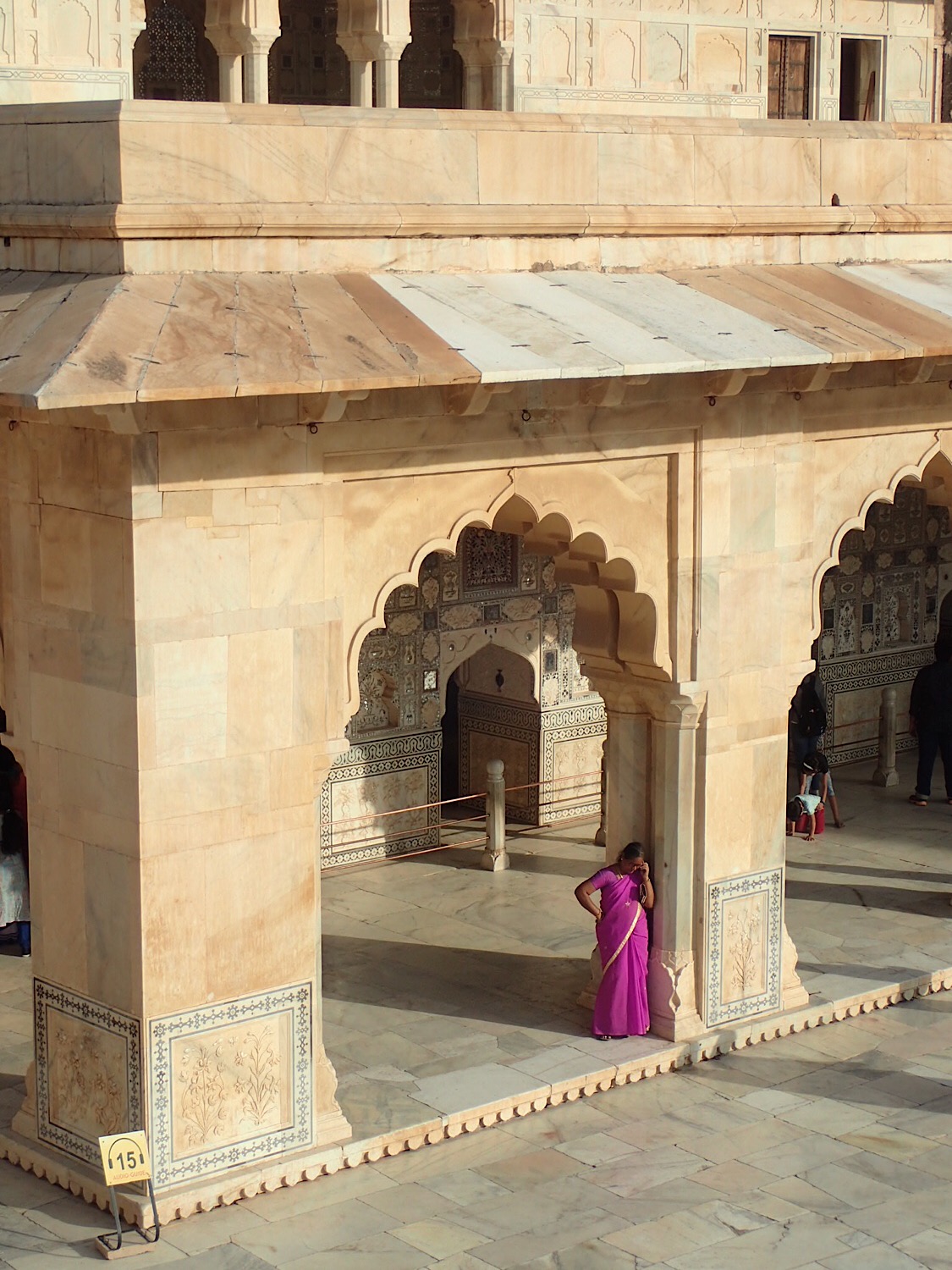
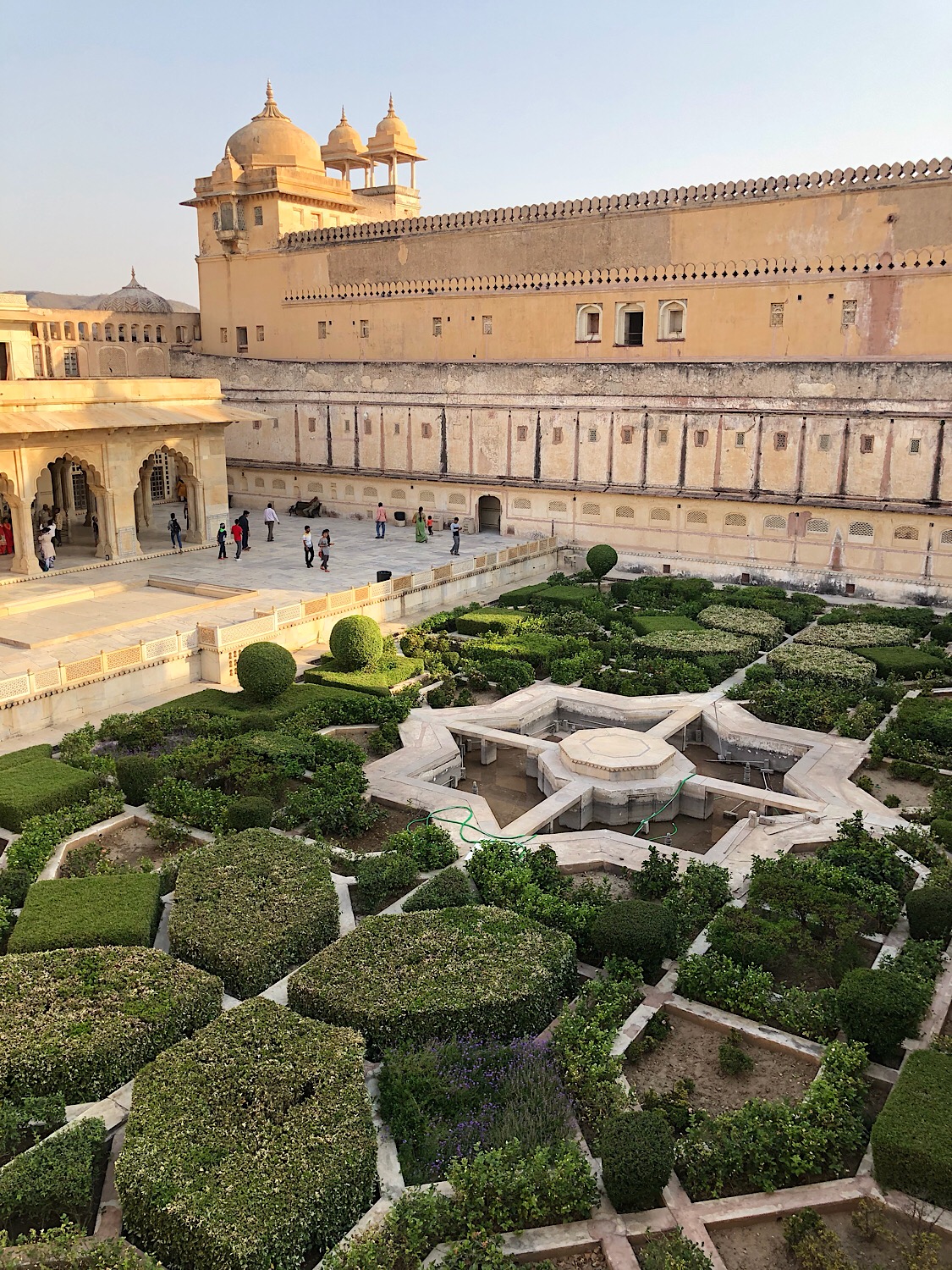
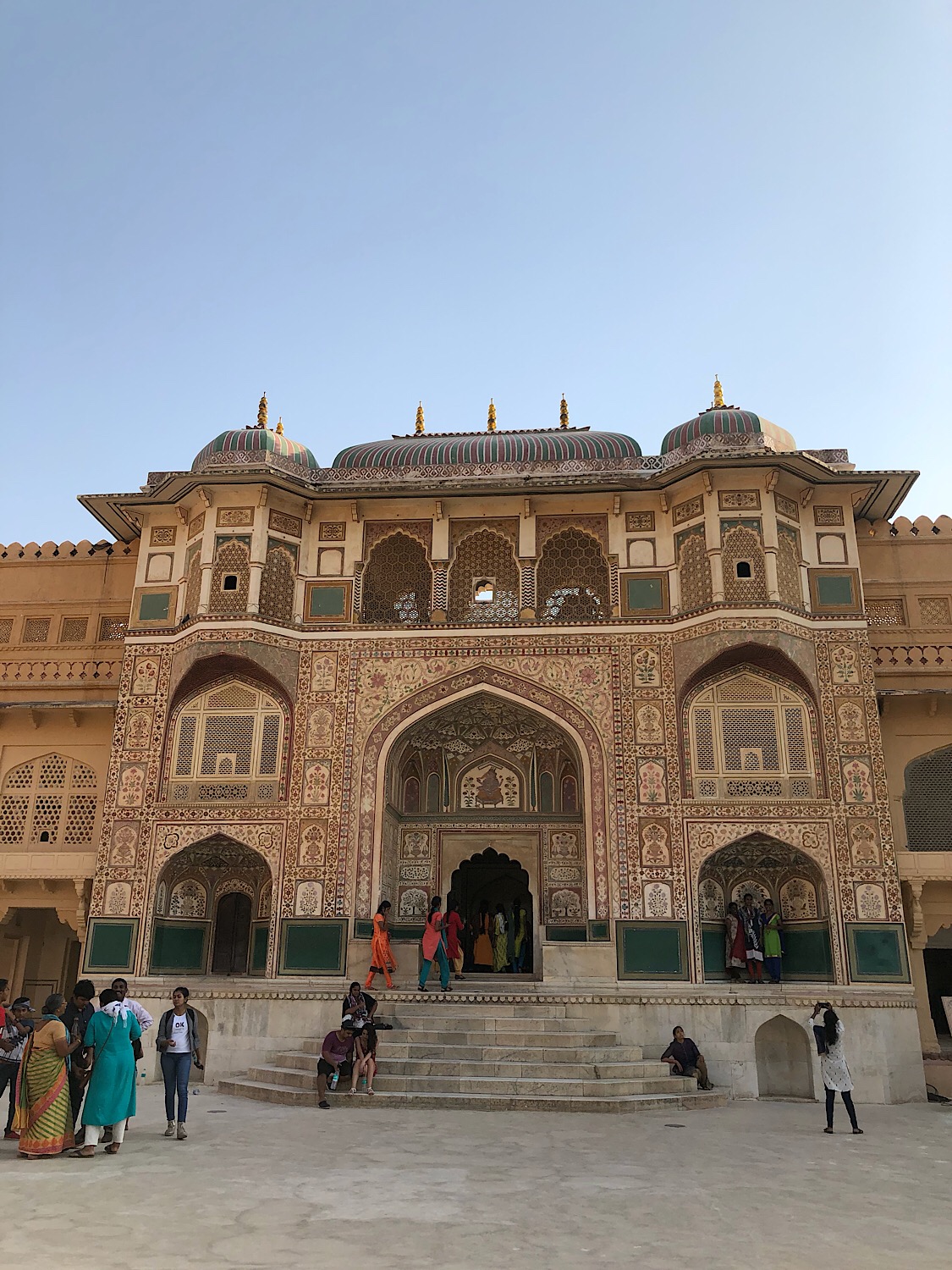
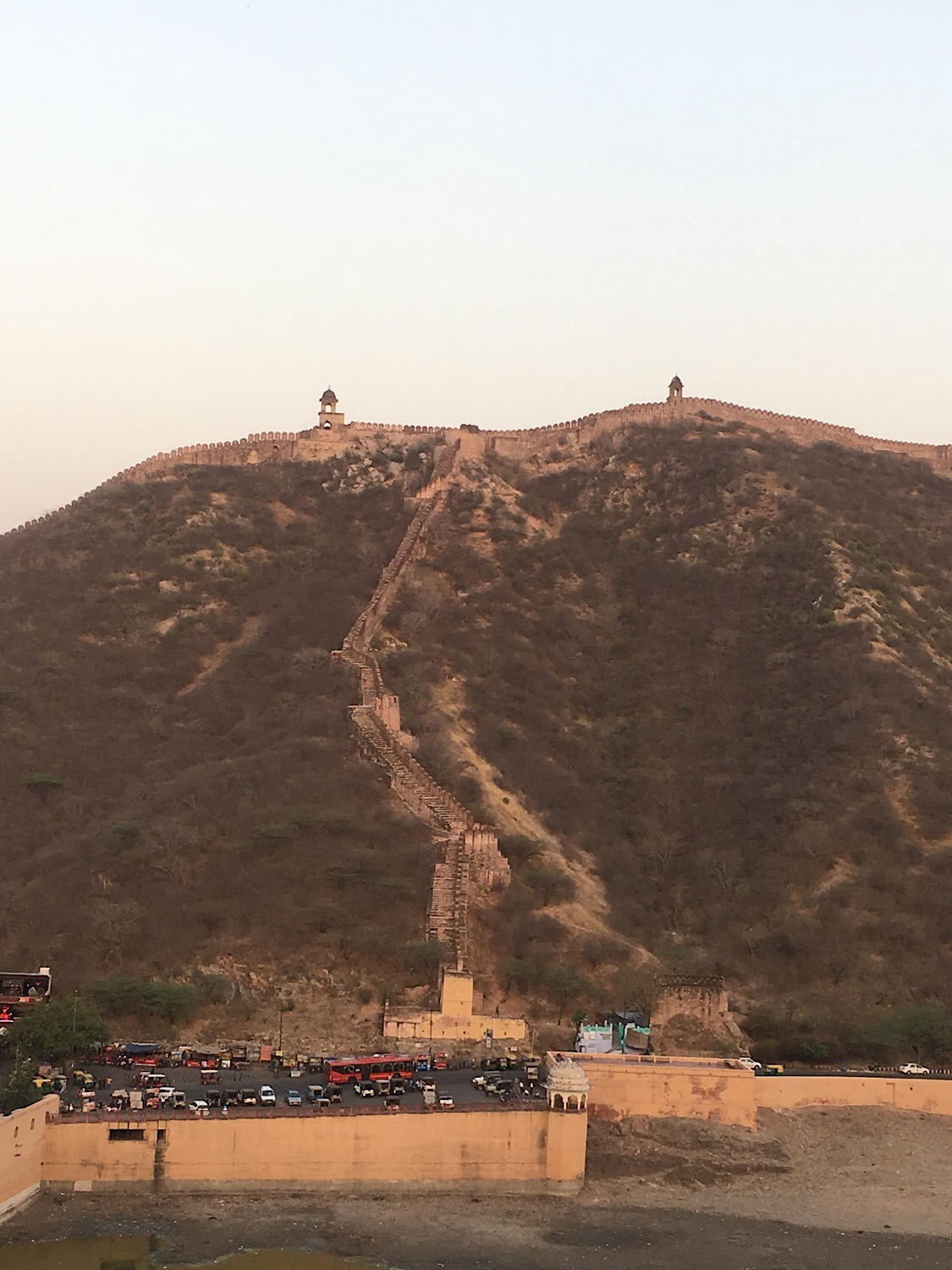
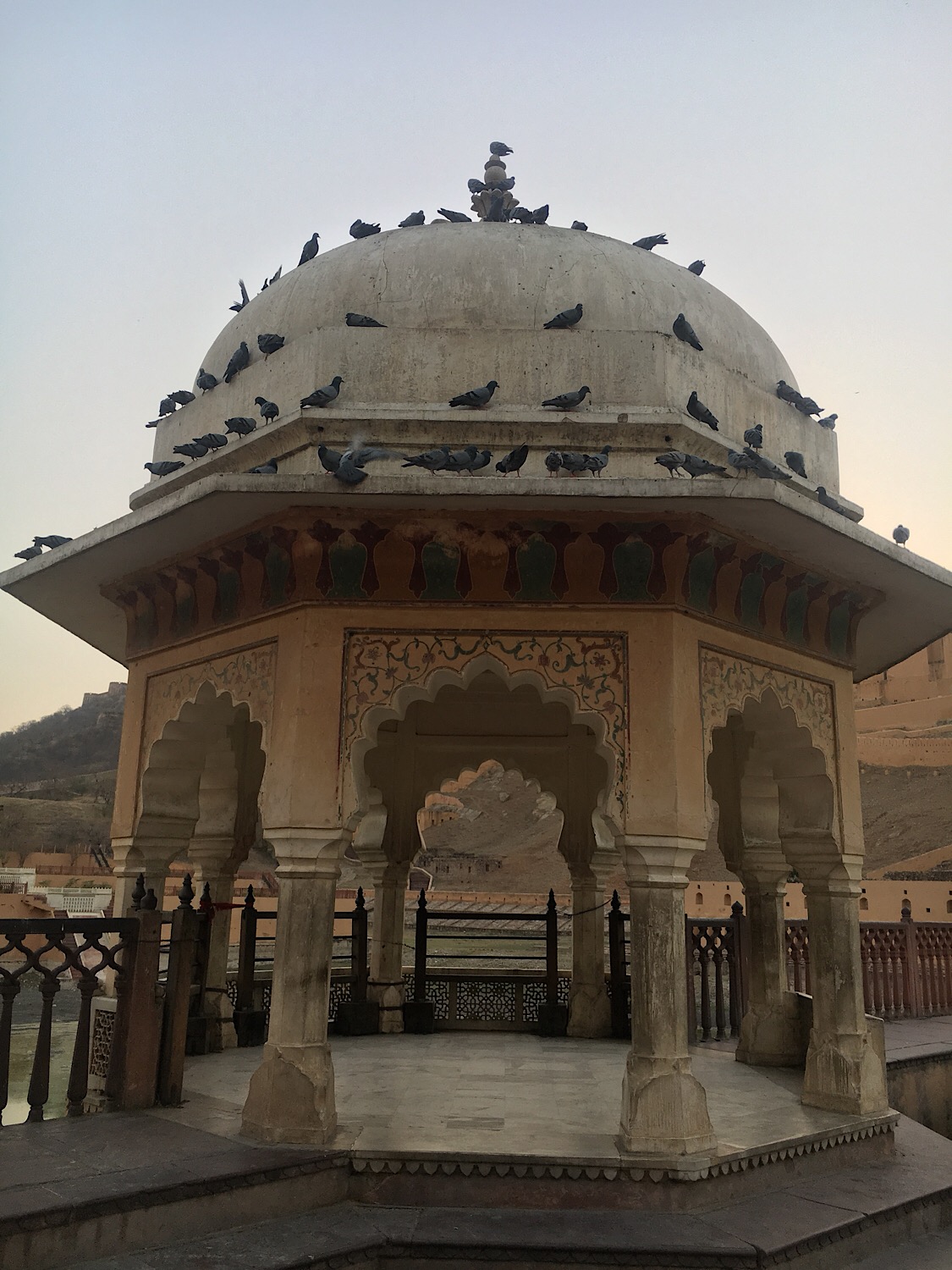
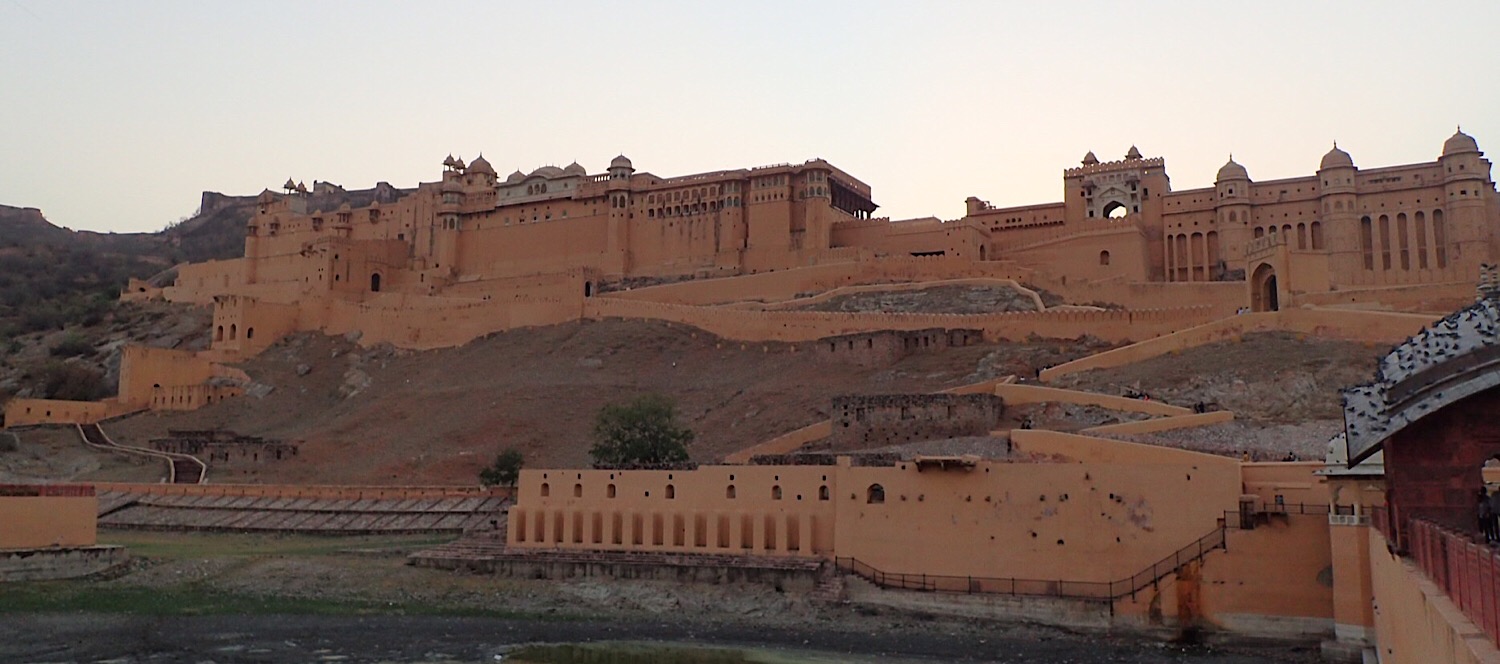
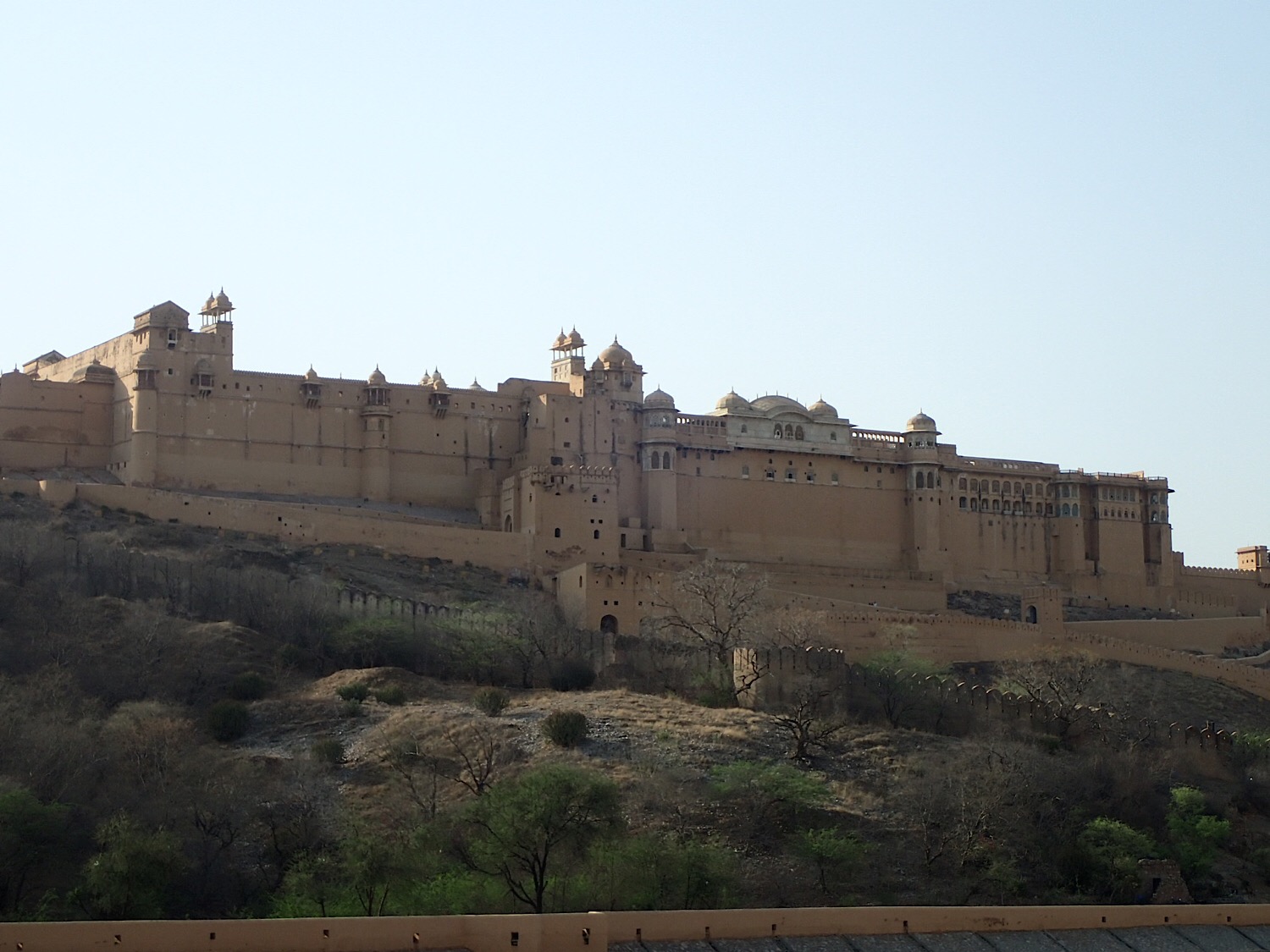
The Amber Fort was the first of many spectacular Rajasthani forts we’d see over the next couple of weeks and it was a real humdinger to start with. Perched on top of a mega hill just outside the modern city it’s a labyrinth of courtyards and corridors leading to exquisite mirrored halls and well manicured gardens, the surrounding walls and ramparts stretching as far as the eye could see. We were lucky enough to time our visit with sunset and were treated to a gorgeous orange sky that made the Amber Fort an even more sublime colour.
Jaisalmer – The Mummy meets Indiana Jones in the desert

After a long, hot, dusty and packed day of sight seeing we decided it would be a good idea to get the 11.45pm night train to Jaisalmer. Bizarrely given the outrageous farting, snoring and burping noises coming from the other passengers in what should have been otherwise known as ‘The carriage of wind’ I slept like a baby, tucked up on the top bunk.
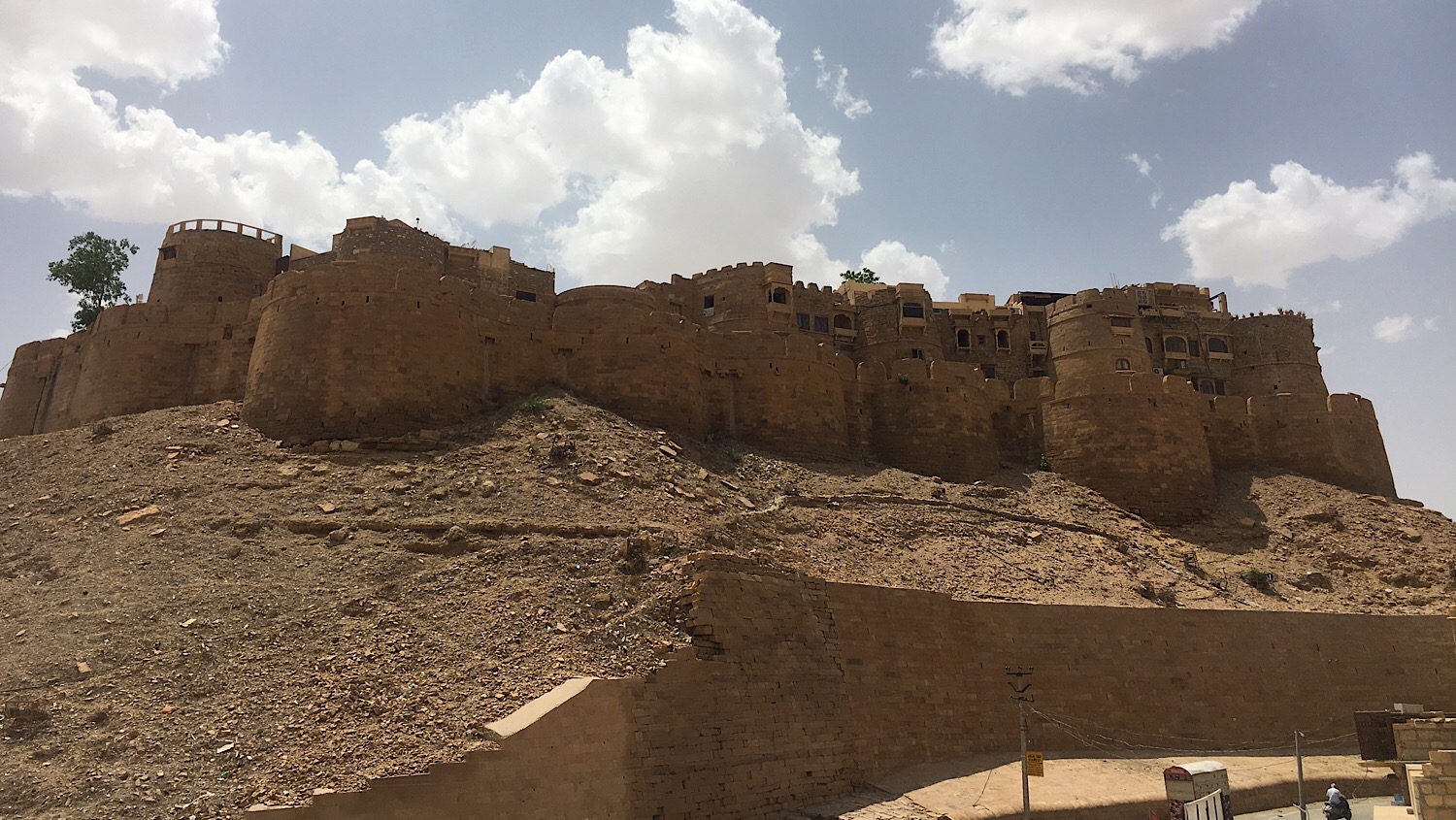
Twelve hours later we arrived in Jaisalmer – an ancient fort city close to the Pakistan border that rises up out of the desert like a brilliant sandstone mirage. Needless to say when we hopped off the heavily air conditioned train onto the platform around midday it was insanely hot, but what hit us what how different the heat was, totally dry. The moment you started to perspire it instantly evaporated which I think I preferred to the humid heat of Jaipur. It just meant you were dead thirsty all the time and your lips were really dry! So if you are planning a visit to Jaisalmer, which I would heartily recommend, take some decent lip balm.
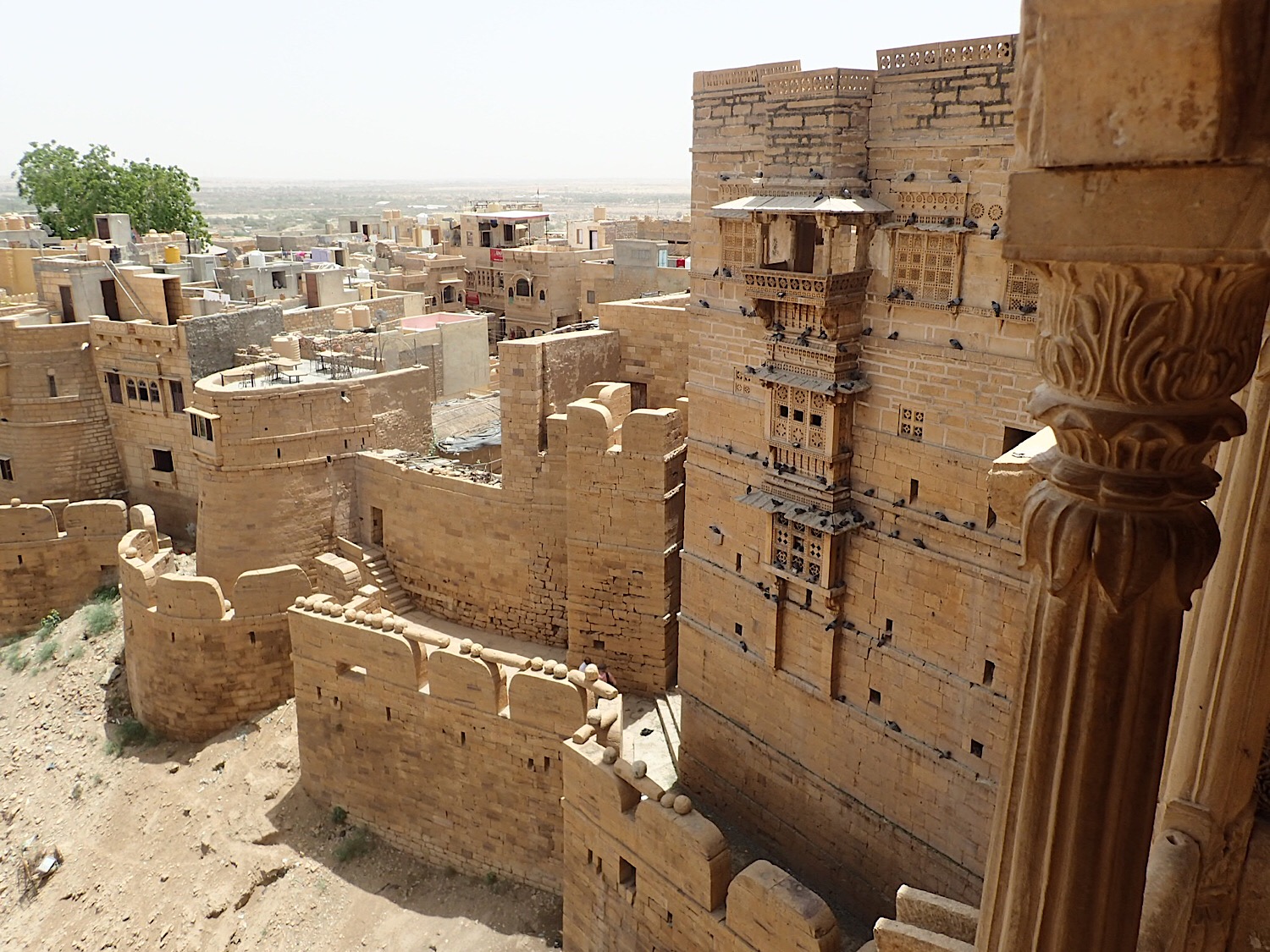
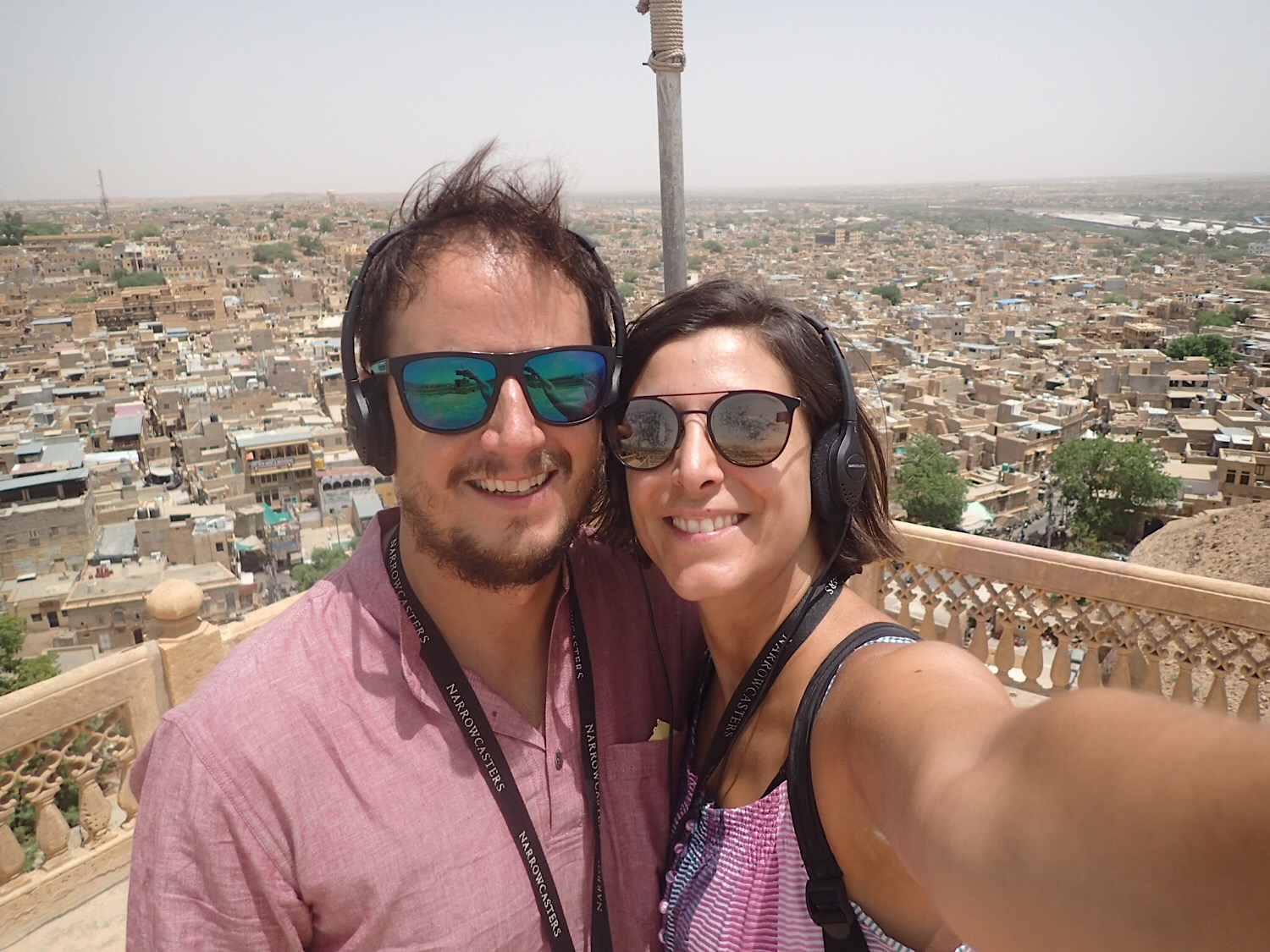
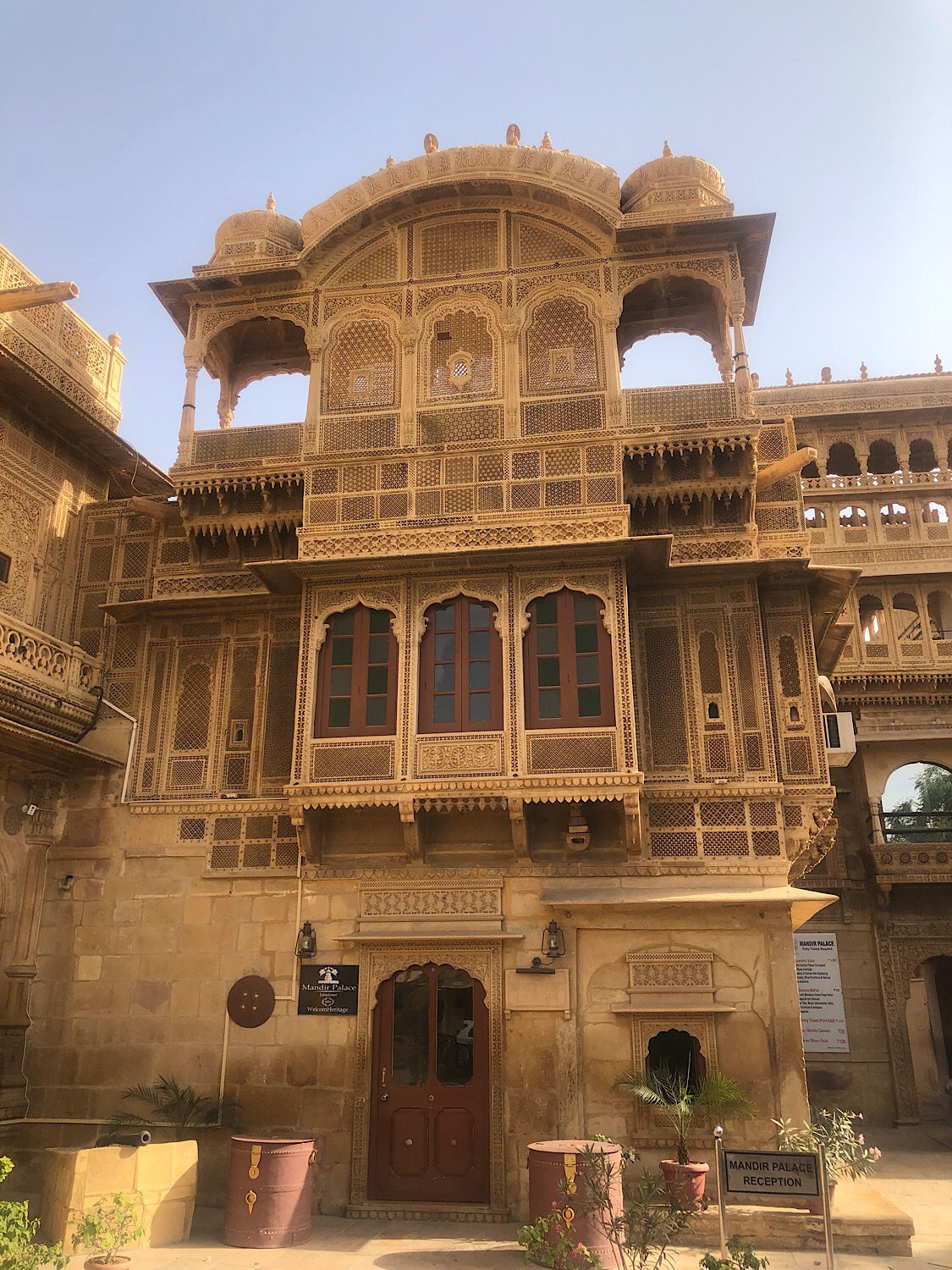
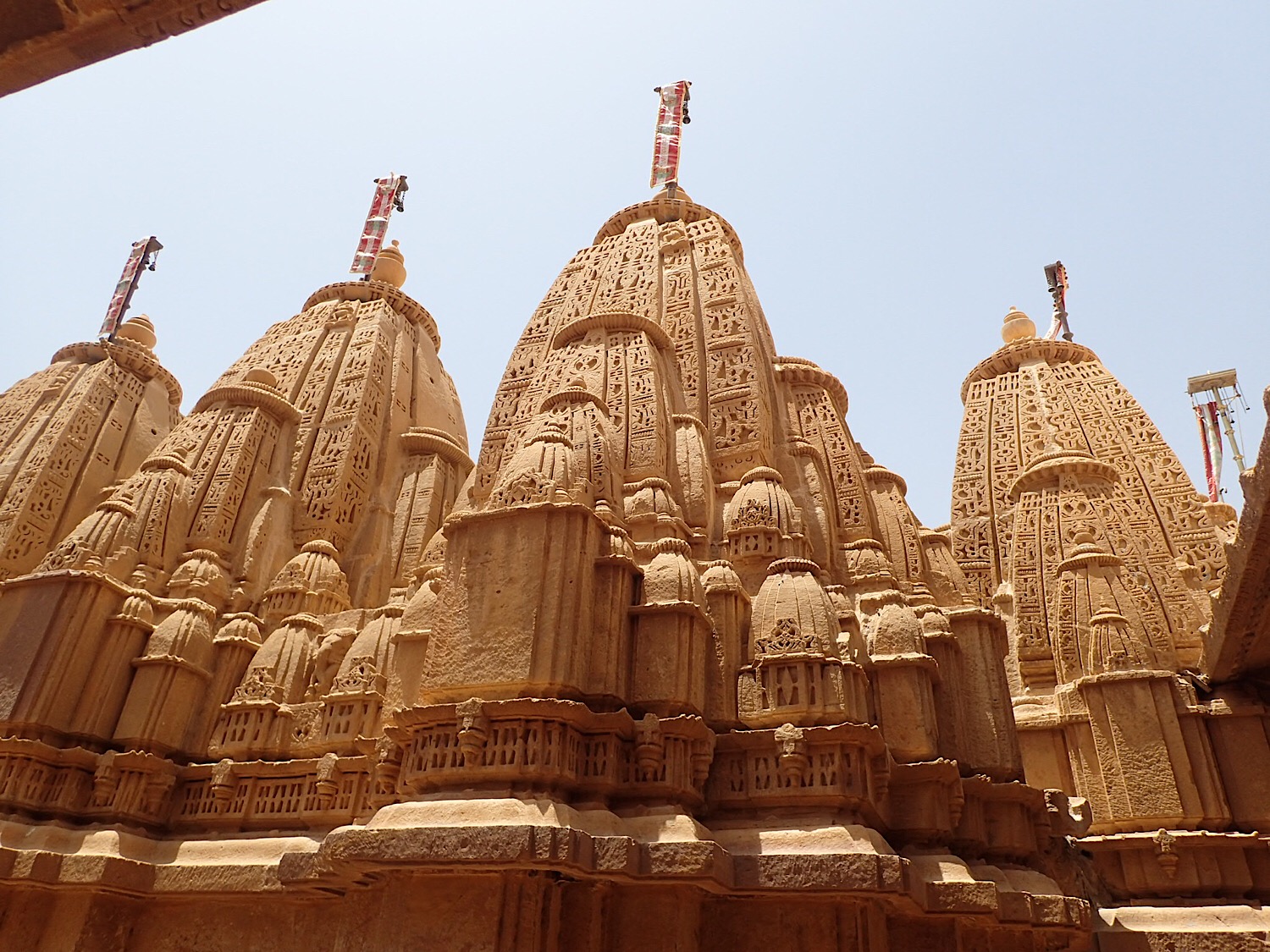
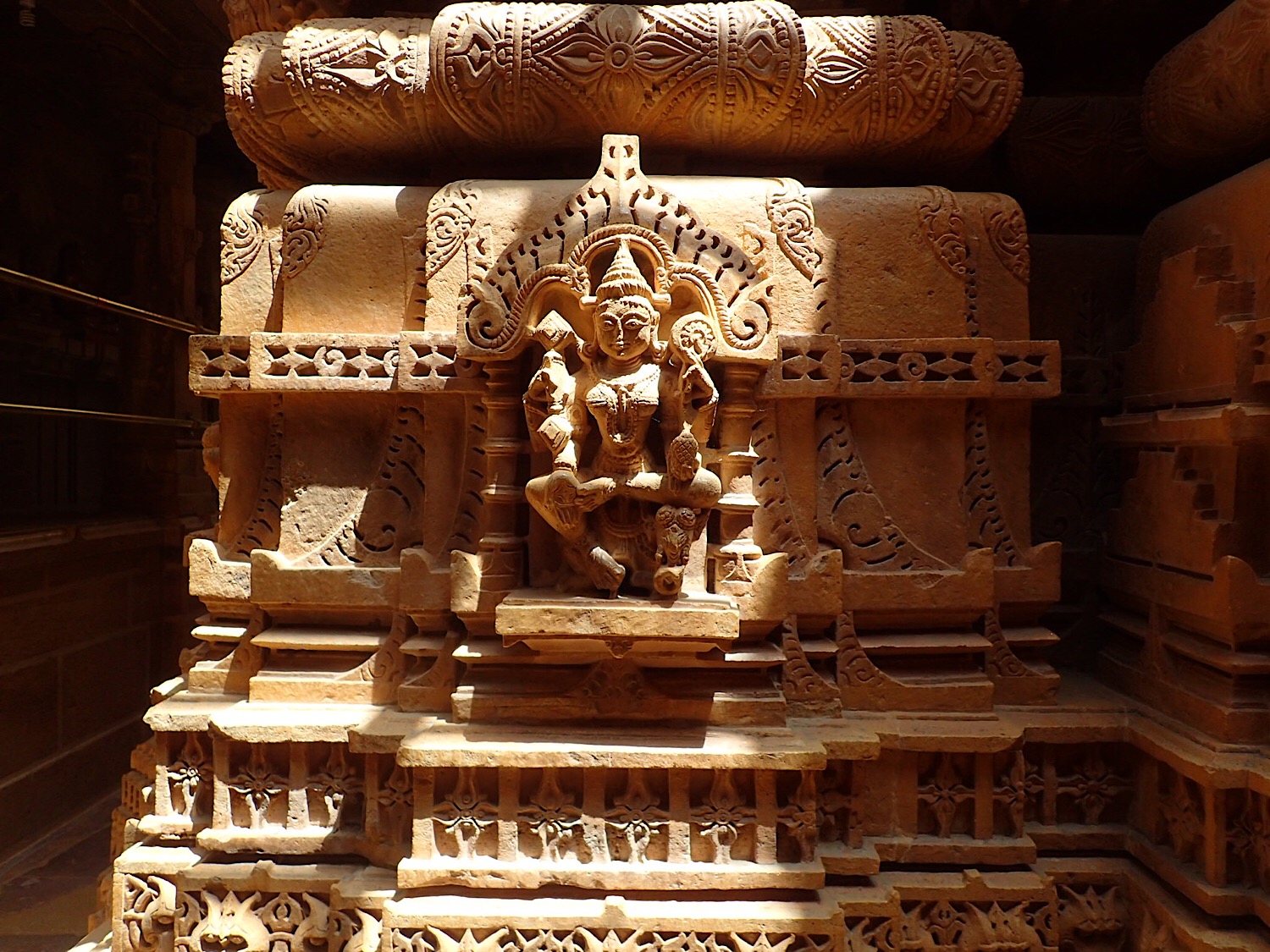
The fort itself is the largest and oldest ‘living’ fort in the world with around 4000 people living within its walls and, although the modern conveniences of running water aren’t doing wonders for the sandstone structure, it is still majorly impressive. The imposing fort walls and 99 ramparts (they’ve 99 problems but ramparts ain’t one) are only broken by the huge wooden gates and within the fort there’s a super juxtaposition of modern commerce – ice cream parlours, tourist tat shops and restaurants against the royal palace buildings that are adorned with extremely intricate stone carved screens and walls that, at first glance, appear to be wood given how detailed they are. Another fantastic audio guide taught us all about the ritual of Suthi where the women and girls of the royal family would dress up in all their finery and throw themselves on a burning funeral pyre if their men died in battle – hectic. We also visited a spectacular Jain temple a complex of three of four Temple all carved out of sandstone and connected but courtyards and walkways. Pretty much every surface is covered in intricate carvings of gods, goddesses, deities and demons. Apparently the traders were historically very wealthy and clearly this entrepreneurial streak still rings true with the modern Jain holy men since we paid to enter the temple then also had to pay the multiple guides who helpfully showed us around and imparted their wisdom plus leave a donation before we left!
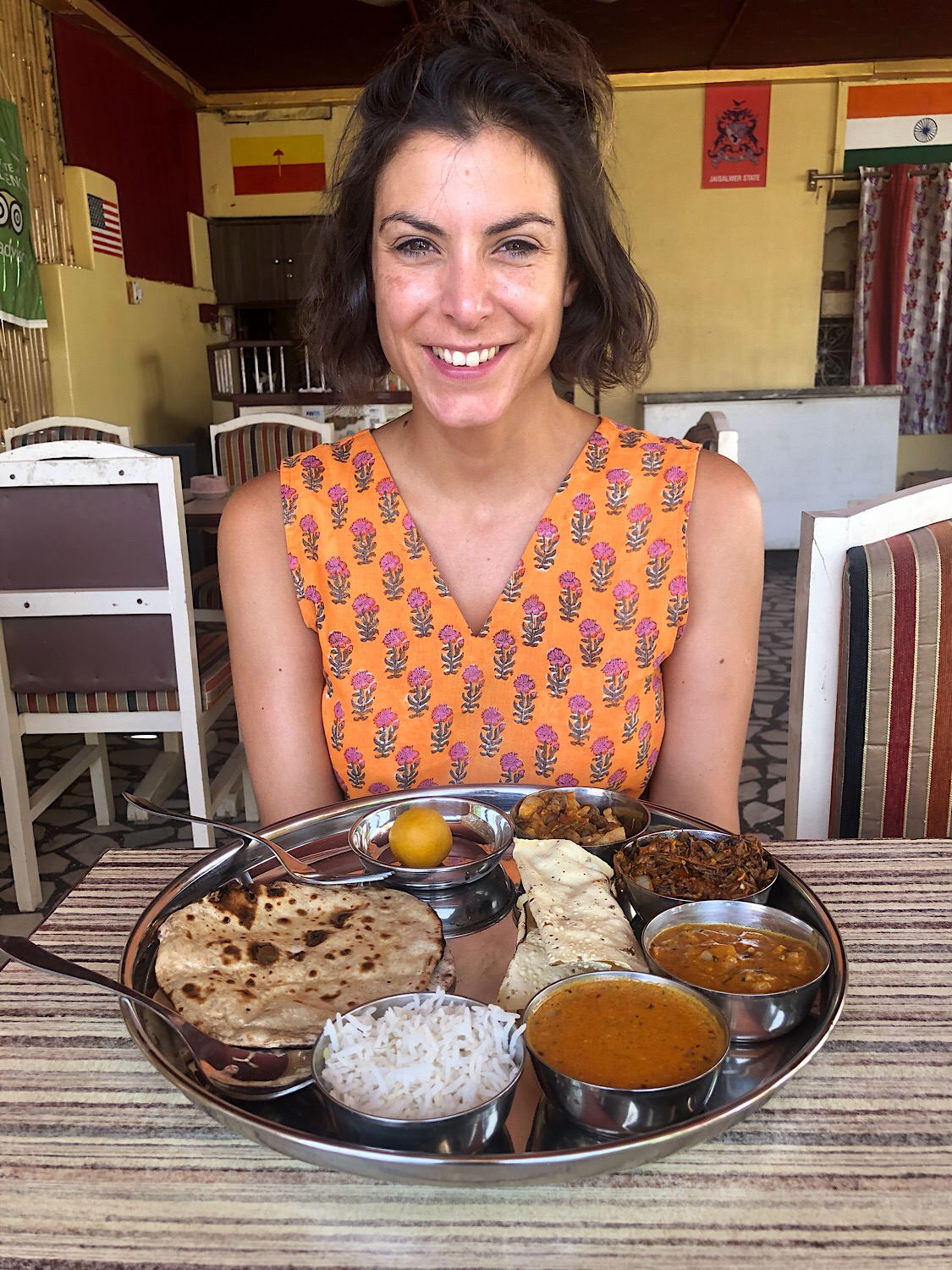
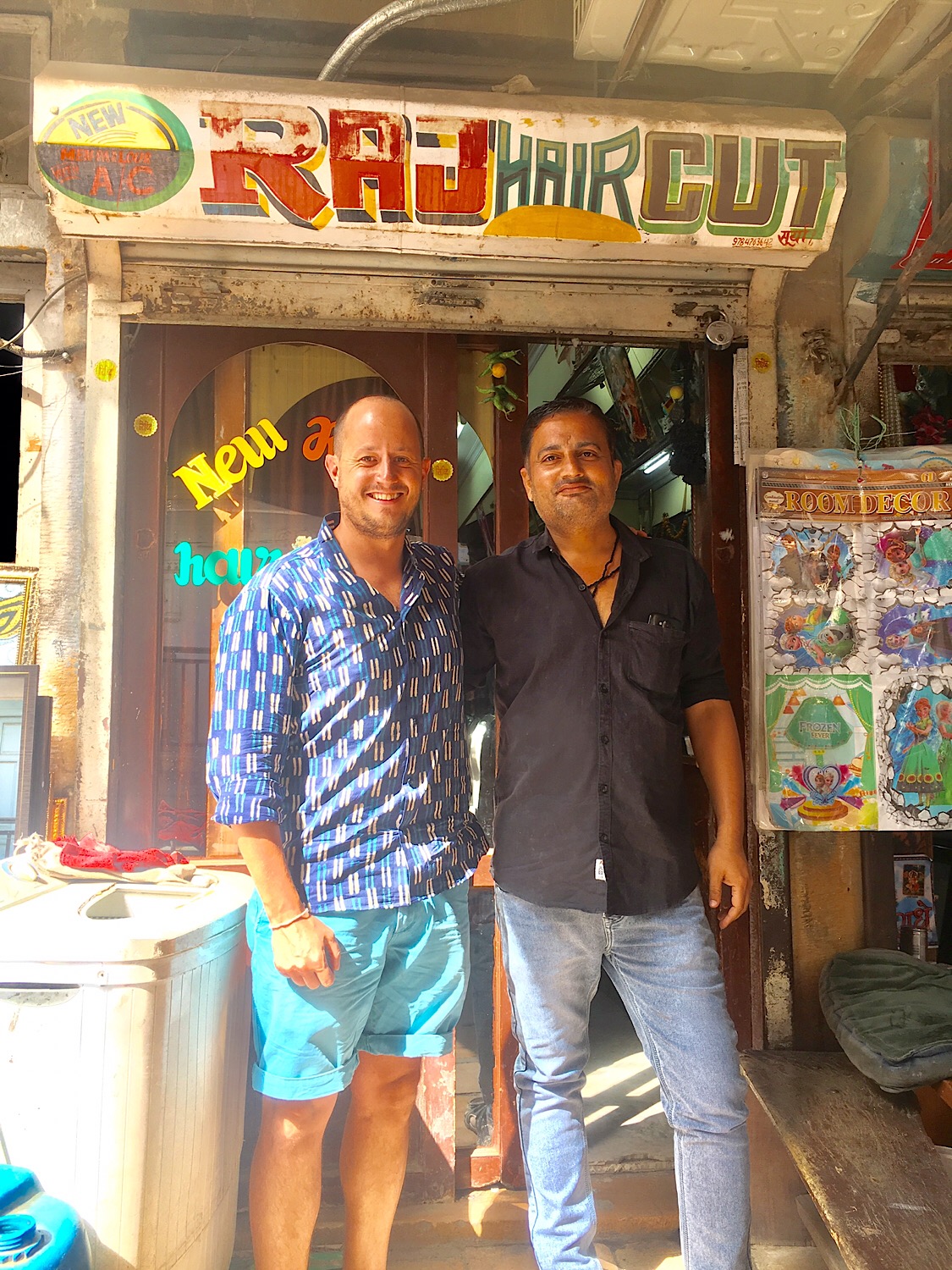
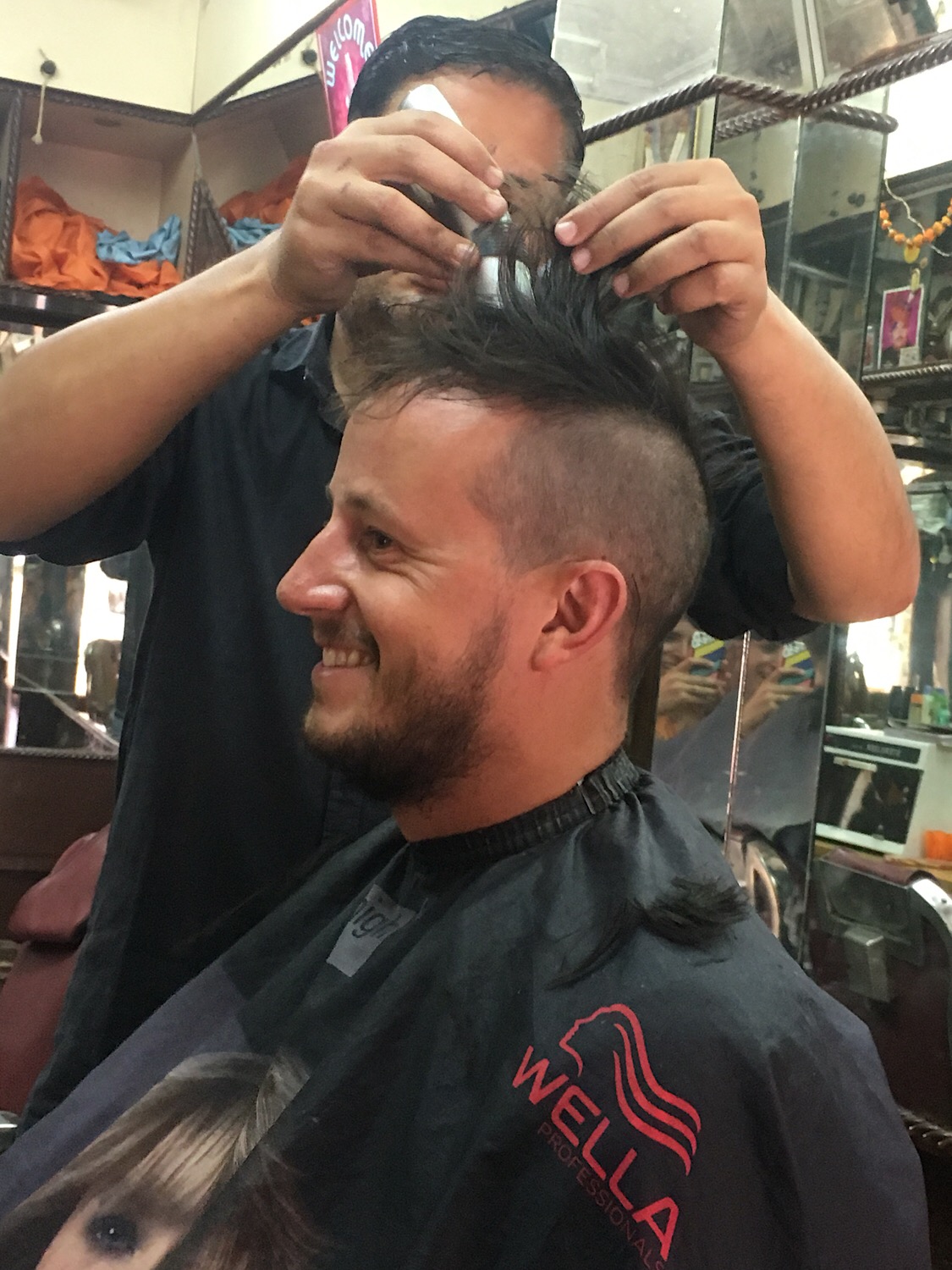
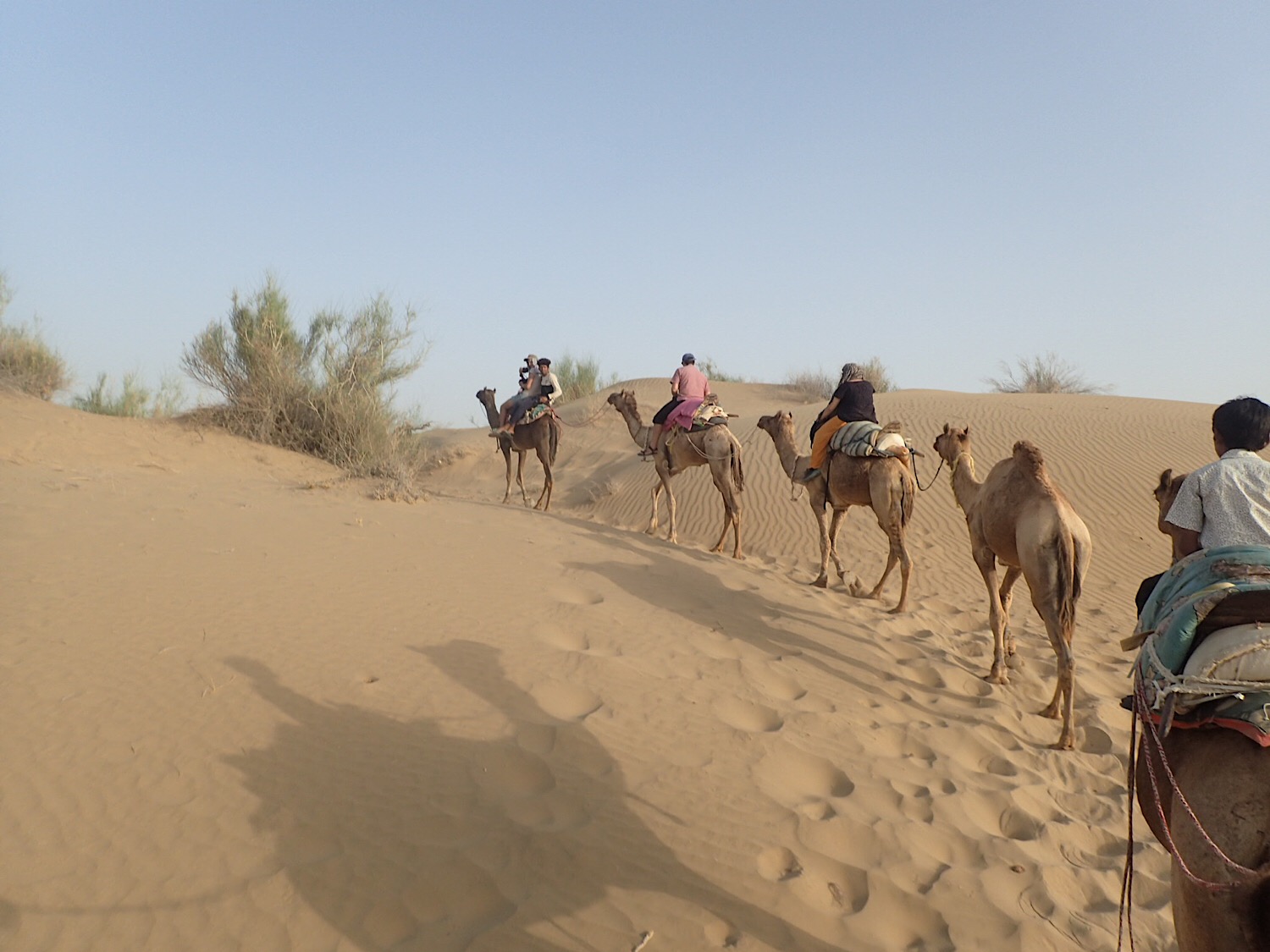
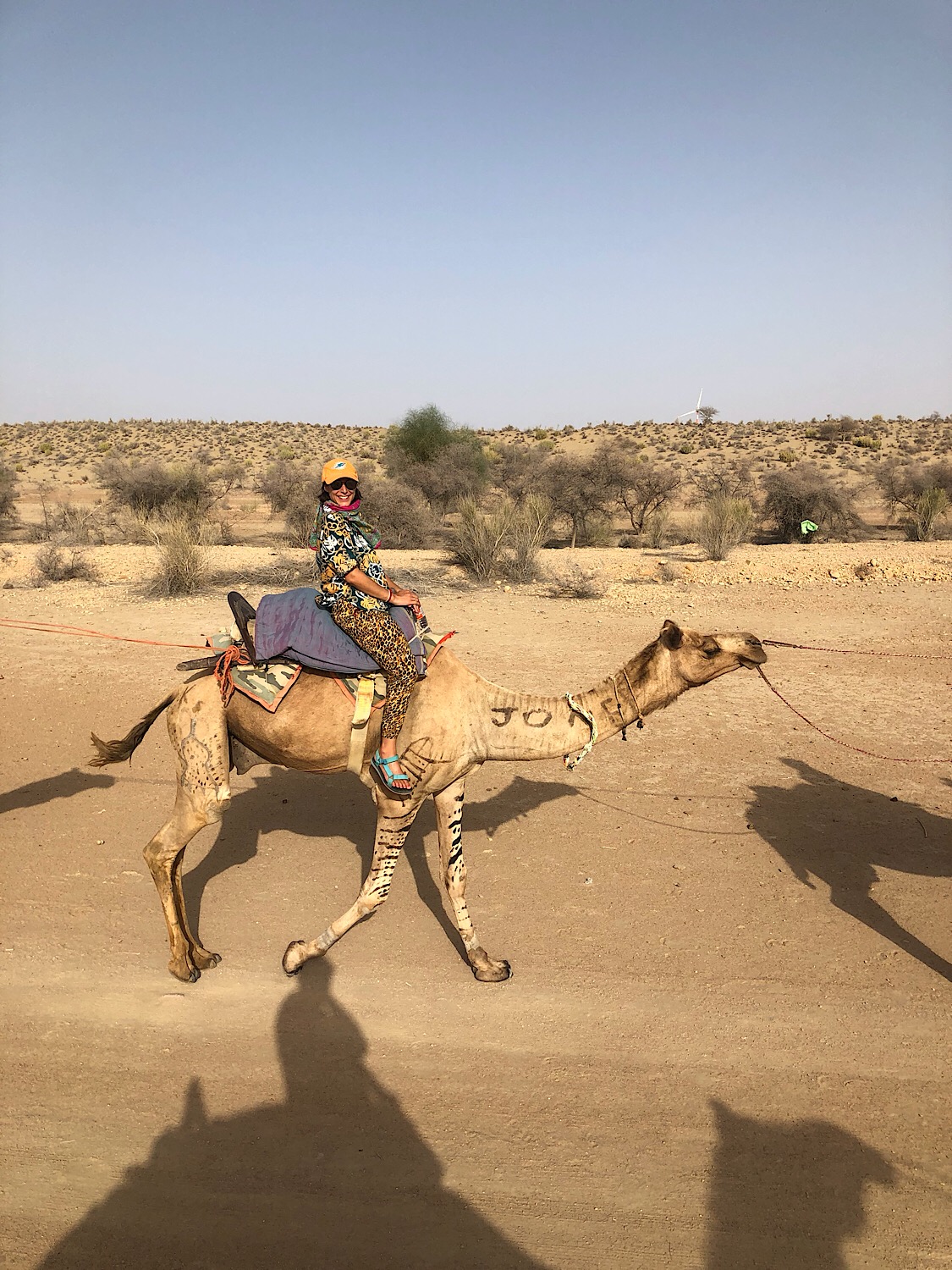
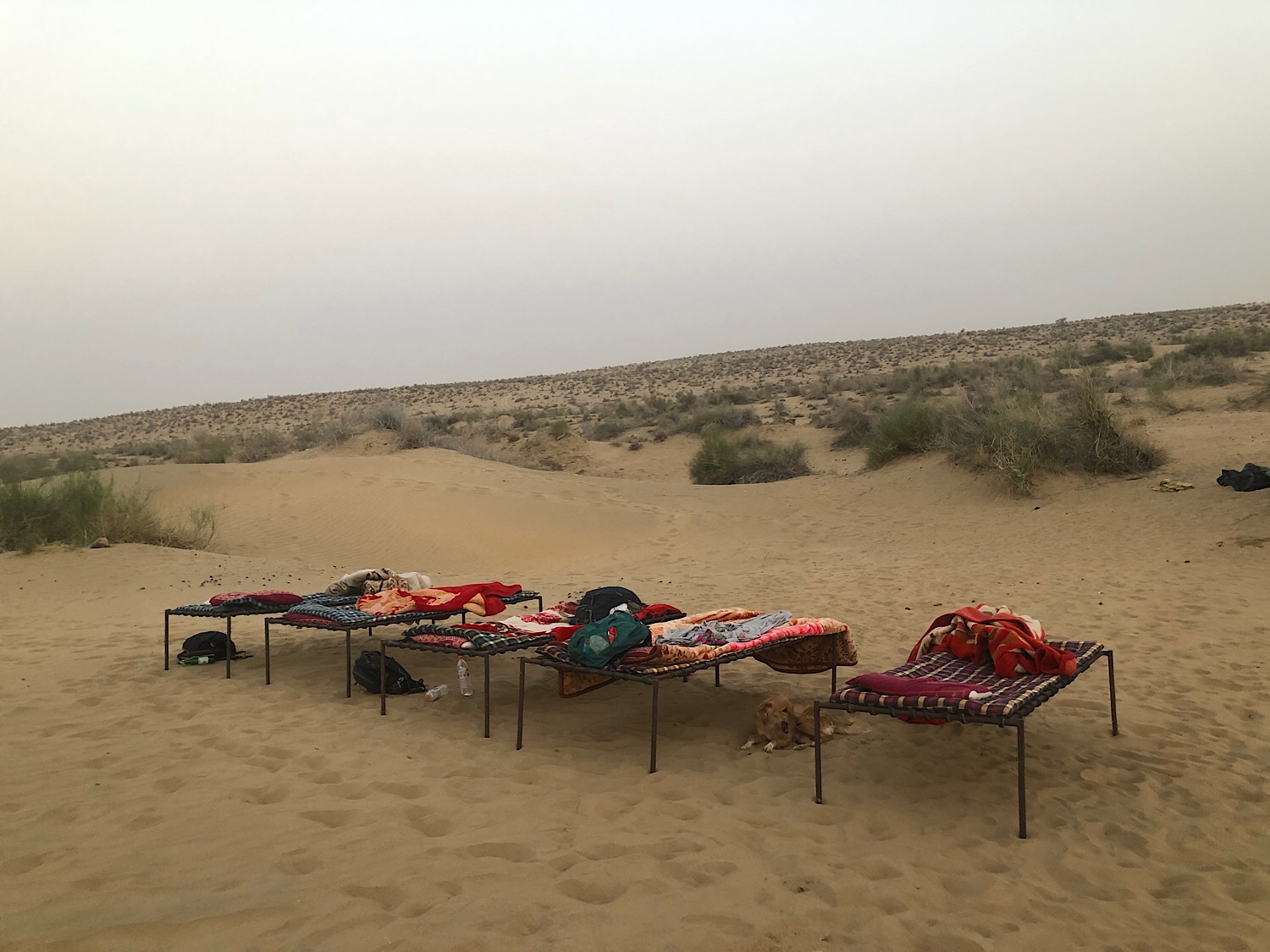
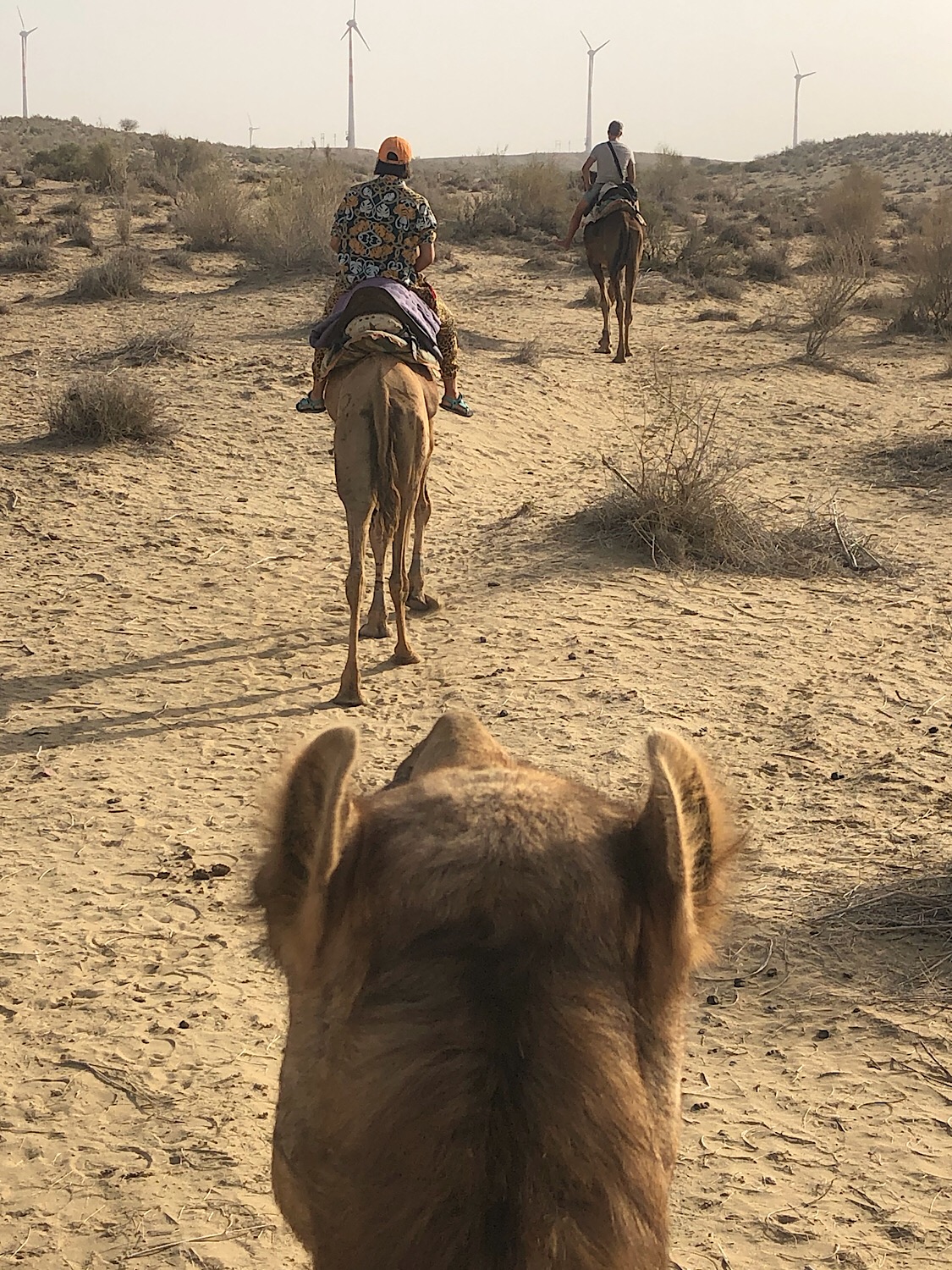
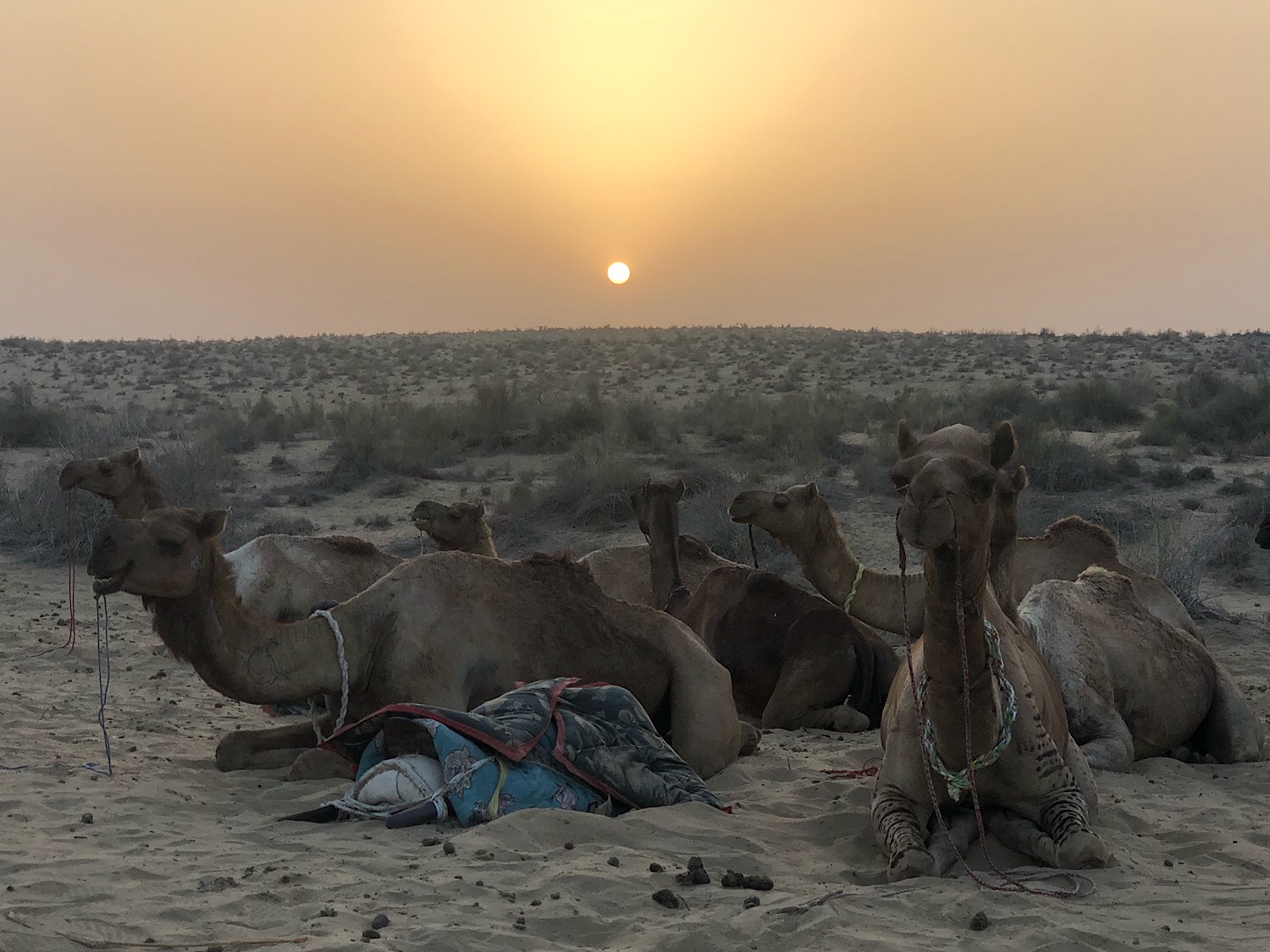
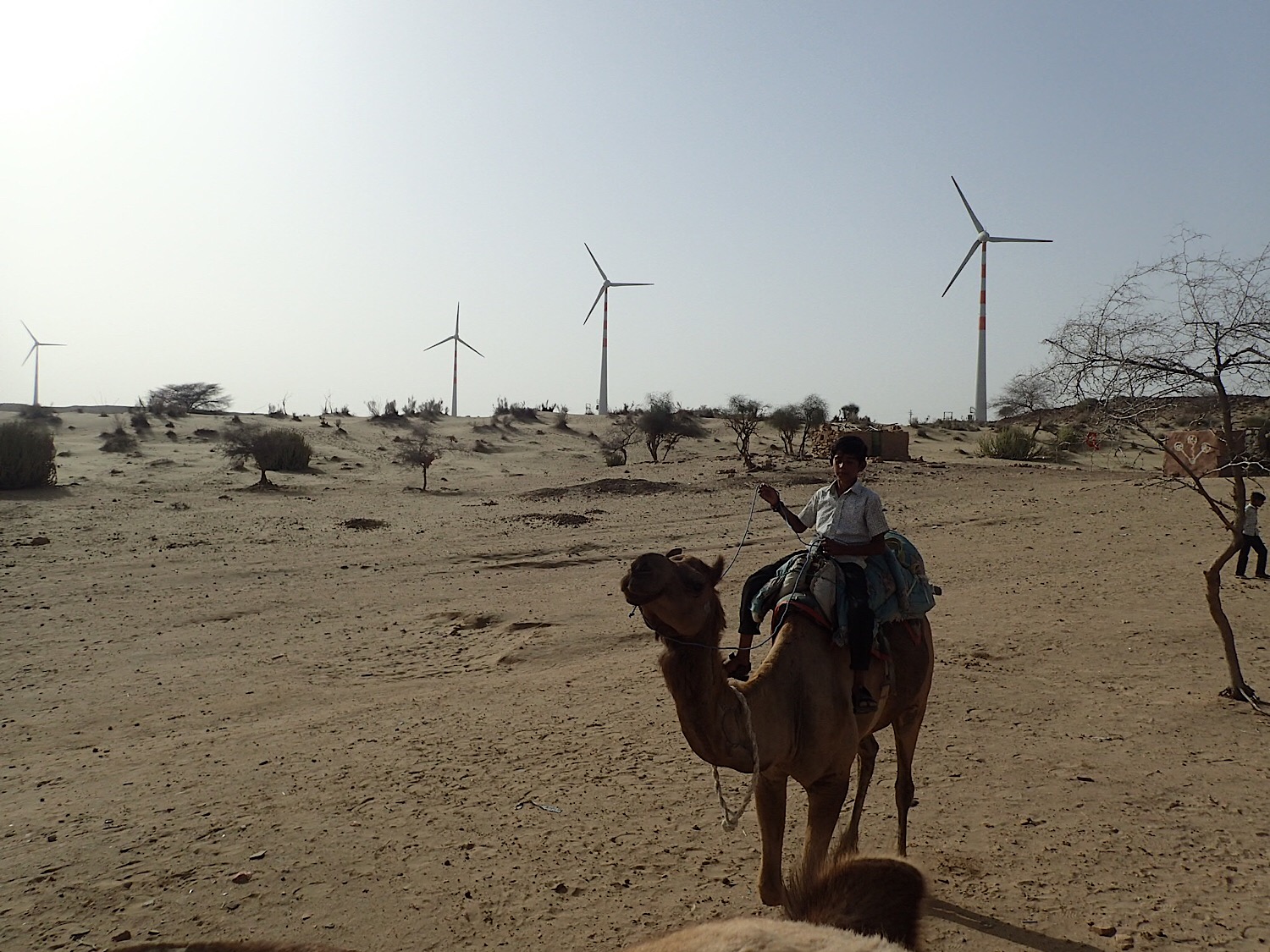
The unquestionable highlight of Jaisalmer (just edging ahead of when Fred had all his hair shaved off by Raj – see picture) was our overnight camel trek in the Thar desert. We drove out into the middle of nowhere in a jeep where we met our guides and camels, I was assigned Jony and Fred was riding Al Pacino (lols). Once we were acquainted, we plodded across the desert through fields of wind turbines (which was odd but also cool) for a couple of hours passing only a handful of goats, some cacti and the occasional shrub. When we reached a lovely spot in the dunes we dismounted and set up camp for the night. There were some metal frame camp beds and blankets and that was our bedroom for the night – under the stars in the desert. Our guide and his assistants cooked up a delicious and hearty dinner on the open fire of daal, veg curry, popadoms and rice which we scoffed down followed by some nicely chilled beers (ok so it wasn’t Bear Grylls level of wilderness – but it was exciting nonetheless). After watching the sun go down on the desert we sat around the fire chatting before turning in. The adventure was made even better due the lovely Dutch couple Rob and Tosca who were also on the trip and who introduced us to the concept of self drive and sleeping on top of your car in Africa (more about that in following posts). It was so surreal and exciting to be in the open desert lying under a sky filled with stars that I was too excited to sleep for the first few hours, we lay there watching the sky and spotting an unbelievable number of shooting stars. I also had one of the desert dogs, a lovely little pup come and keep me company, snuggling down into the sand between mine and Fred’s beds. Although the majority of western tourists that make it to Jaisalmer probably do the overnight camel safari it was truly an awesome and incredibly unique adventure that left us both buzzing!!!! The next morning we watched the sunrise with a cup of chai before a great breakfast (that included maggi instant noodles – which I was totally fine with). Overnight they loosely tie the camel’s front legs together, which feels a bit cruel, then let them roam free whilst we were sleeping, tying their legs together means they shouldn’t roam too far, in theory. However when we were almost ready to leave plucky Rob volunteered to go with some of the young camel herders to round them up. They were gone rather a long time and it turned out they had actually roamed an awful lot further than they usually would meaning it was a long old sweaty walk for Rob! Once they’d returned we boarded our trusty steeds and headed back to where the jeep would pick us up. We also got the chance to get the camels ‘trotting’ which was bloody bumpy and hilarious.
Whilst in Jaisalmer we also met a third generation artist who specialised in wildlife and tree miniature paintings and after much deliberation we bought a lovely set of three Indian native bird paintings which will hopefully look as lovely on our wall in Holloway as they did in the shop!

Jodhpur – The Blue City, short but awesome
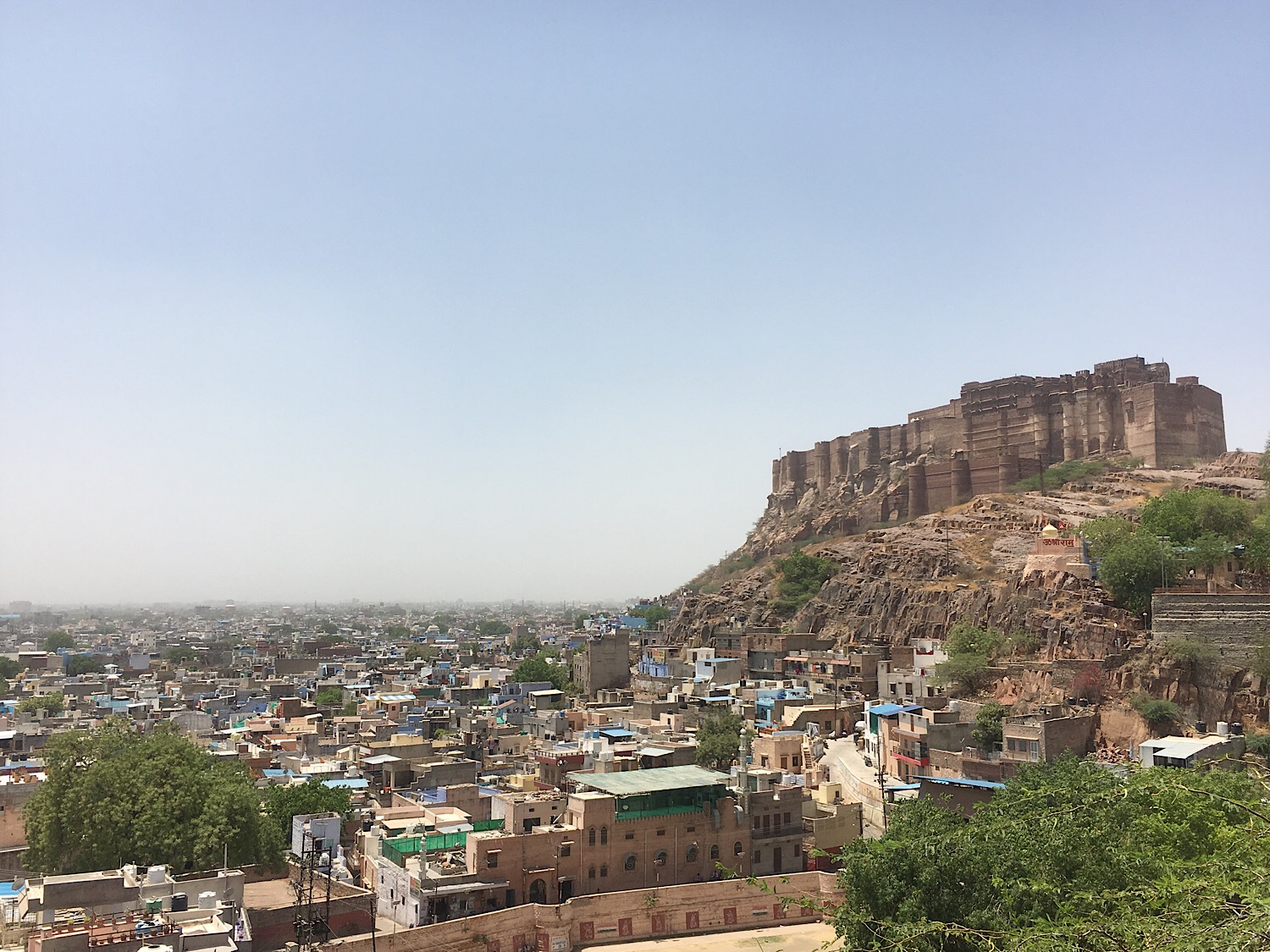
Another Indian Railways train took us back into the heart of Rajasthan for an action packed 24hrs in Jodphur, we arrived late in the evening and a shister tuk tuk driver dropped us off in completely the wrong place, after trying to negotiate a maze of sketchy alleyways with all our worldly belongings we were lucky enough to bump into a relative of the guy who owned the hotel we were trying to locate. It was a beautiful restored haveli with loads of original features – think huge wooden doors and sweeping stone arches in all the rooms. It was owned and run by an Uncle and nephew, who had inherited the property from their great grandfather who had been one of the many locals who had been ‘gifted’ the property from the Maharaja when then UK had declared independence and HRH was forced to offload his vast estate to the people.
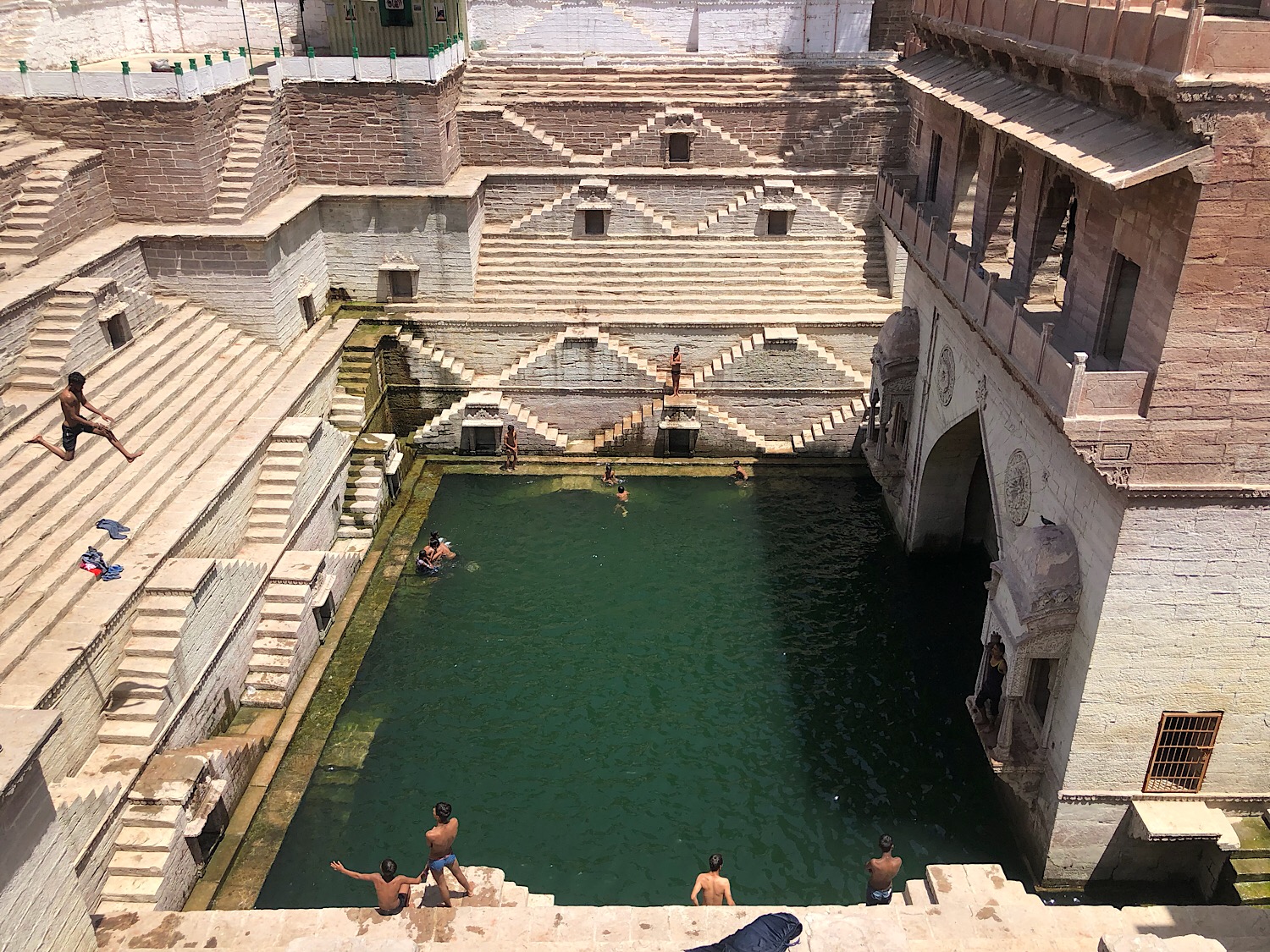
After a good night’s sleep we set off to explore the city, right next to our hotel there was a wonderful and recently restored Stepwell which is a huge water tank right in the city with stone steps leading into its deep aquamarine waters. It was magical and unlike nothing either of us had seen the only thing I could compare it to is a cenote, the huge natural sinkholes you find in Mexico that the aztecs used to launch various human and animal sacrifices into. There was a gaggle of local boys plunging into the pool from various daring heights, much to our and other onlookers delight and horror. The water did look pretty tempting given the heat but ingesting any of that water would not have ended well.
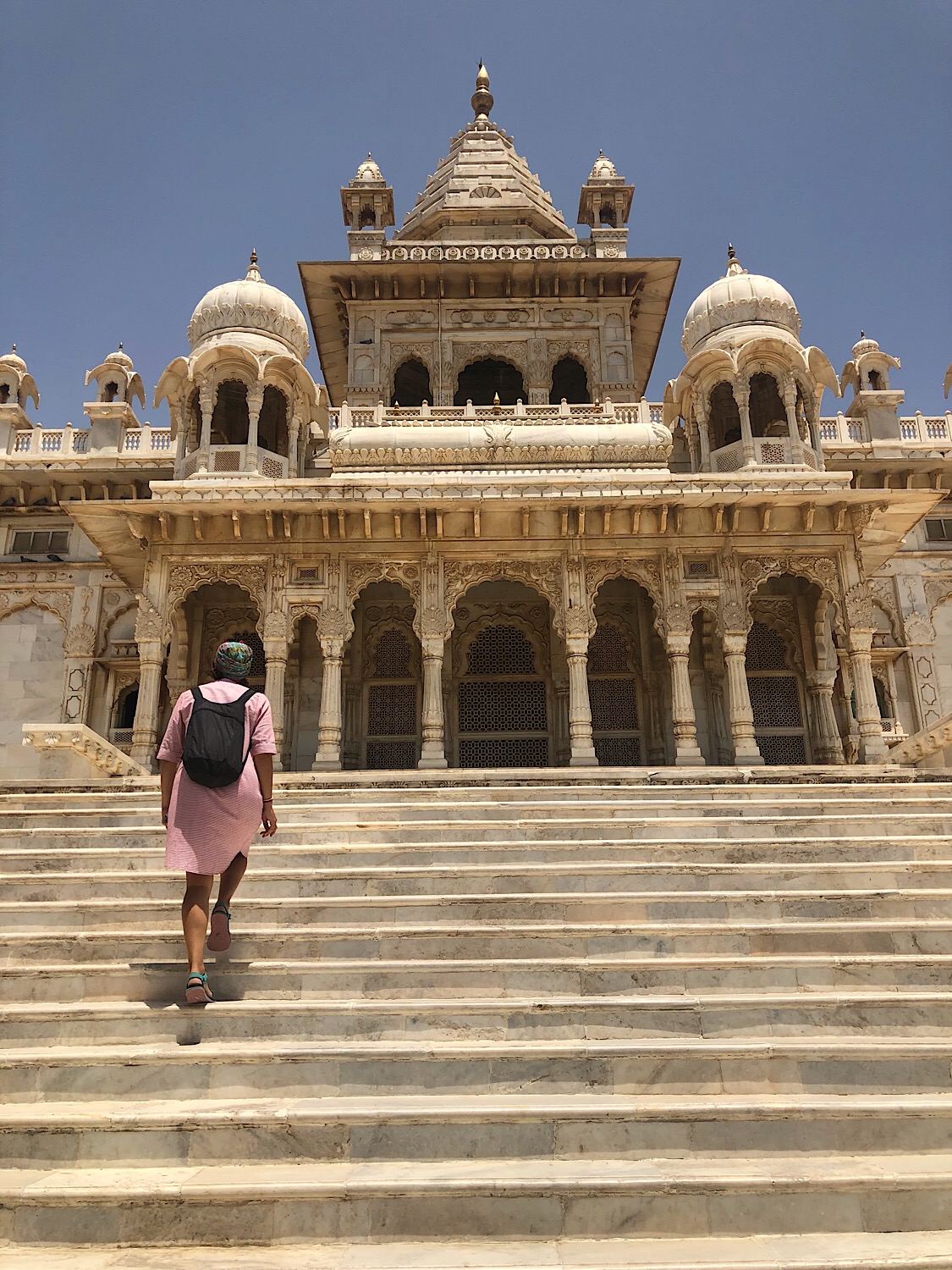
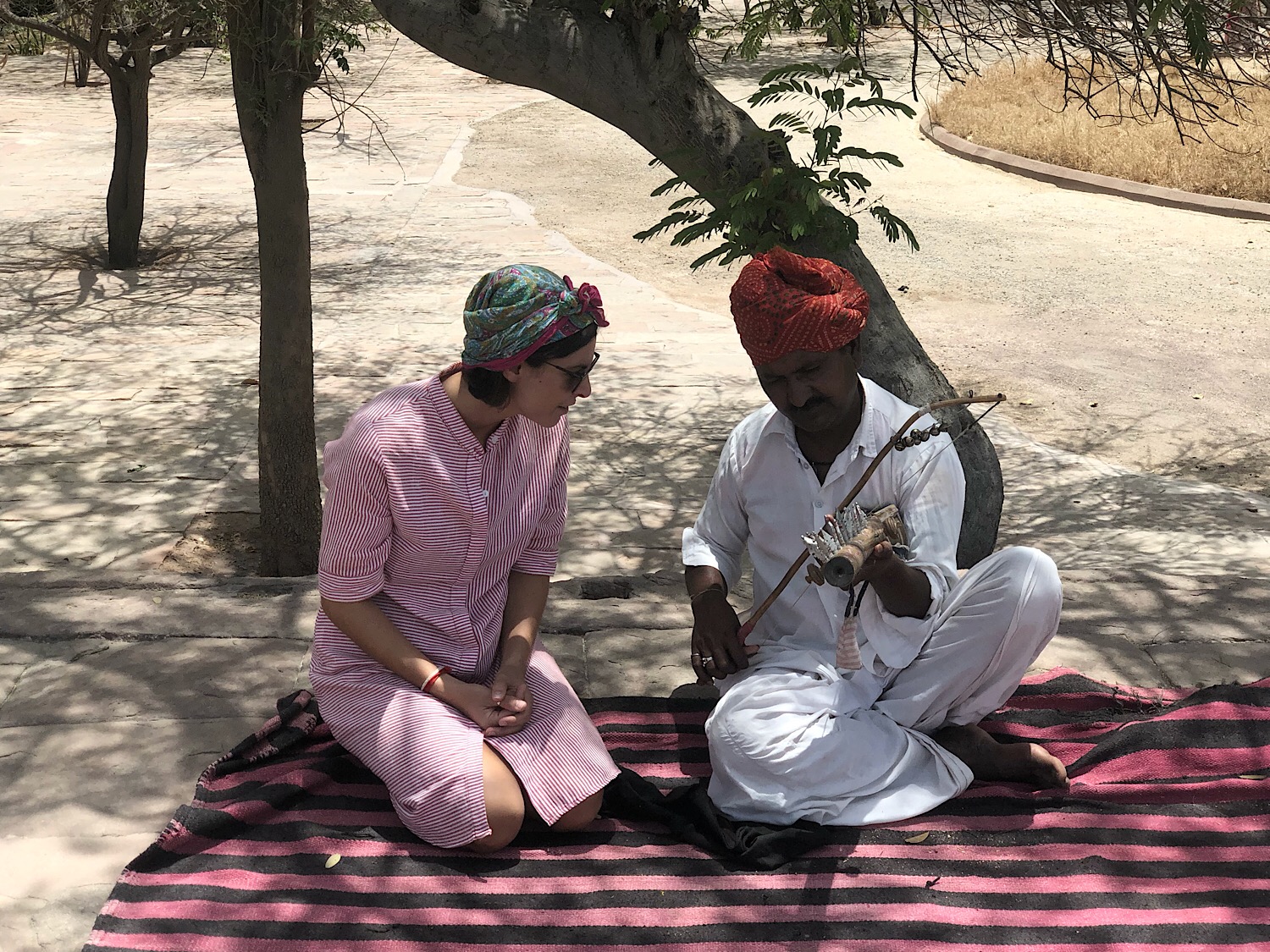
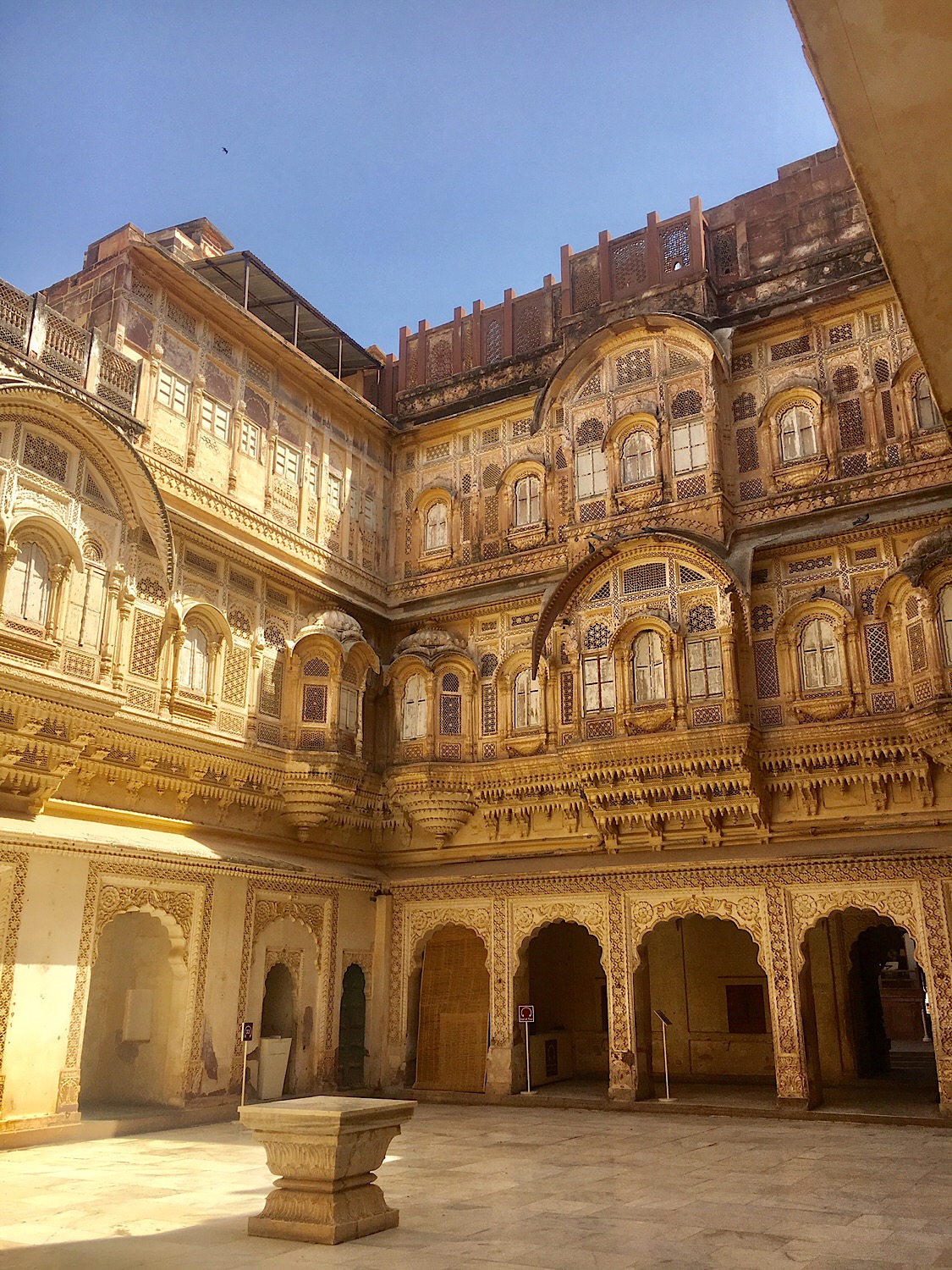
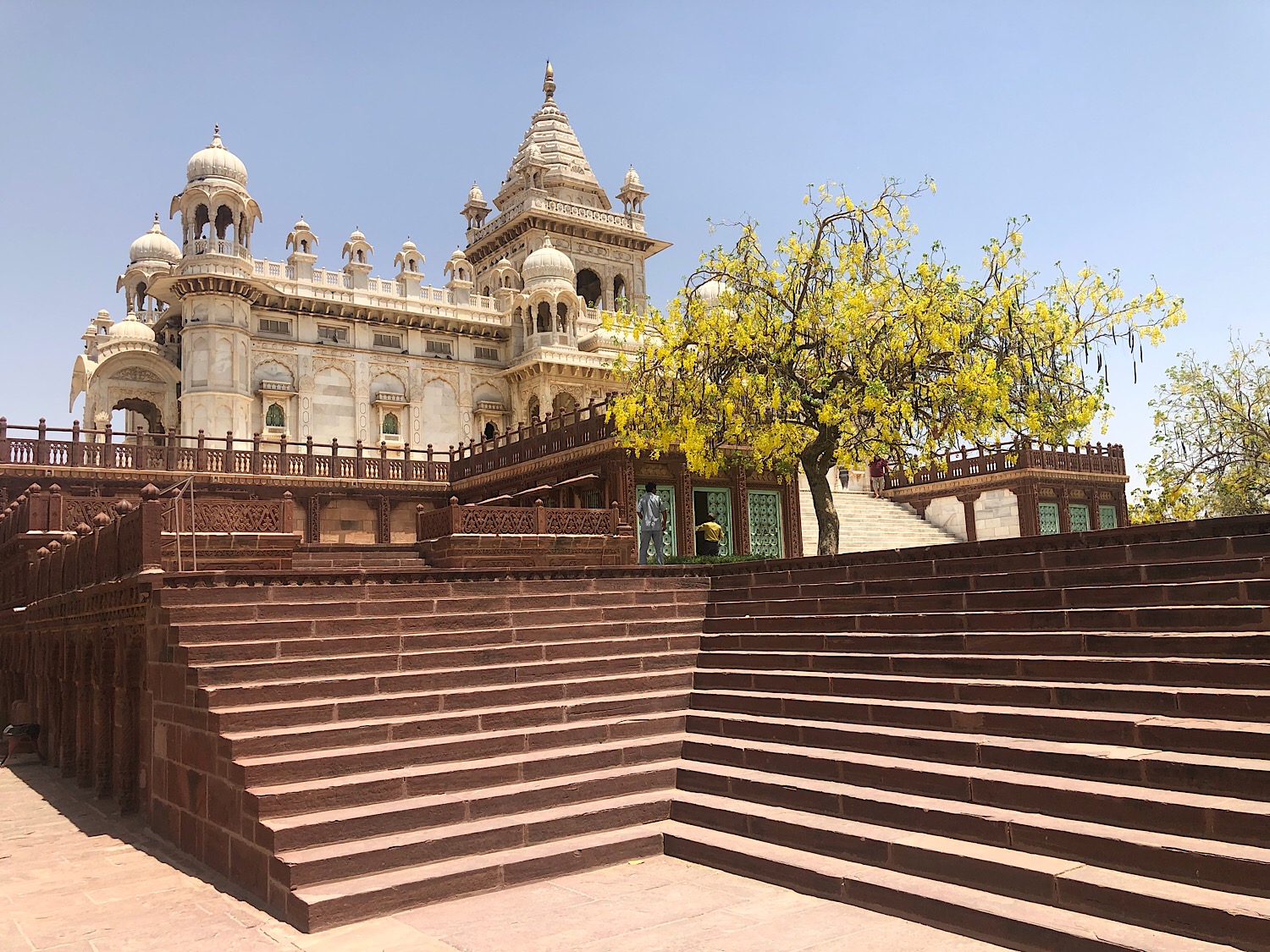
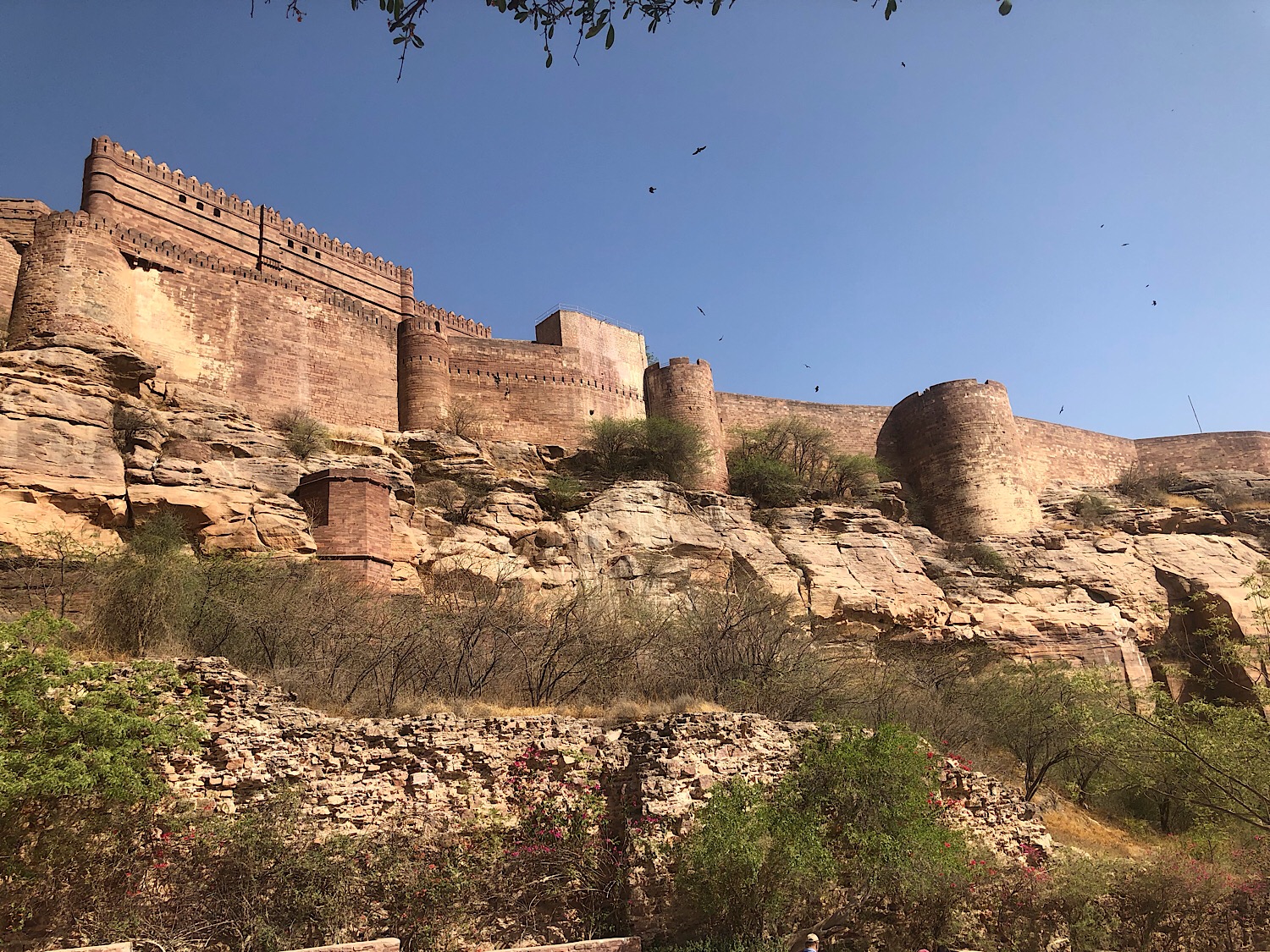
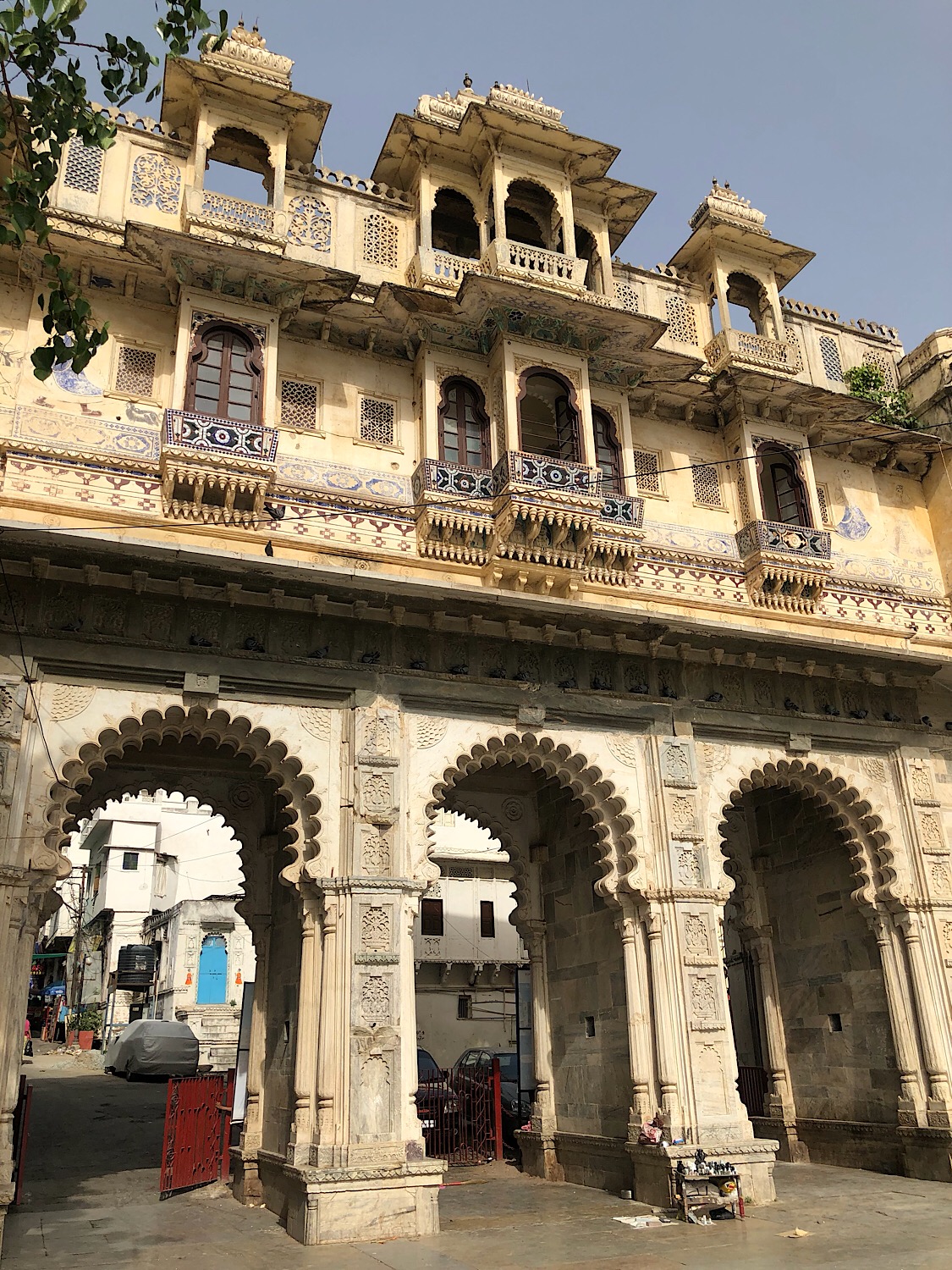
Another day another epic fort that was preceded by a visit to the royal mausoleum which was far more peaceful and beautiful than you might expect, all white marble and luscious green gardens. The fort in Jodphur is particularly imposing since the walls are insurmountably tall – 40 metres in some places, with the huge wooden gates we were used to seeing adorned with menacing metal spikes to deter enemy elephants from smashing them down. Swarms of eagles soar over the palace making it feel very medieval, it also didn’t disappoint in terms of the totally extra and opulent courtyards, mirrored pleasure rooms, stained glass windows and extravagant baby cradles for the royal squirts.
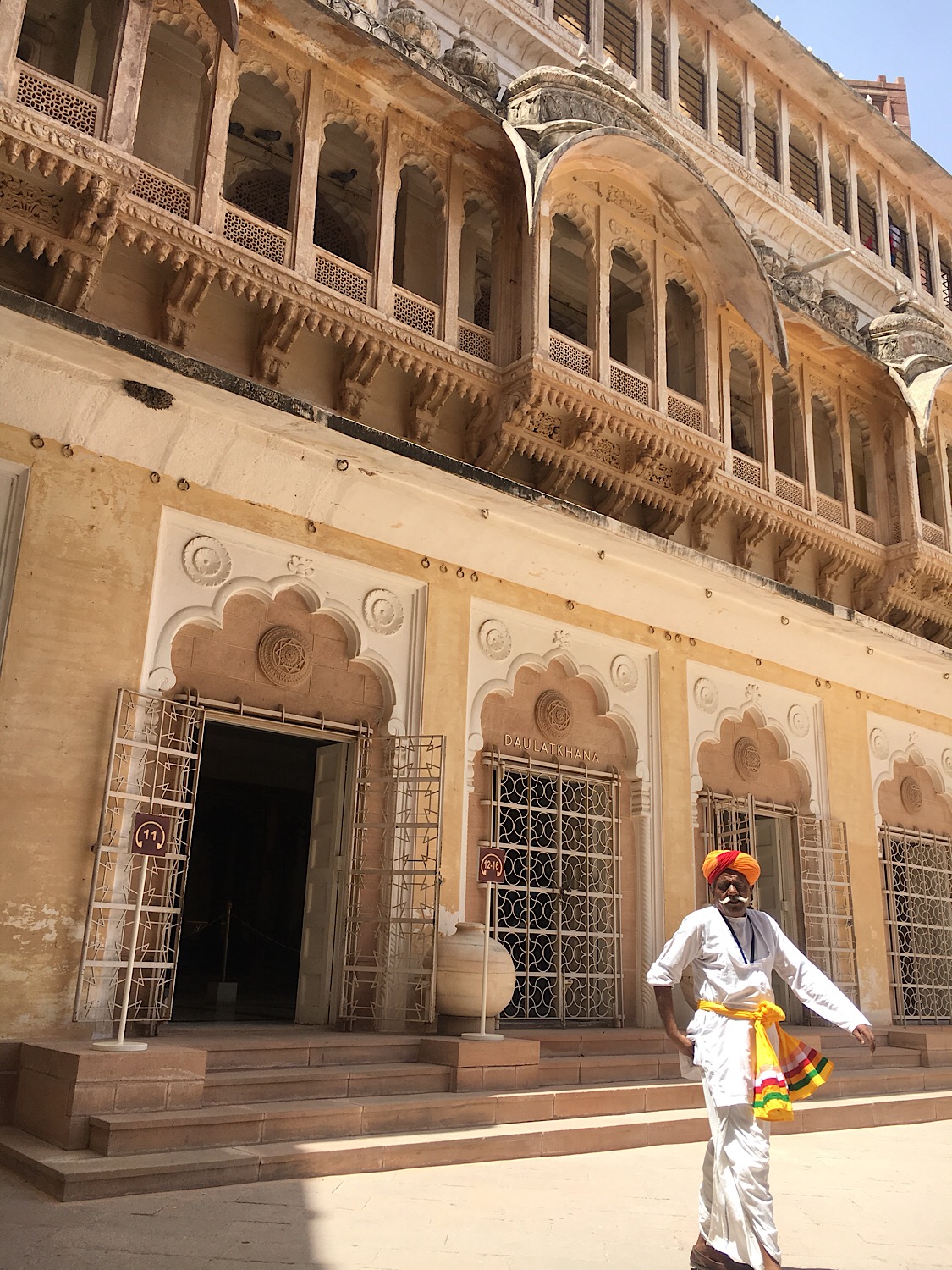
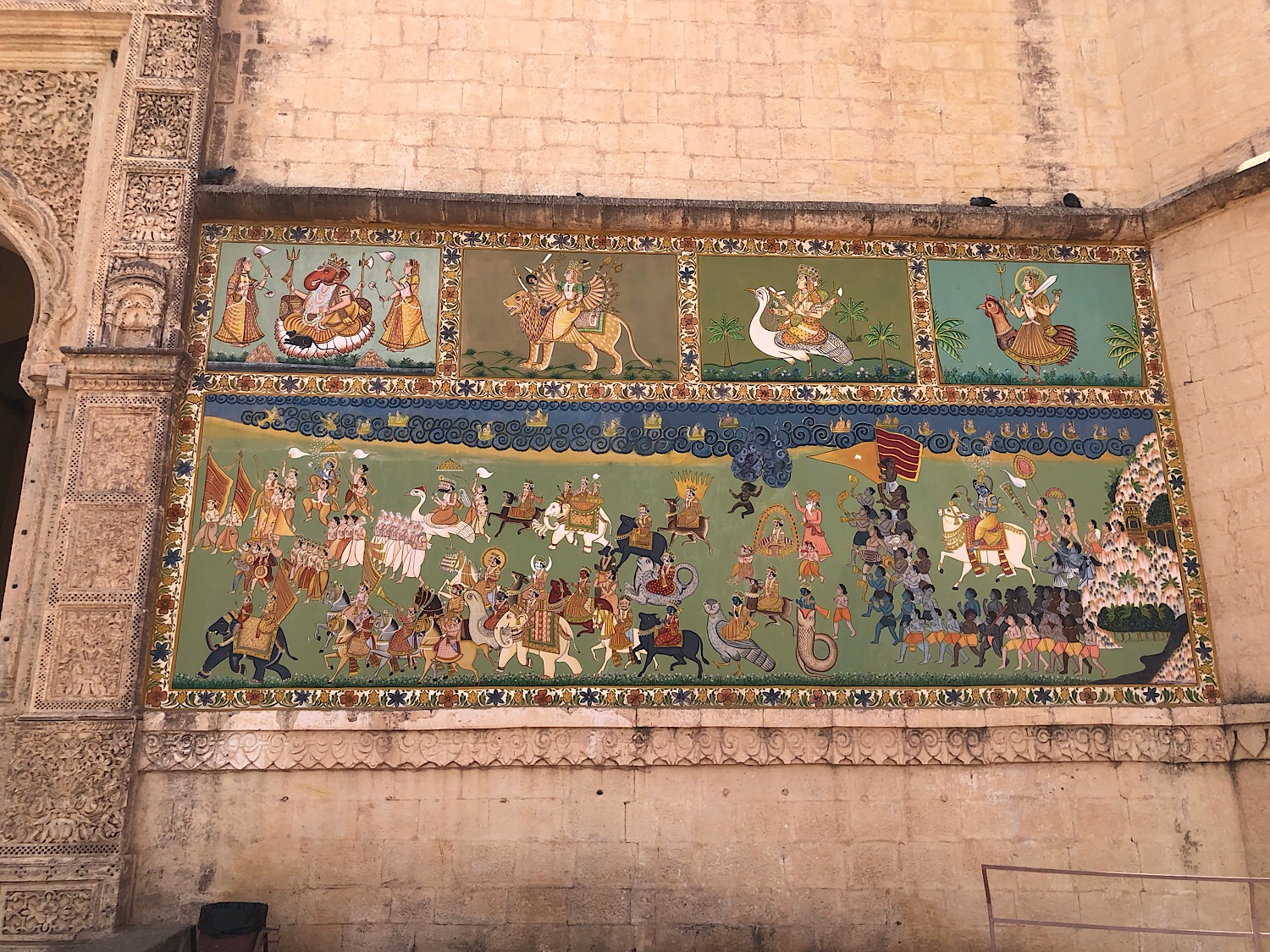
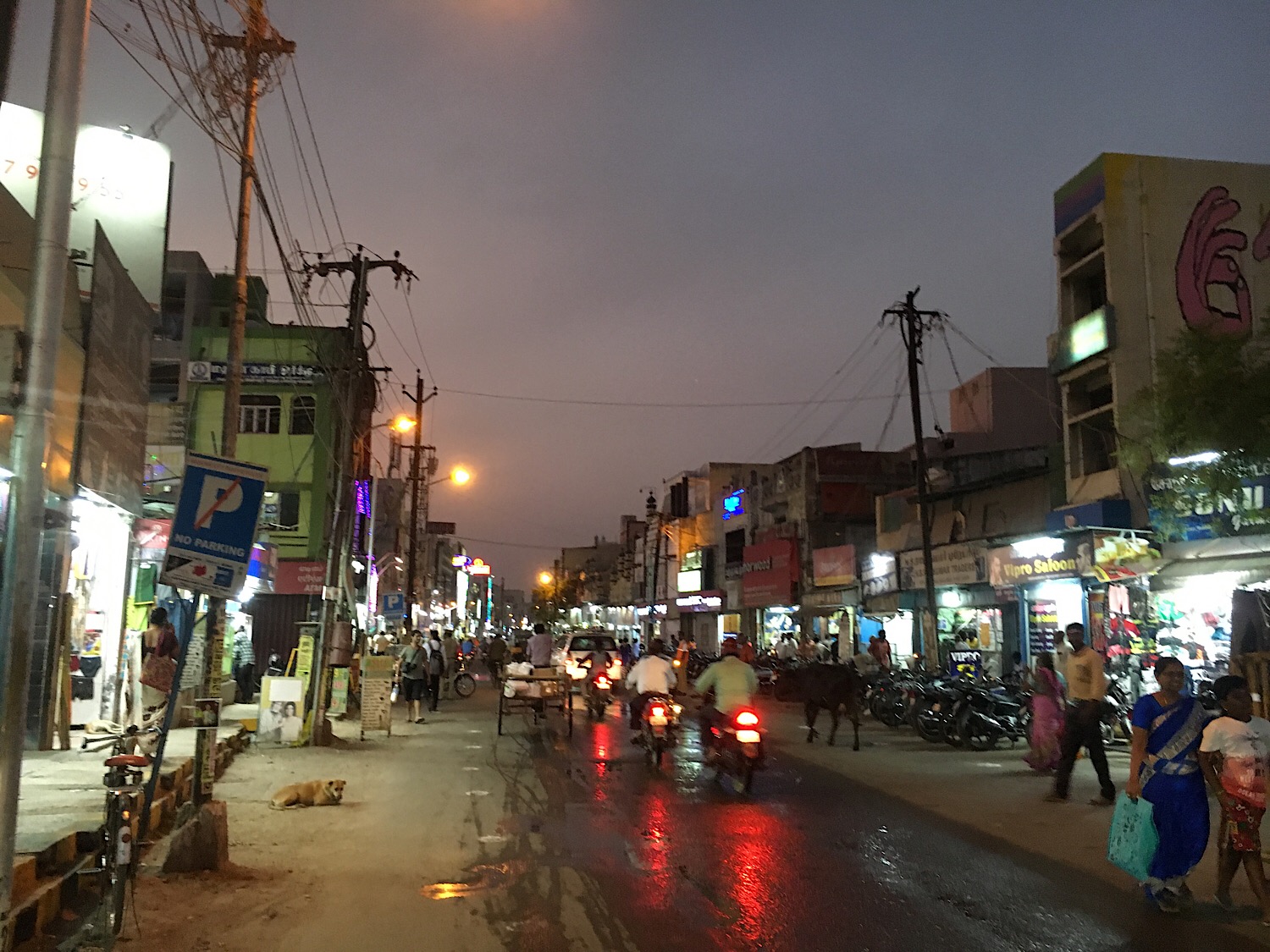
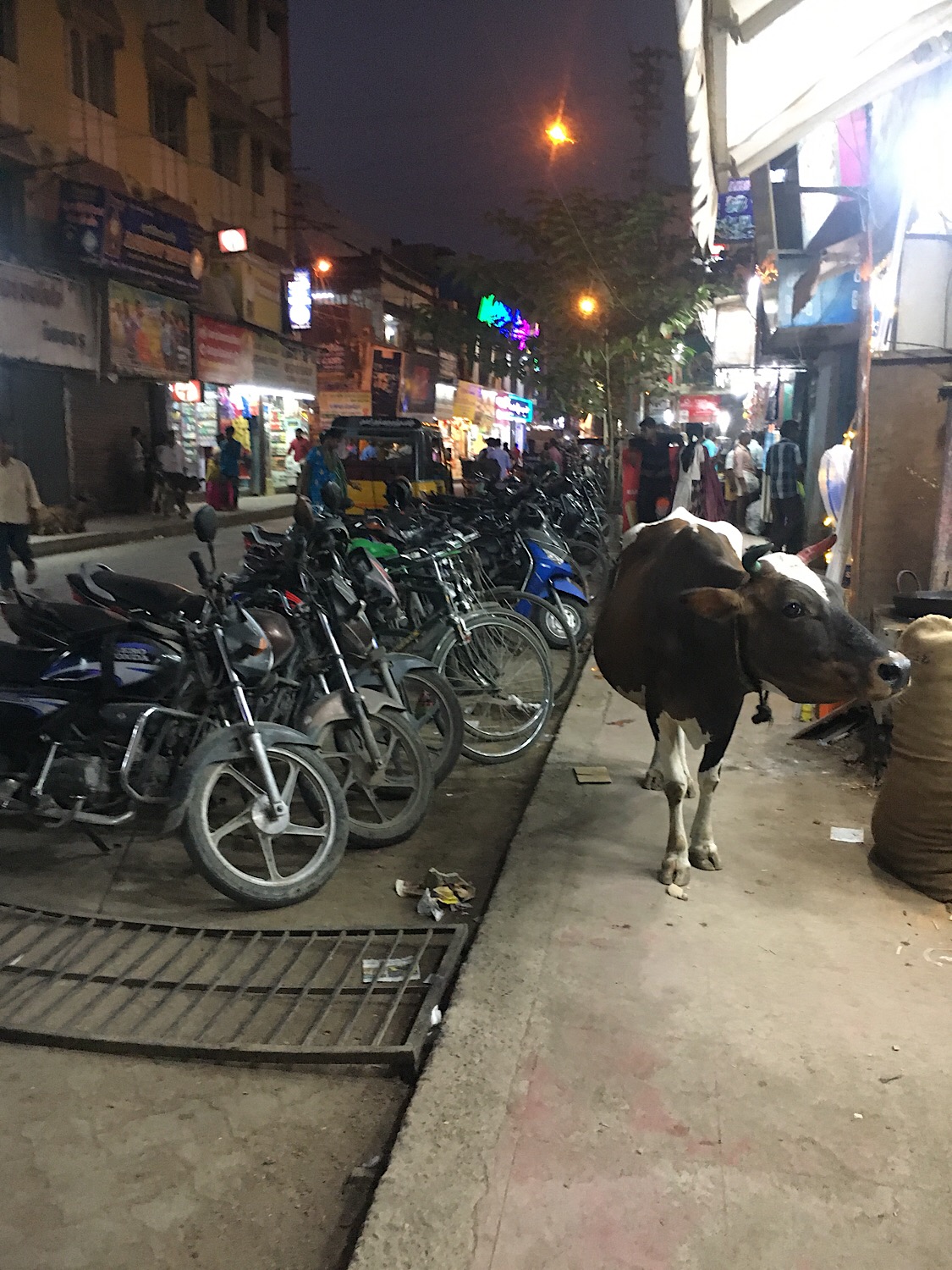
After our fill of another fort and yet another excellent audio tour we wandered down into the beating heart of the blue city then through to the madness of the clock tower bazaar. It was the archetypal chaos of Indian cities that you might expect but a few notches up from that, people, motorbikes, cows, bicycles, stalls, hawkers and cars everywhere, there was even a Bollywood music video being filmed – so many sights, smells and sounds, real sensory overload stuff. I desperately wanted to press pause for a moment to try and take it all in but unfortunately after purchasing some delicious freshly (deep) fried samosas we were off again to catch a really average bus to Udaipur the next stop on our rip roaring tour of Rajasthan.

Udaipur – City of Lakes
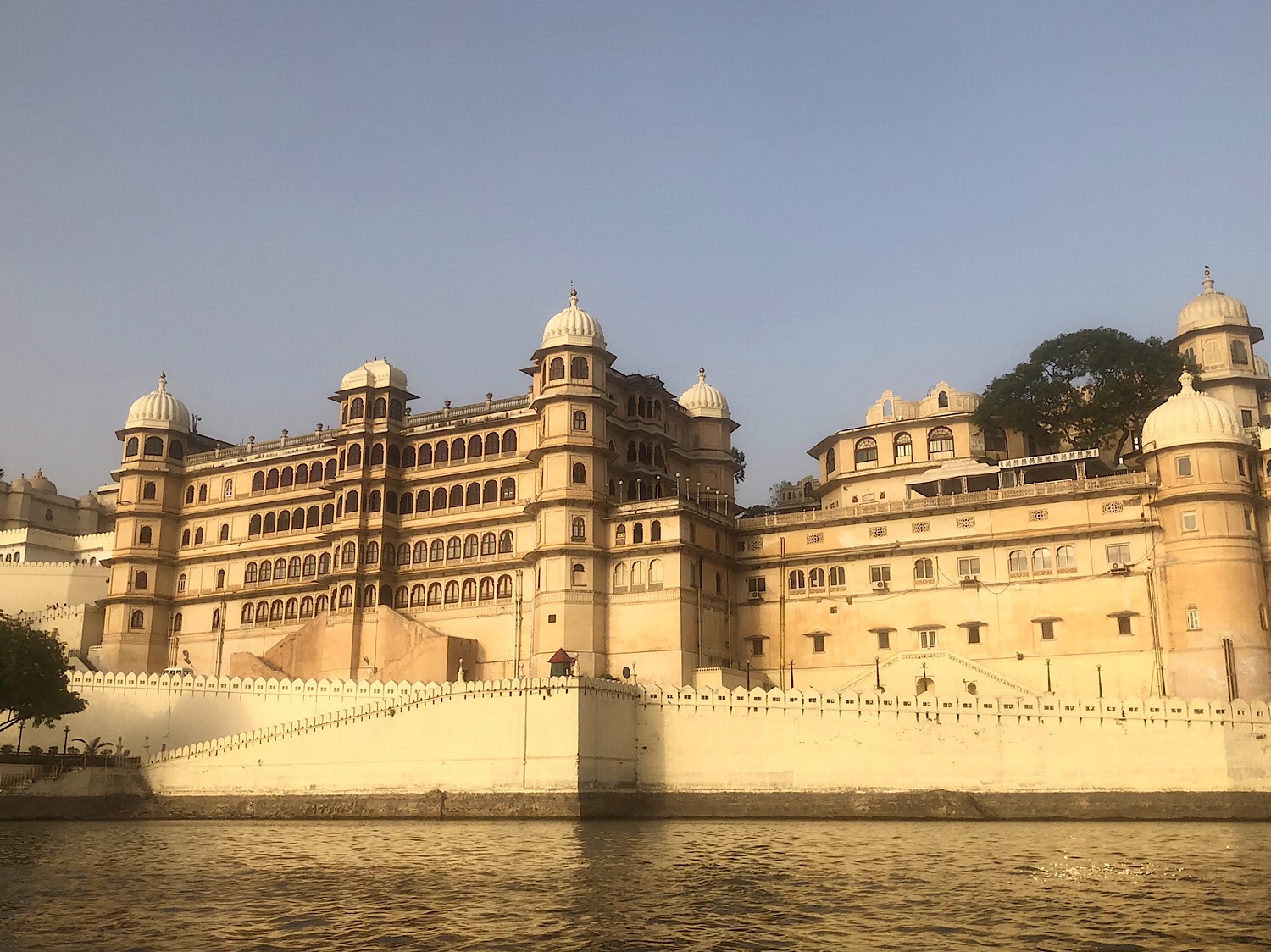
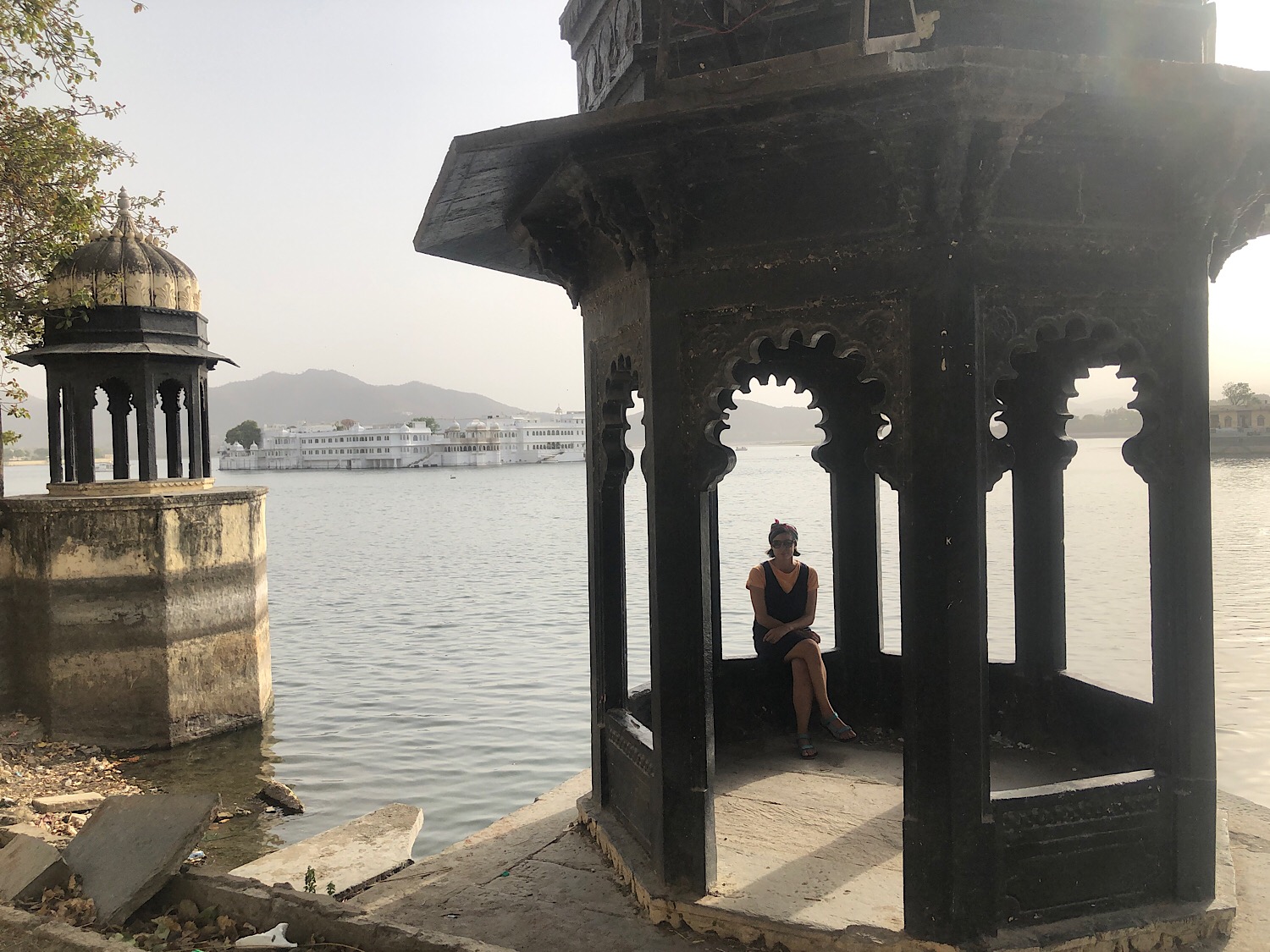
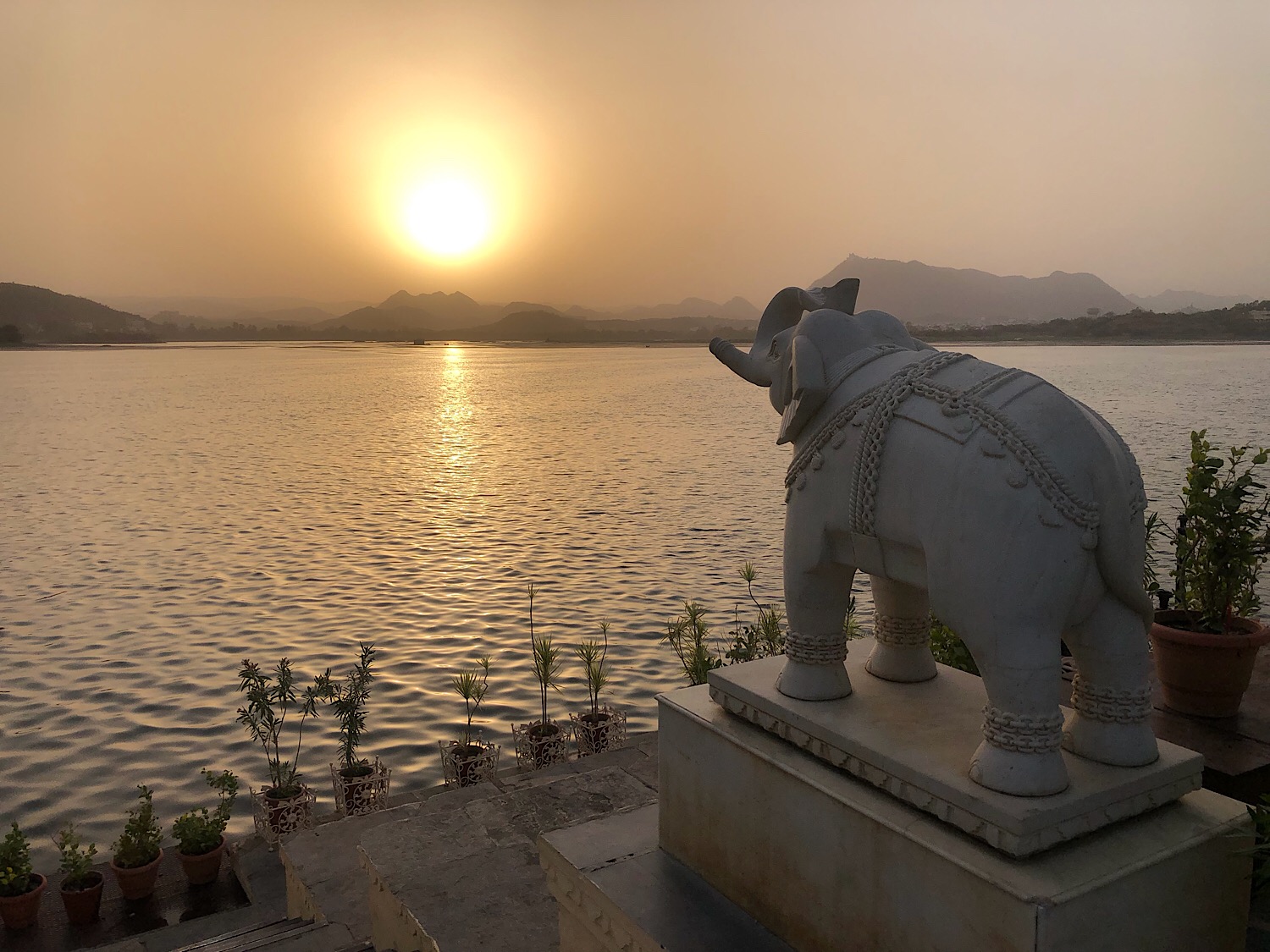
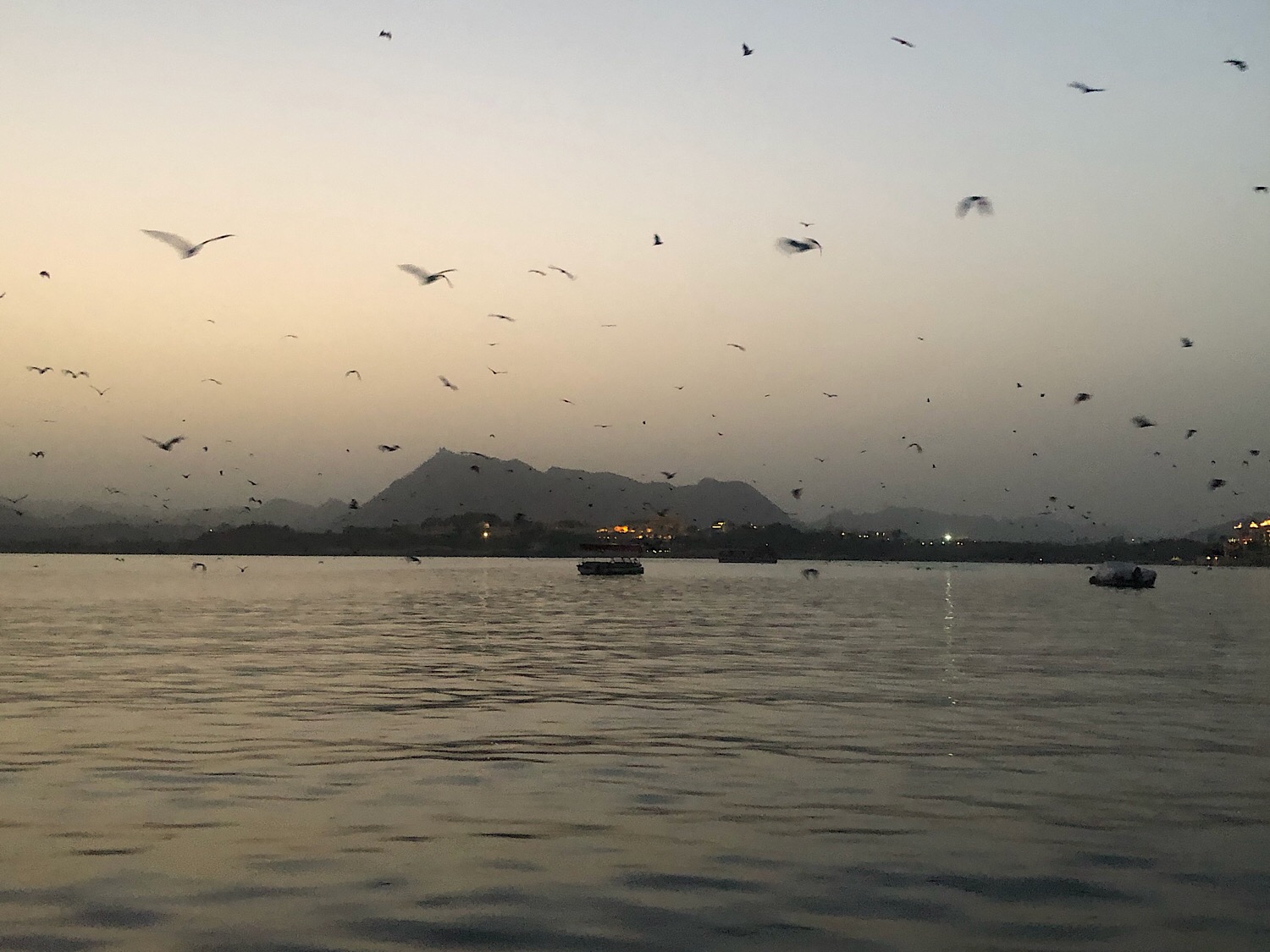
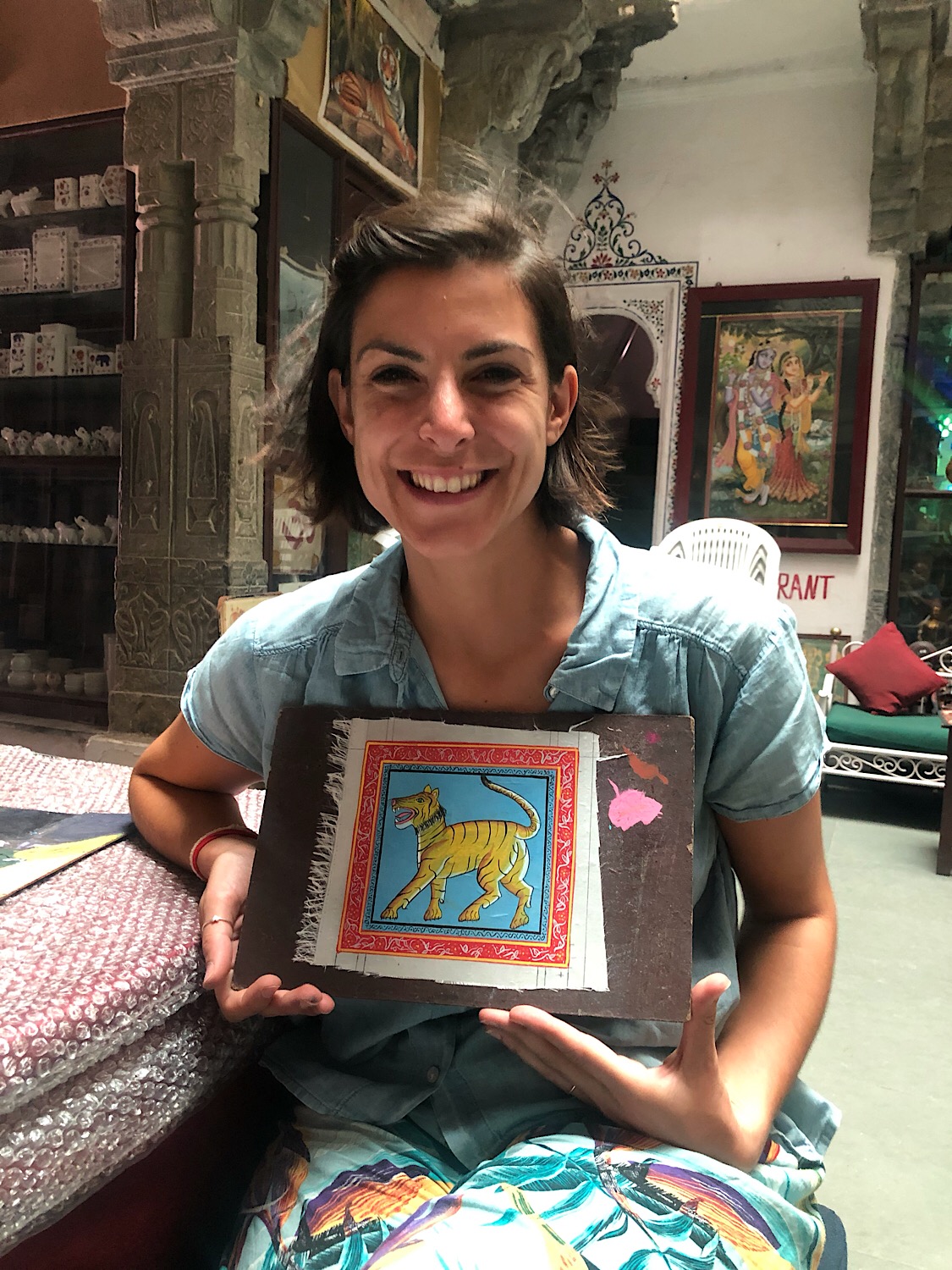
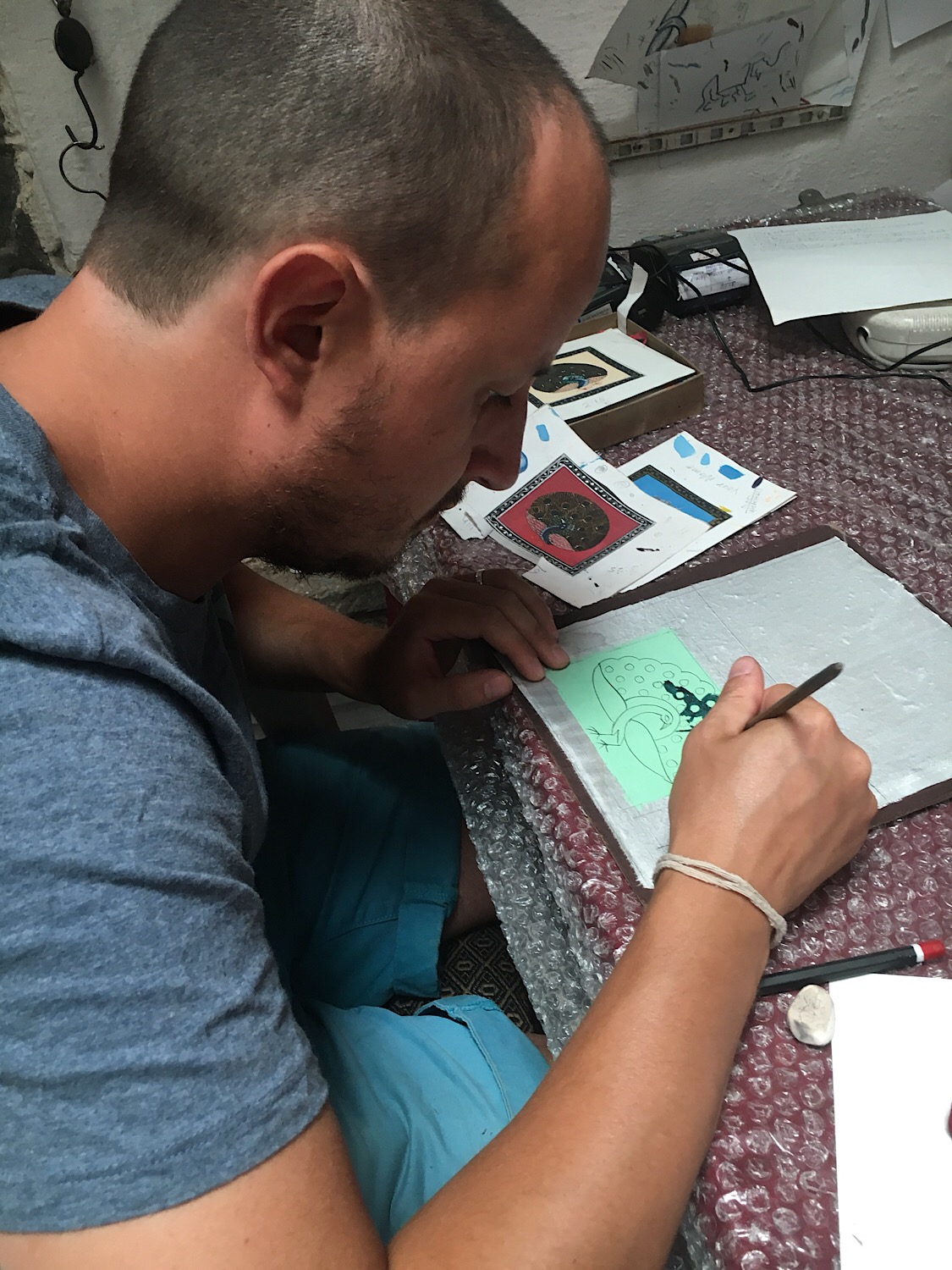
Unfortunately the huge lake that lies at the centre of Udaipur wasn’t as impressive on arrival as we’d expected as the water level is so low during summer, but it’s still a very romantic and magical place. The highlight for me was a sunset boat trip from the City Palace to Jagmandir Island (the former exclusive playground for the rich and famous Rajasthani’s) out in the middle of the lake, at dusk as we were making our way back to the shore the massive fruit bats we had seen hanging in the trees when we set off were out to feed on all the bugs that swarm at sunset. The sky was filled with thousands of the things, some with a wing span of about 70cm, it was like there were loads of big scraps of burnt paper floating around – very cool. The next day we took a miniature painting class and after four hours of sketching and painting we were both pretty happy (even Fred!) with our depictions of a tiger and a peacock.
And this is where our whistle stop tour of royal Rajasthan came to an end, I have already decided I’d love to go back as it absolutely personifies the wonderfully hectic and historic land that comes to mind when you imagine India.
Damp Darjeeling – jars, momos and mountain views
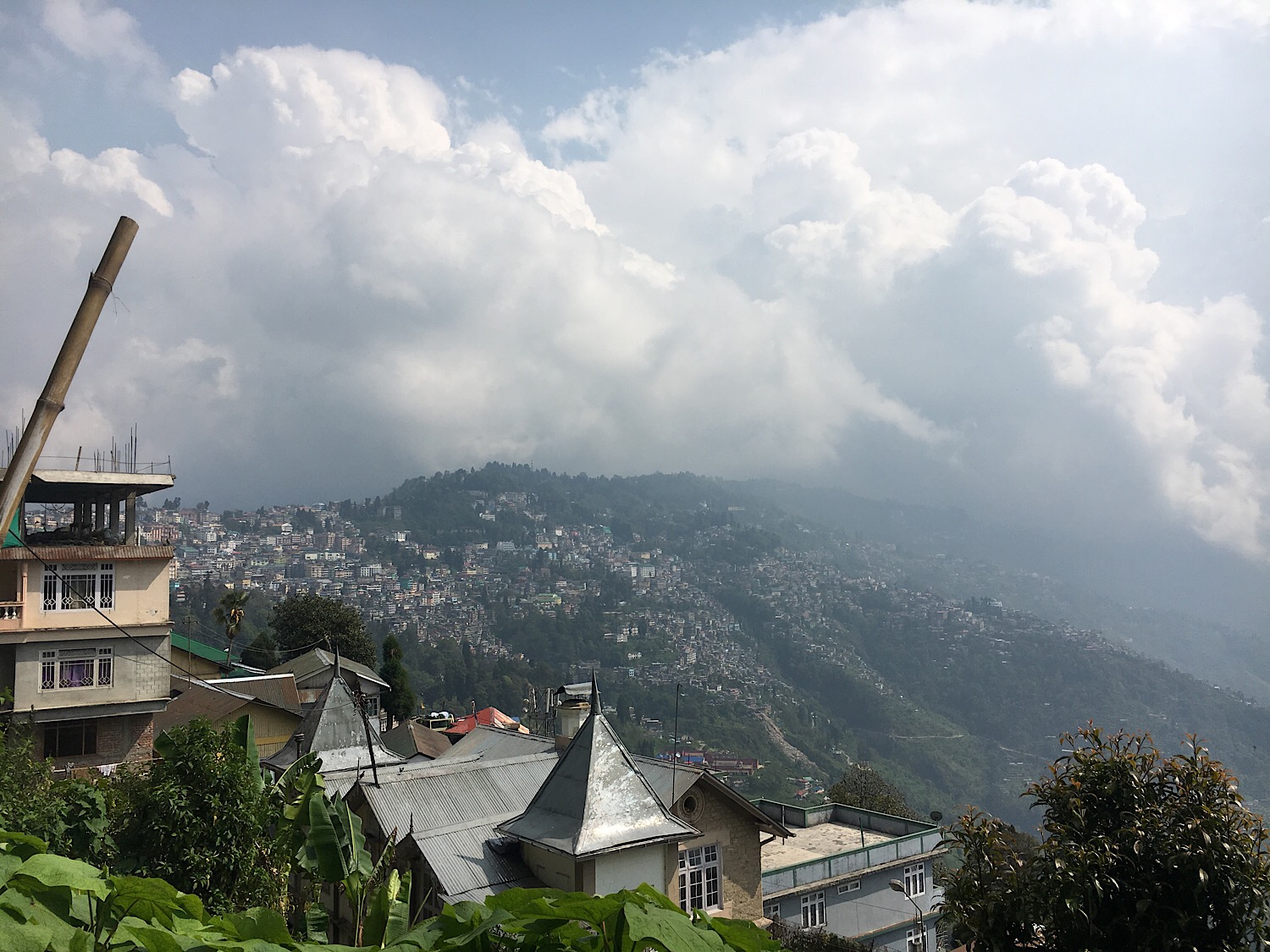
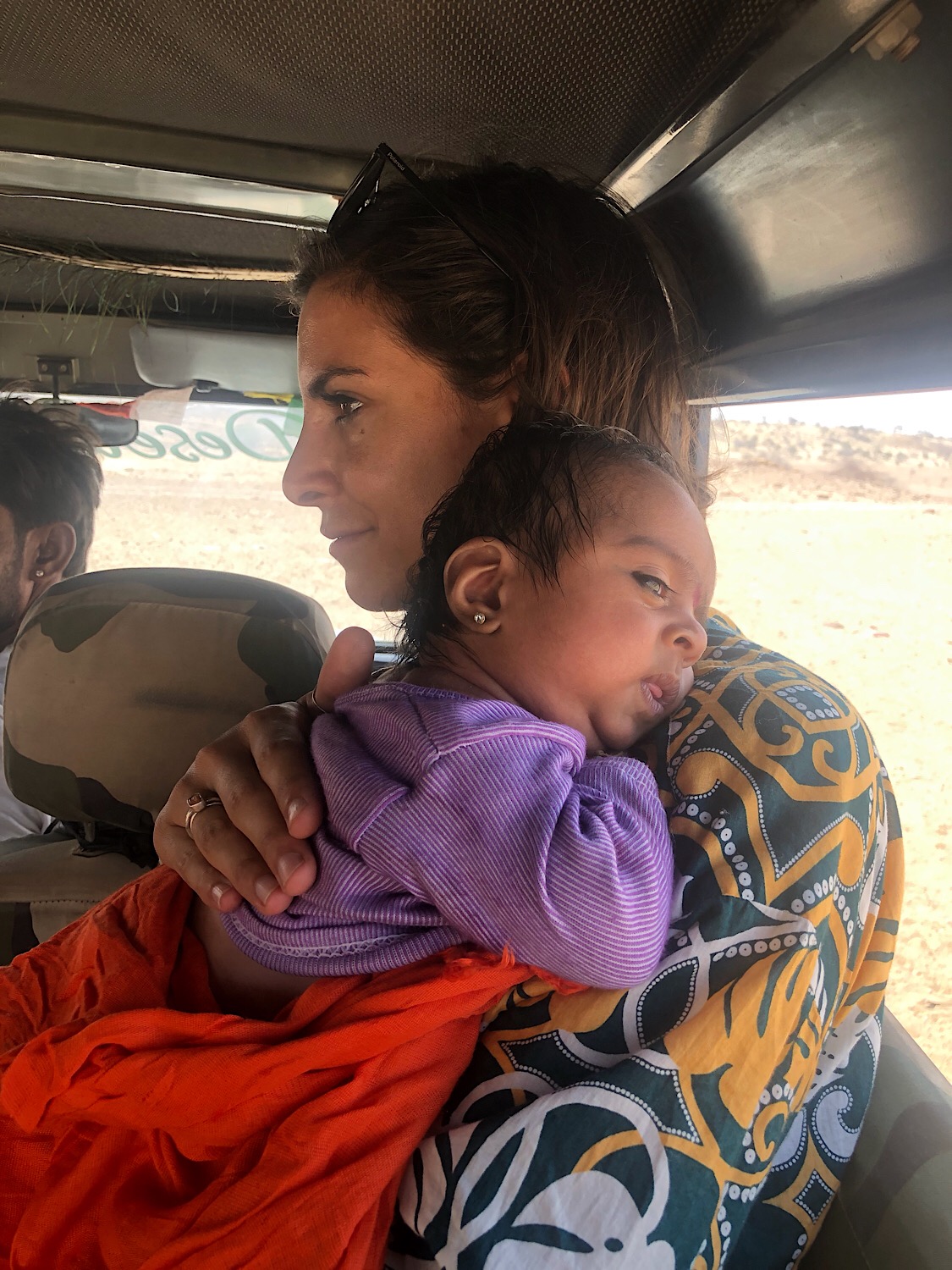
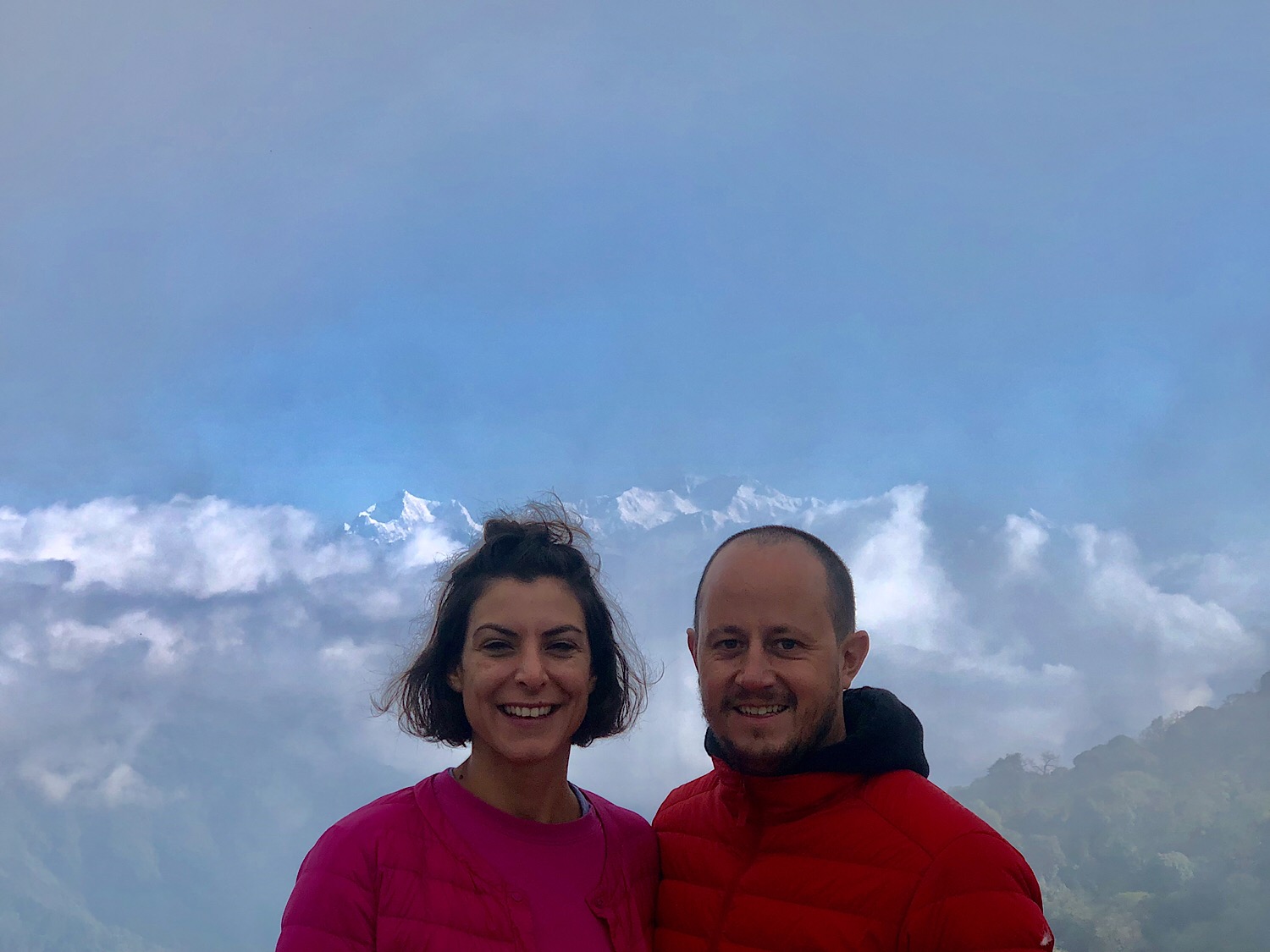
After a pretty long journey that included two flights (one I almost missed, because I was in Delhi airport M&S buying pants) and an extremely bumpy/hair raising mountain drive we arrived in Darjeeling, the hill top tea town famed for its views, which unfortunately was not only very misty and very rainy but seemingly full of terrible accommodation, including the place we’d booked. But once we found a decent place to stay, eaten some delicious freshly cooked momos for lunch and met up with Gautam a local guy who ran a great bar and trekking company we were much happier!

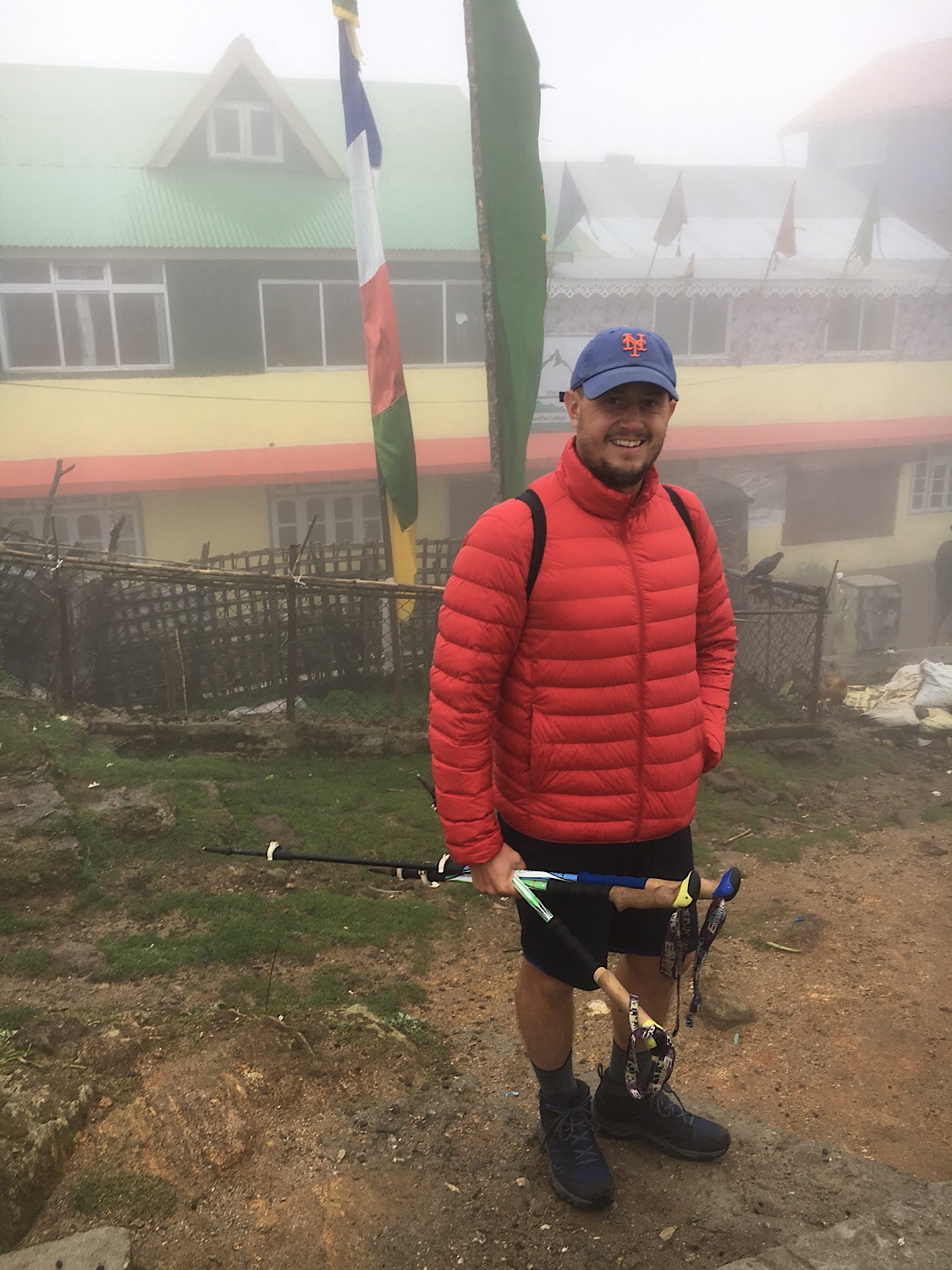
We’d planned an overnight trek which wasn’t boding well the next morning given the torrential rain. But after a 2hr drive to our starting point with plenty of momo pit stops on the way the weather had cleared however the mist still clung to the mountains spoiling the views somewhat. We did a decent uphill trek to our lodge for the night which was actually over the border in Tumling, Nepal spotting lots of rhododendrons, cows and bamboo along the way. Our early start to see sun rise over four of the highest peaks in the world was also thwarted by the bastard mist but you can’t control the weather right? So we just enjoyed the walking!
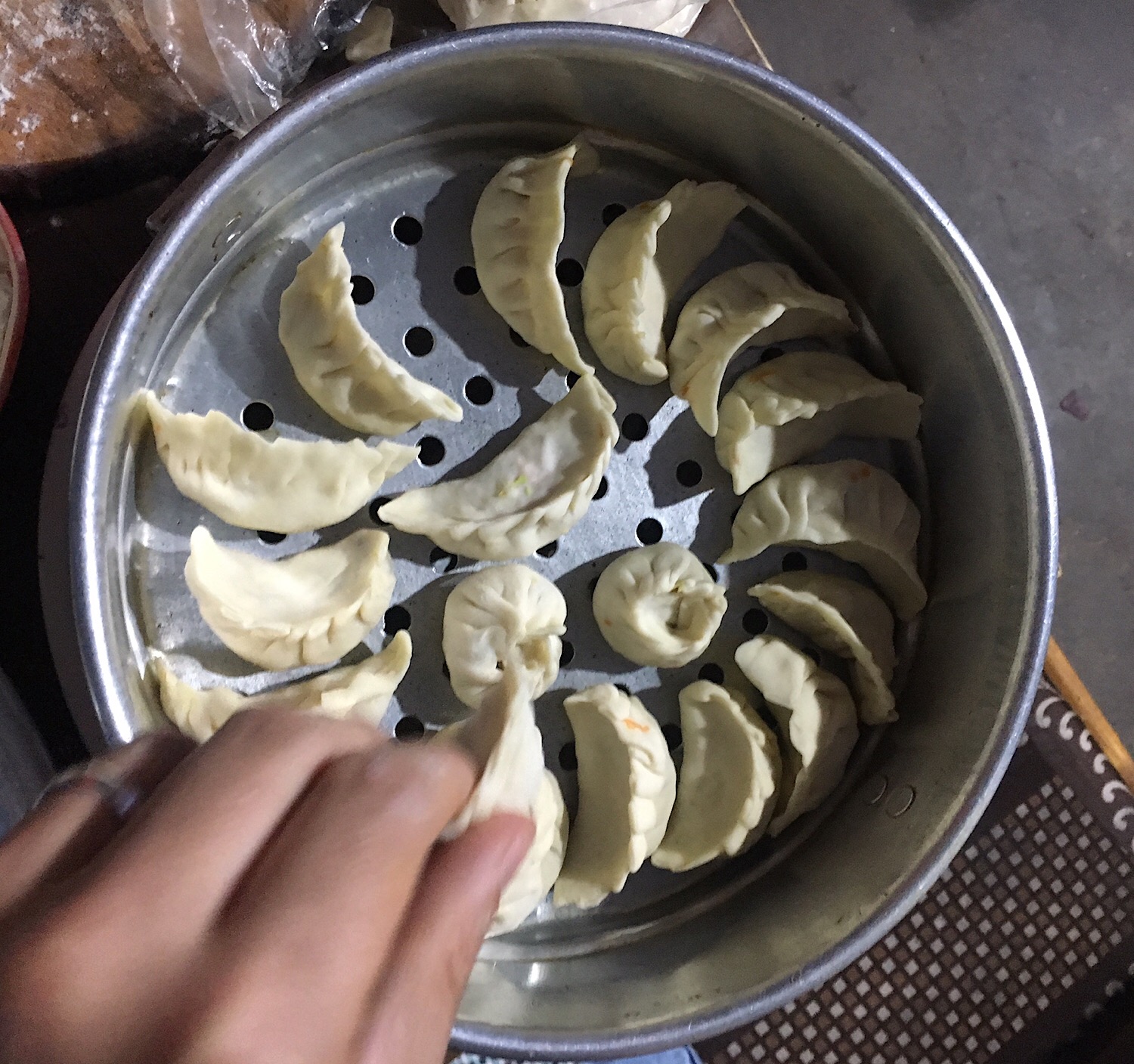
The rest of our time in Darjeeling was largely all about momos, eating them obviously but also making them in a cooking course in a tiny local restaurant with a lovely patient teacher (getting the fold right is rather tricky). FYI the secret to delicious momos is steaming them over a rich vegetable stock/soup – oh and MSG! We also visited the mountaineering institute and Zoo. Tenzing Norgay the Nepalese/Indian Sherpa who was among the first to successfully scale Everest with Edmund Hillary was from Darjeeling, the institute was rather odd but interesting nonetheless!
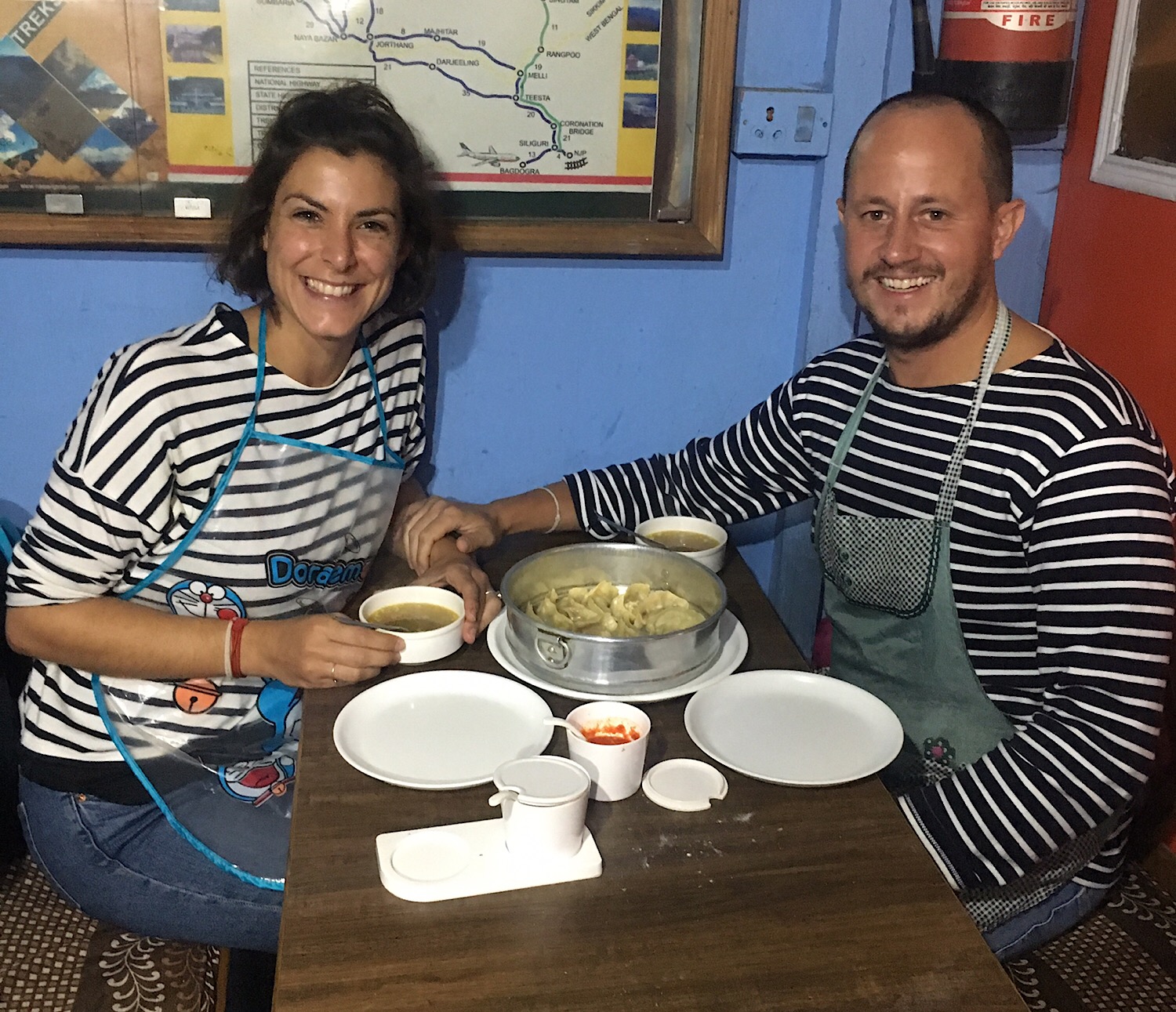
And with this our month in amazing India was drawing to a close. Darjeeling was a really interesting way to end our trip as the people, culture and vibe was so different to anywhere else we’d visited in India, it’s far more Asian in terms of the food and the way people look and behave, it was a real contrast that actually made our transition to Nepal seamless (but more of that from Fred!)

India really is a spectacular, exotic, chaotic and wonderful place to travel. It’s such a vast landmass, with such diverse people, districts, culture and food and if you like it (which not everyone does!) you could travel there for years and never get bored. Yes there is extreme poverty, often less than pleasant ablutions and you’ll inevitably encounter someone trying to sell you something on every corner, but for me the positives absolutely outweigh the negatives and when you think about the fact that there are more than 1.3 Billion people living there you can’t blame them for hustling for a living!

Watch this space for the next thrilling instalment of Frabby’s adventures – where we head to Nepal to realign our chakras with some major ‘Ooooooooooooooommmmmmmmmmmmmmmmmmm-in!’

Big love, Frabby xxx
Leg 3: India – Tamil Nadu to Andaman and Nicobar Islands🇮🇳🕉🏝

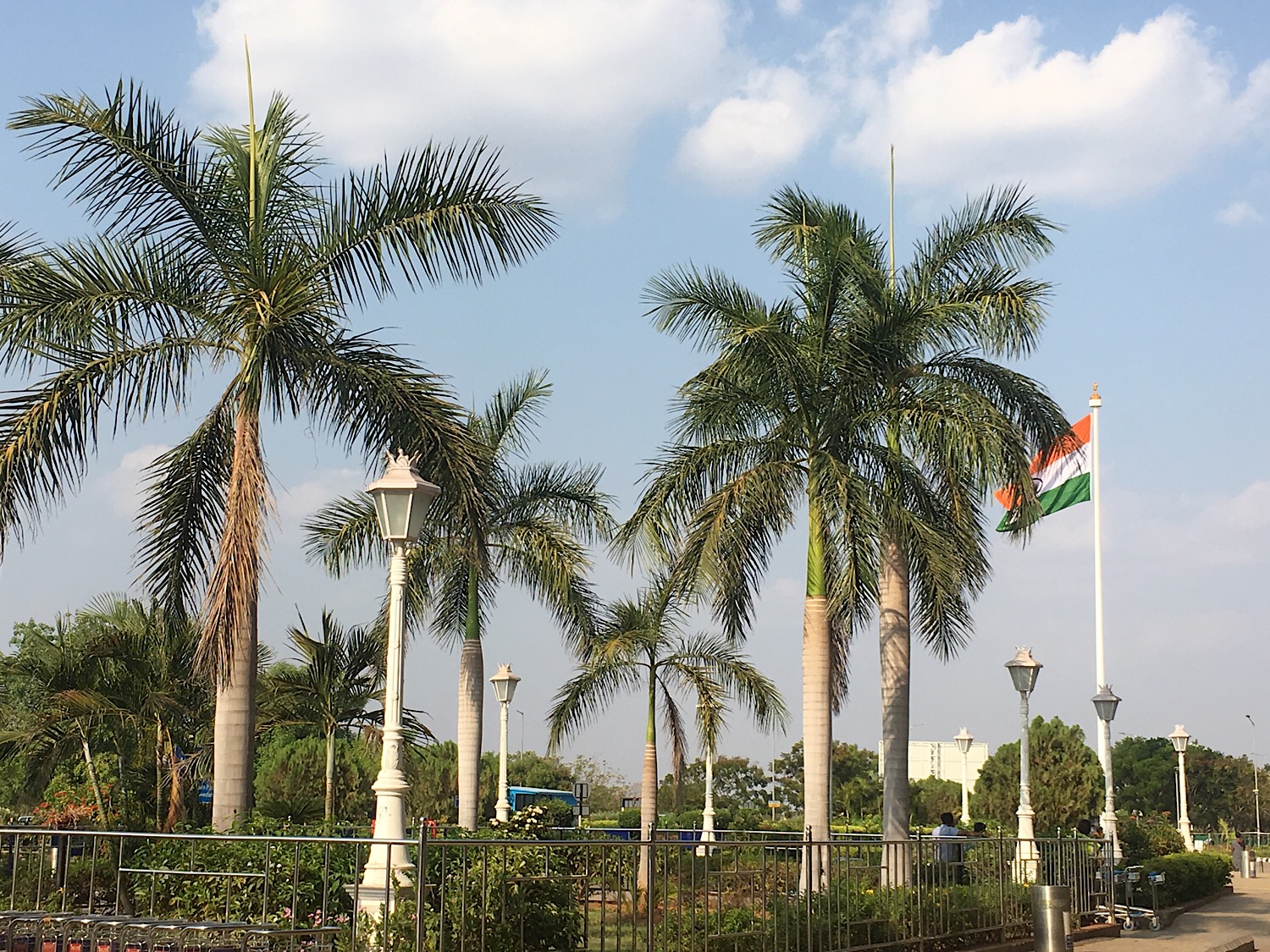
“Red! Hot! Spicy!” were the words that greeted us as we boarded our Spicejet flight from Colombo to Madurai. Excited as we were to be heading to India, we were also sad to leave Sri Lanka, so as a parting shot, Peahead managed to paralyse the entire airport security corps with her Kindle which they handled extreme bafflement as though it had descended direct from Alpha Centauri. Despite multiple attempted explanations of this device, the Bandaranaike airport elite division ultimately concluded that they were never going to understand what it was, so waved us through and we clambered up into our Bombardier Dash turboprop headed for the brilliant madness of India.

Historic Madurai is one of India’s oldest cities, dating back millennia to the ancient times of the Romans, Persians and Chinese where it was an important trading post (spices) on the silk route. It is also one of the only human settlements globally to pre-date Dot from EastEnders. 

Moody Madurai

We had chosen Madurai in the South of India (Tamil Nadu) on a bit of a whim, mainly because it was conveniently located as a launchpad for our Indian odyssey and you could fly there from Colombo, so we were a tad apprehensive on arrival about what this particular Indian box of tricks might hold. We really knew very little about it other than that Rick Stein had stopped here on his India series – so it can’t be that offensive, right?
What better way, then, to throw ourselves into the chaos than to hit the town on a “foodie tour” of Madurai?! The use of the word “foodie” had a strangely mixed effect on me: at once comforting – it implied we’d be in for a tasty evening pitched at Birkenstock-clad, Guardian-reading, western liberal metropolitan elites looking for an authentic (but safe) experience of India that they could casually drop into dinner party conversations once securely reinstalled in Stoke Newington – and at the same time, slightly embarrassing, in that I then remembered that we were exactly the target market. Note to self: must be more dangerous

Indian cities are nuts! 🥥

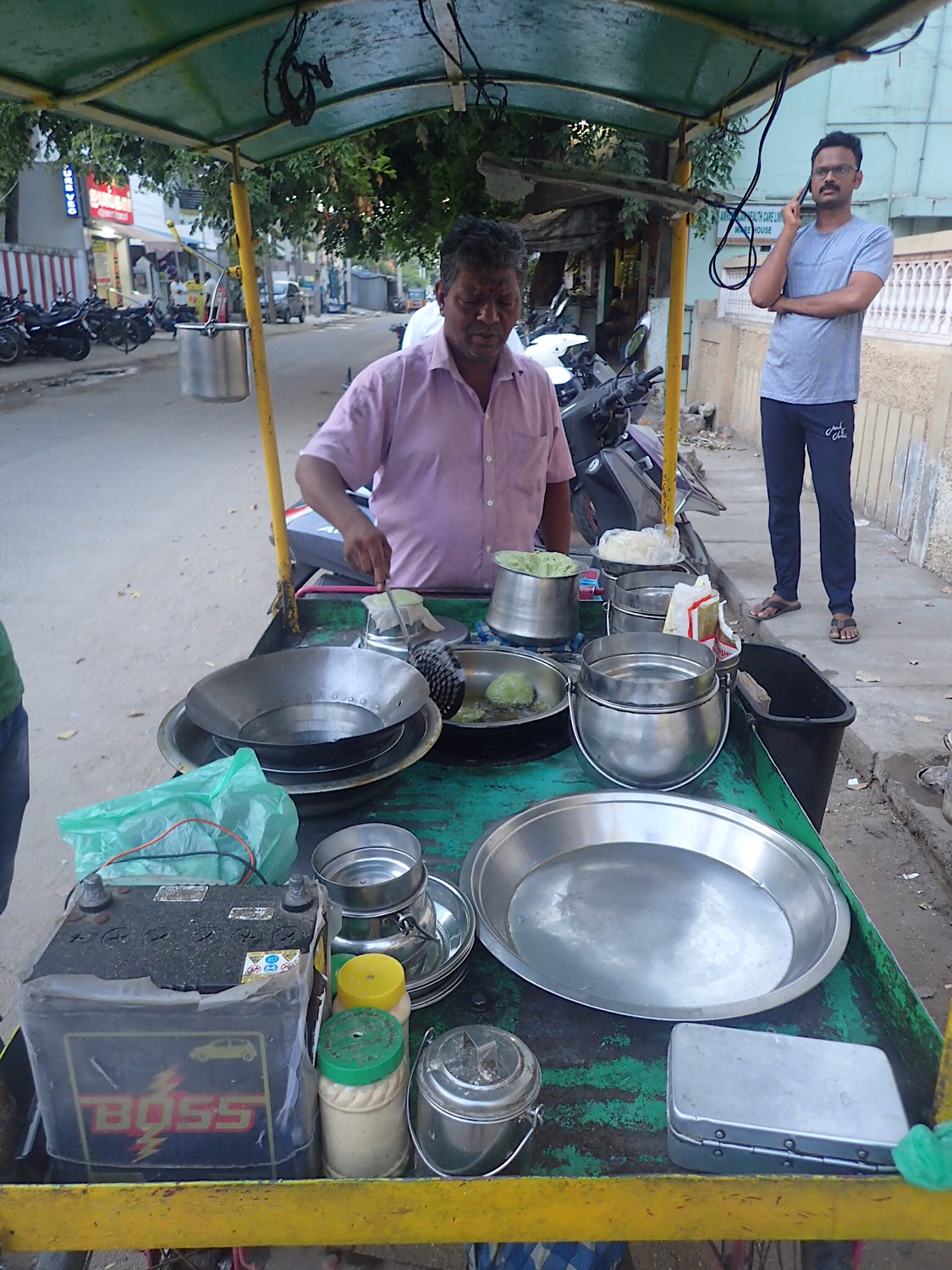
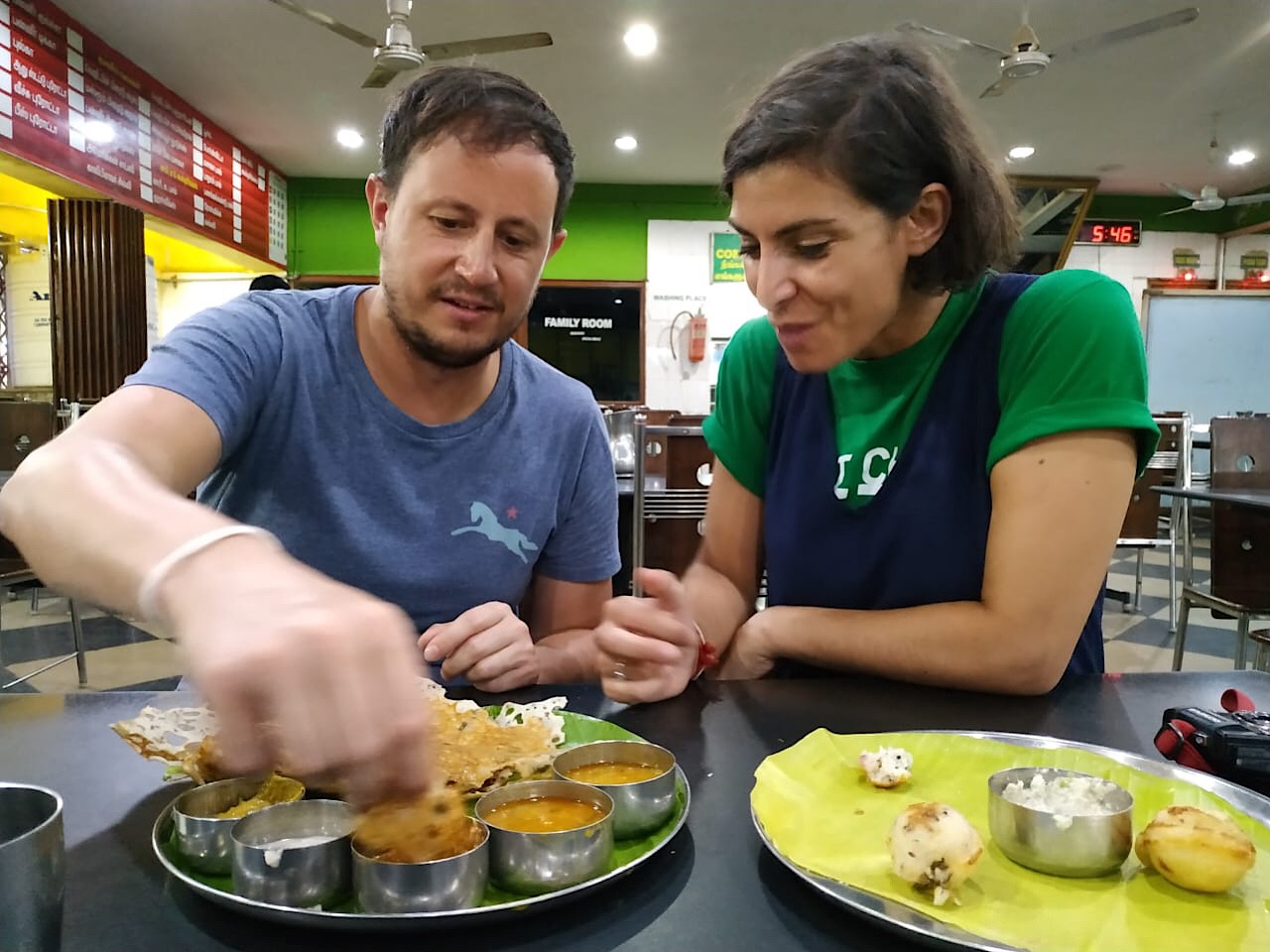
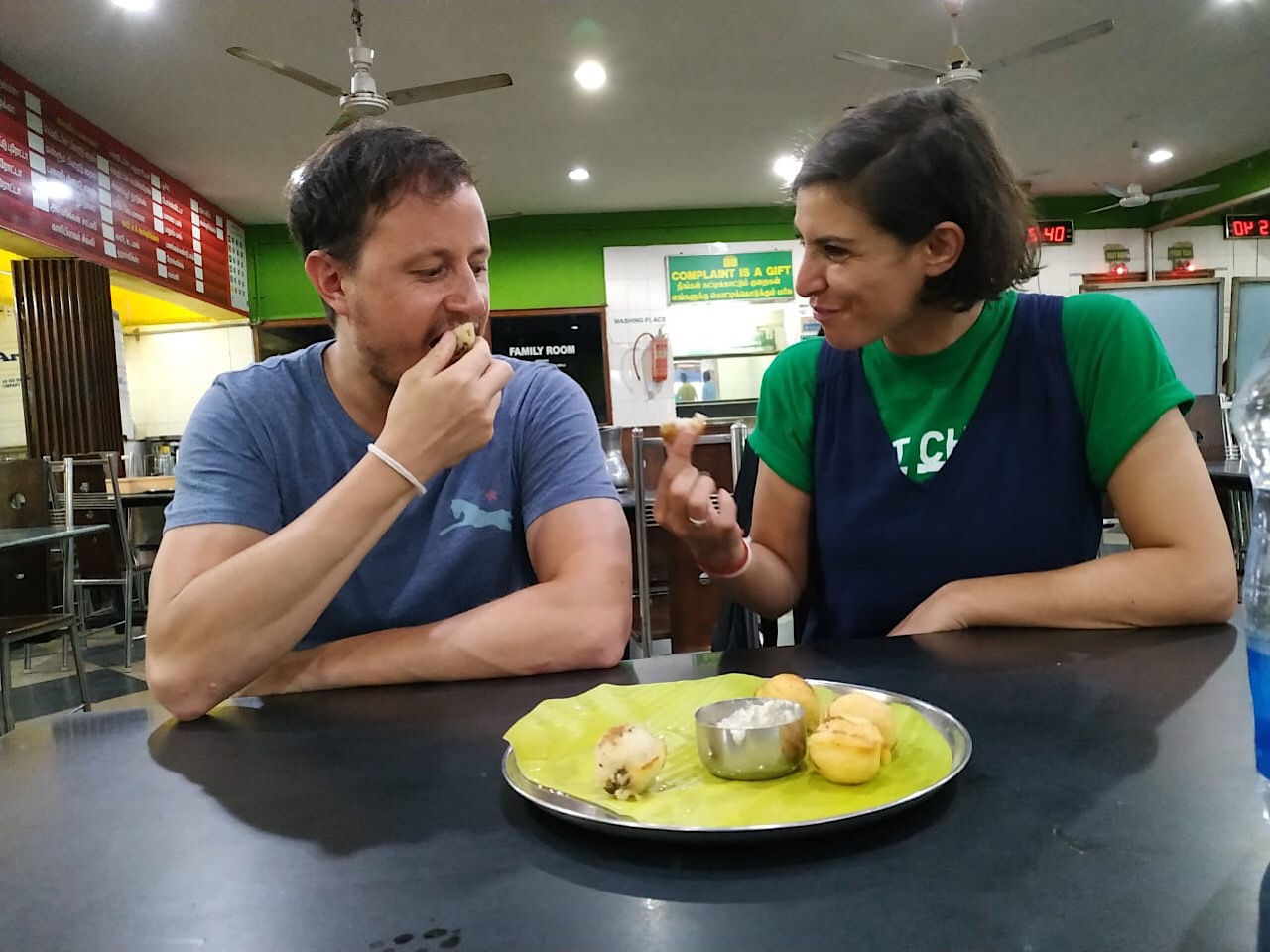
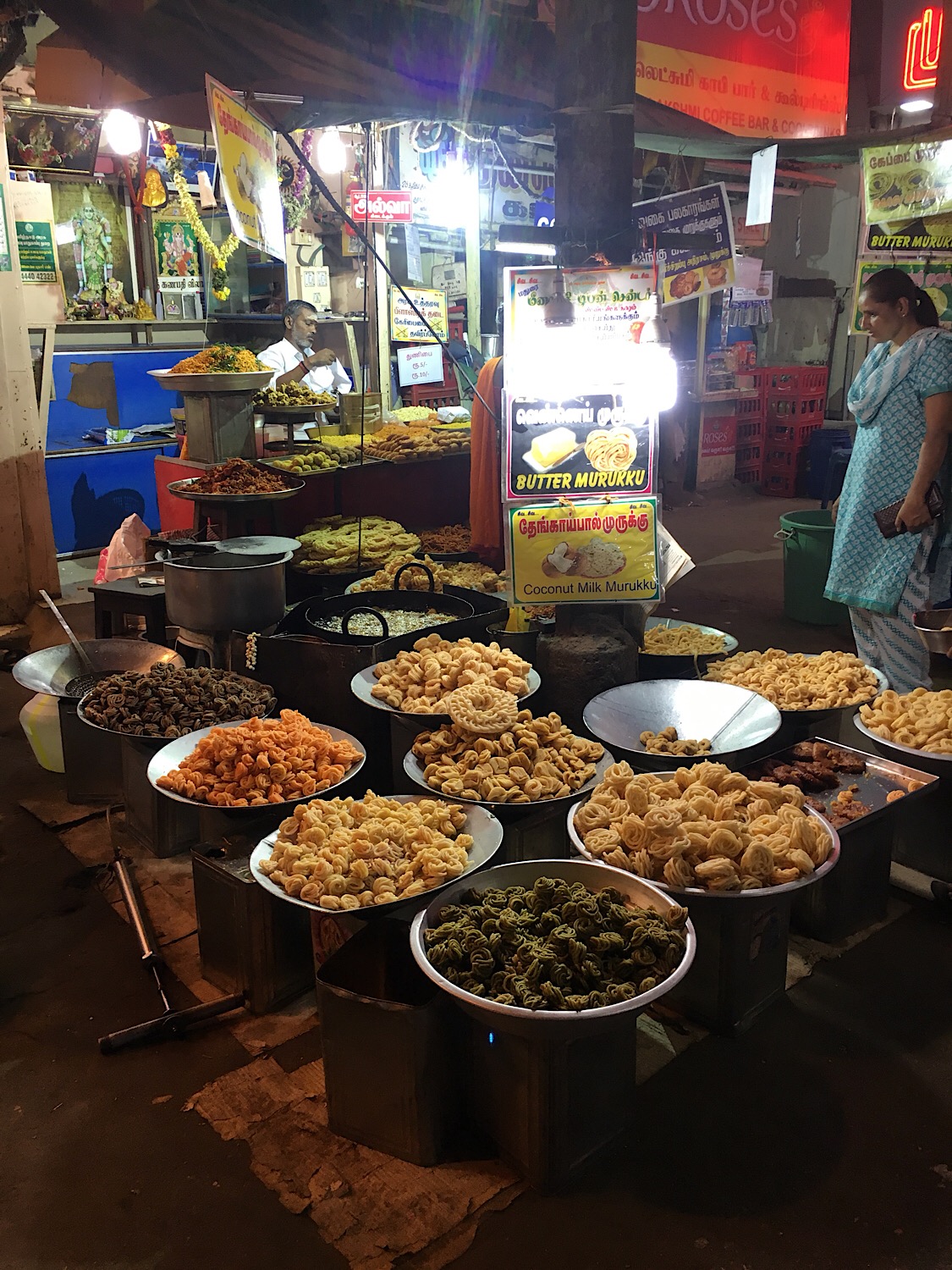
And so off we trotted, whisked from restaurant to street food cart to venues resembling neither, all in the safety of an air con private cab, naturally. It was brilliant! I don’t actually remember every single morsel we tried (this was conveniently emailed to us the following day), but highlights included “Paniyaram”: deep-fried chickpea balls (about golf ball-sized) which came in both sweet and savoury form, with the sweet one being the real champ due to the delicate cardamom spicing. Another real treat was a truly wondrous semolina dosa, wafer thin, crisp and containing cashew nuts, with a quasi-honeycomb, lattice structure in places. So good we went back for lunch the next day. Other bites, of varying quality, included a tasty deep-fried millet puff from an enterprising gent who placed his cart at the doors of the temple – collecting orders from worshippers on the way in for pick-up on the way home after presumably intensely famishing temple sessions – and “the famous Jigarthanda”: condensed milk churned with ice cream and agar agar (small jelly chunks which reminded me of tapioca)a fairly odd ice cream, affogato-like dessert which apparently has now become the official pud of Madurai. 

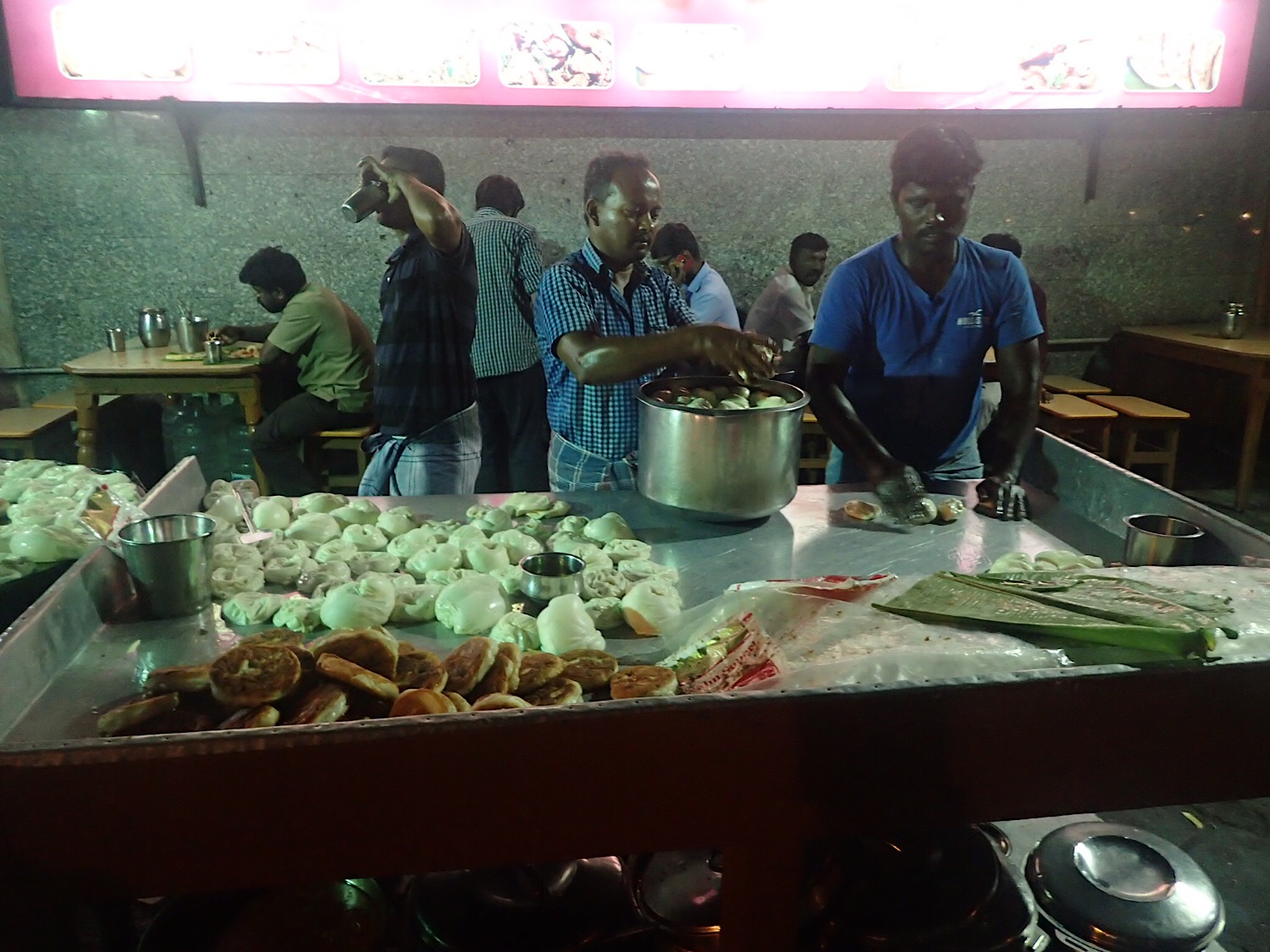
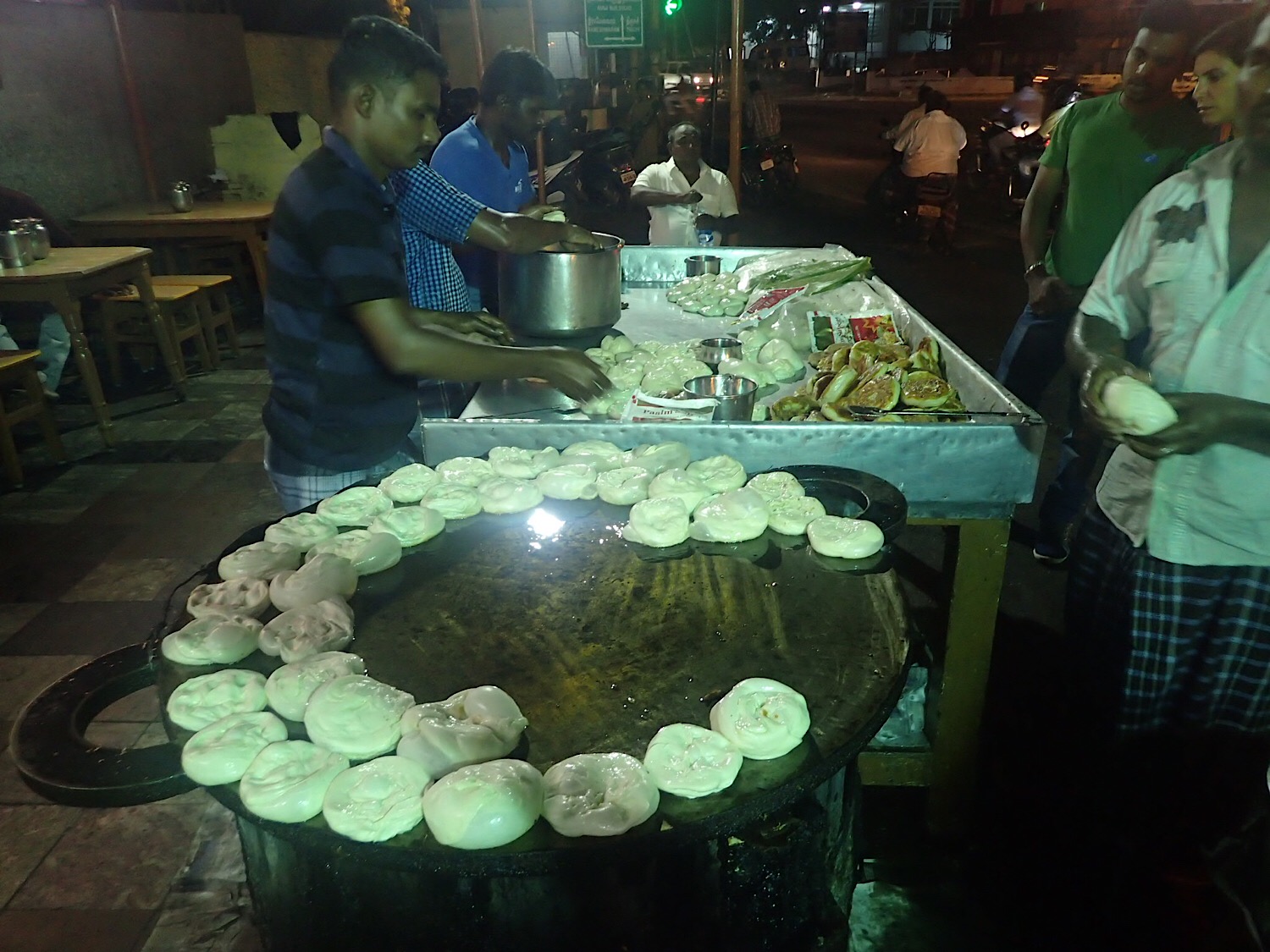
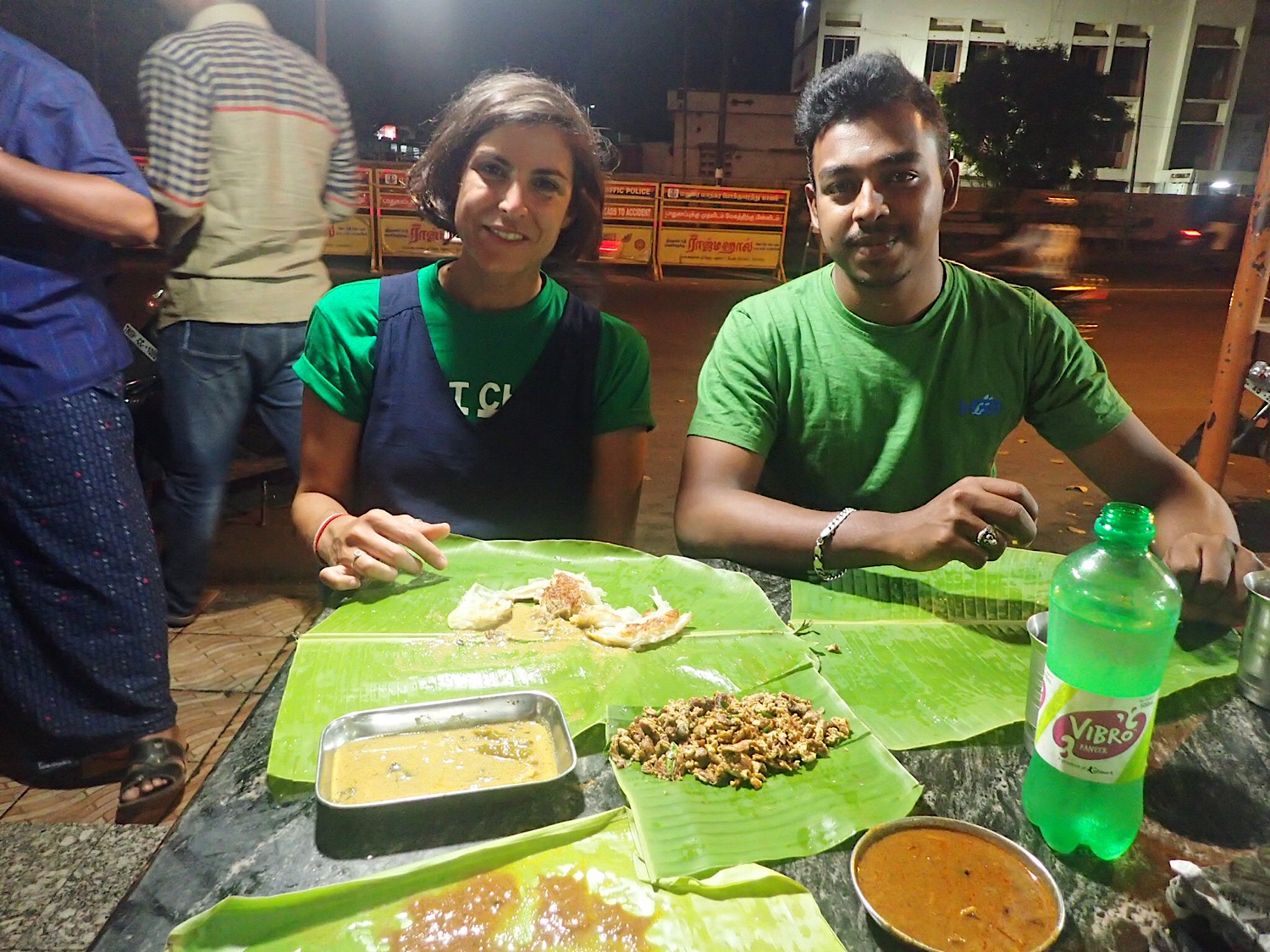
Hands-down, top dog, however, was unquestionably and indisputably the roadside bun paratha stand. This place was a cathedral for gluttony, immense satisfaction and cardio-vascular complications. Set on the edge of a somewhat disorderly, major roundabout, was a small outdoor area where four men were throwing dough, like a pizzaiola, until it was almost see-through thin, before folding and scrunching it back up into a bun full of air pockets and the size of a large muffin. These were then lobbed onto an oil drum hot plate with a fire raging inside and a lake of ghee simmering on top and heaving with these small bundles of pure delight. Once cooked through, crisped and browned on the outside, one of these would be served on a banana leaf (like everything in Tamil Nadu) alongside a small saucer of “gravy” for dipping (essentially a liquid curry with small food chunks). I had “mutton” (which is actually goat) and Gabs had veg.

Divine snacks

Hands-down, top dog, however, was unquestionably and indisputably the roadside bun paratha stand. This place is a cathedral to gluttony, immense satisfaction and cardio-vascular complications. Set on the edge of a somewhat disorderly, major roundabout, was a small outdoor area where four men were throwing dough, like a pizzaiola, until it was almost see-through thin, before folding and scrunching it back up into a bun full of air pockets and the size of a large muffin. These were then lobbed onto an oil drum hot plate with a fire raging inside and a lake of ghee simmering on top and heaving with these small bundles of pure delight. Once cooked through, crisped and browned on the outside, one of these would be served on a banana leaf (like everything in Tamil Nadu) alongside a small saucer of “gravy” for dipping (essentially a liquid curry with chunks). I had “mutton” (which is actually goat) and Gabs had veg.

But the Paratha was what it was all about. Tearing into one of these beauties ticked all the right sensory boxes: hot, feather-light, crispy, crusty, buttery and satisfyingly filling. I just asked Peahead to describe the feeling: “It was like climbing into a freshly-made bed with the pillows fluffed up,” Amen to that.

Peahead became frenzied as she devoured hers, urgently lining up to guttle another. Around us, taxi drivers and other locals peeled off the roundabout to collect stacks of the buns wrapped in newspaper for their families at home, or maybe just for themselves. We got to eat ours straight off the pan – a real treat. This really felt like a locals’ hangout and it’s not hard to see why. After a couple more stops, we called it a night and headed back, splitting at the seams.

The next day we headed into the city on our own and I have to say I found it a bit much initially: people regularly approaching for money, fumes and traffic everywhere, maps and directions not making sense… Welcome to India. I knew it would be like this and perhaps I should have prepared myself for it a bit more, but it really hit me. Time for a lunch break.

Rush hour traffic

Following a delicious £1 thali at the dosa restaurant from the night before (dosas only served at night unfortunately), we hit the Gandhi museum. Gandhi is (unsurprisingly) everywhere in India and Madurai lays its claim to the big little man on the basis that this was where he first decided to adopt his trademark white cloth get-up (Dhoti). The museum itself tells the story of India’s struggle for independence, told across a series of not particularly easy-to-follow wooden storyboards, but the overall message comes across loud and clear: the British were absolute colonial bastards and after much heroism and loss of life, India finally was given independence, with the British then strongly complimented for their gracious departure on the final storyboard, which rather jarred with the absolute savaging dished out on all of the preceding boards! It was pretty uncomfortable reading, but we learned a lot (including the origin of India’s flag and its spinning wheel at the centre). That said, I probably wouldn’t go out of my way for this museum.

Our evening was spent in the and around the temple area of Madurai. 

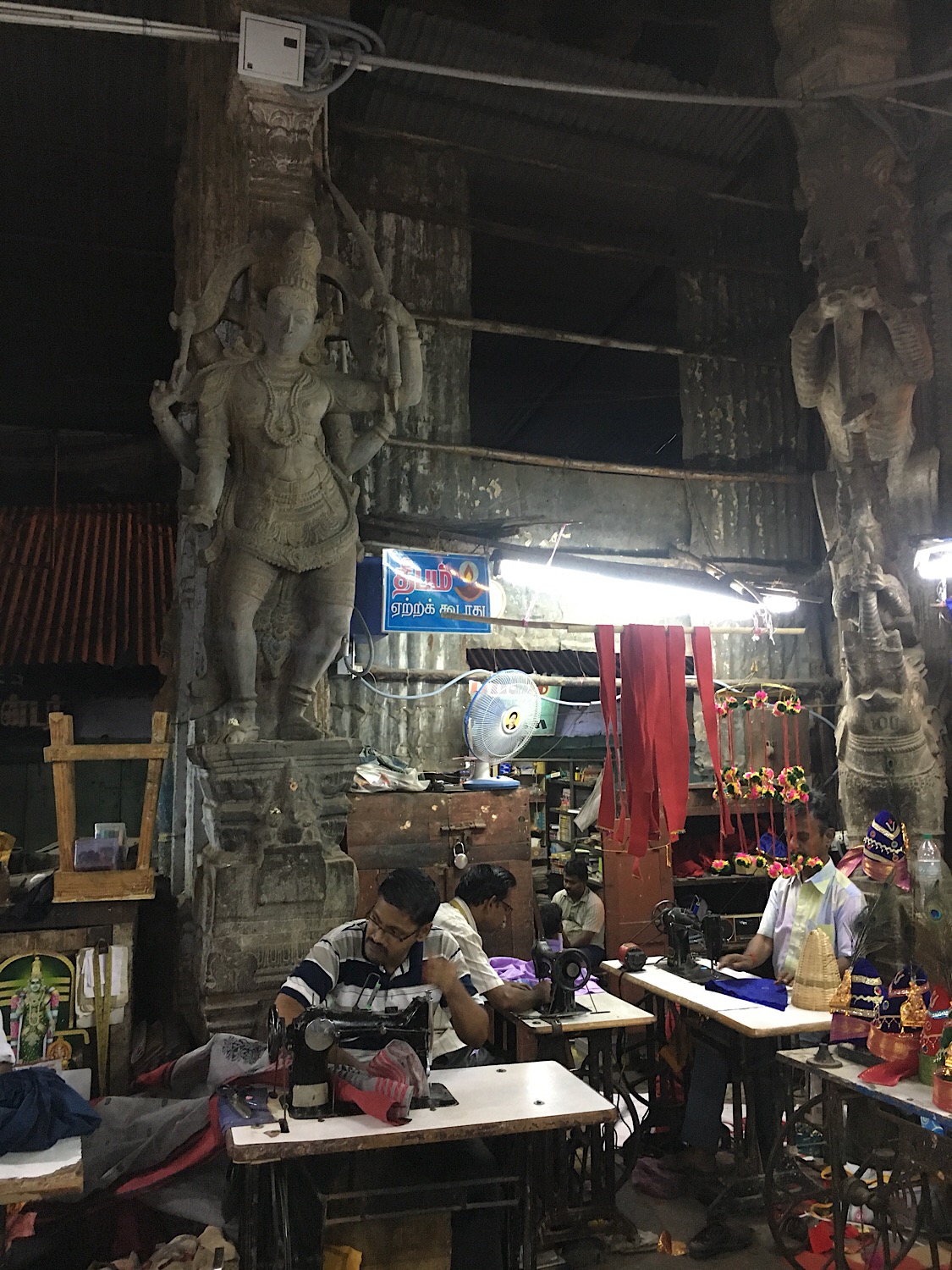
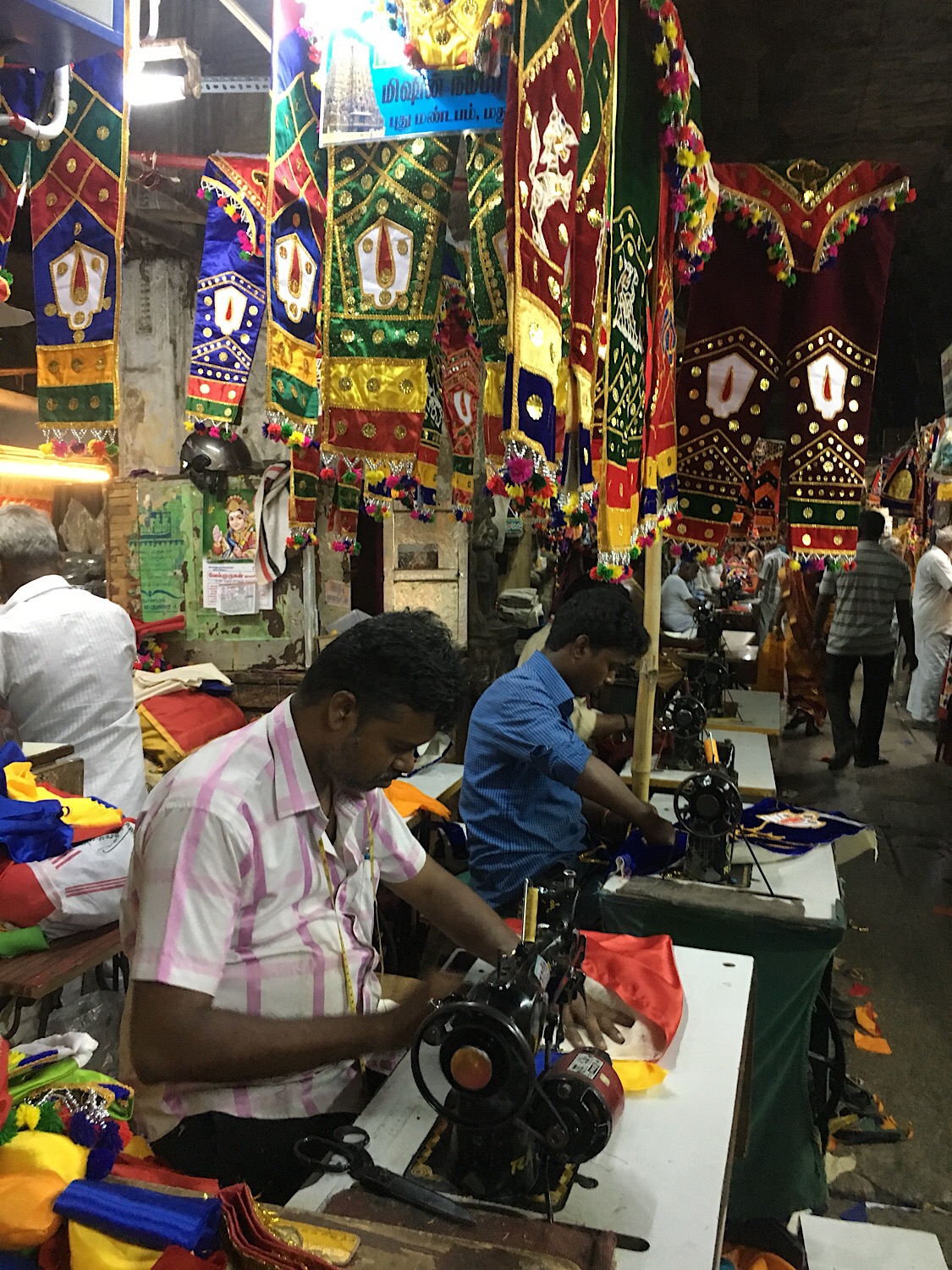
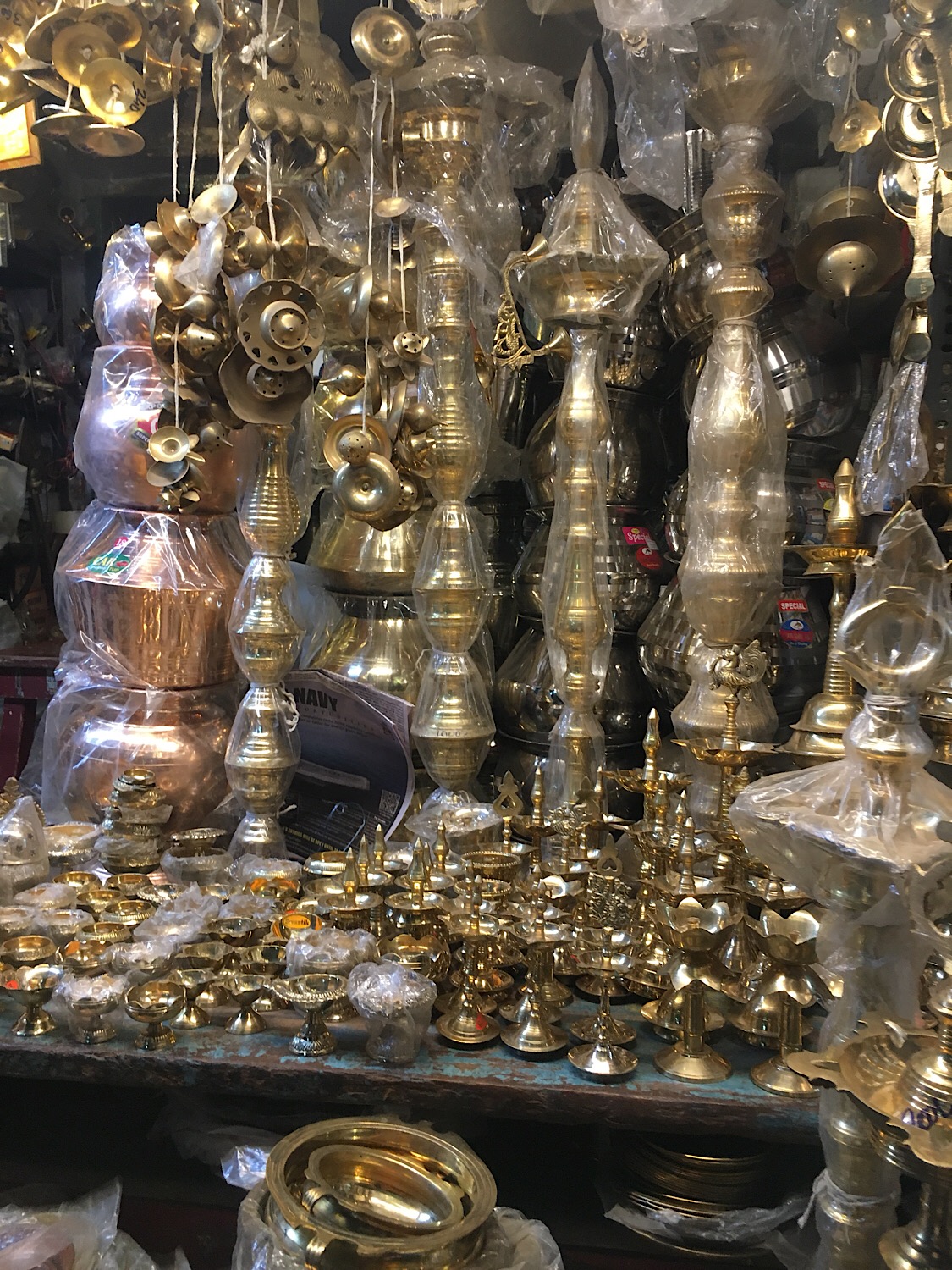
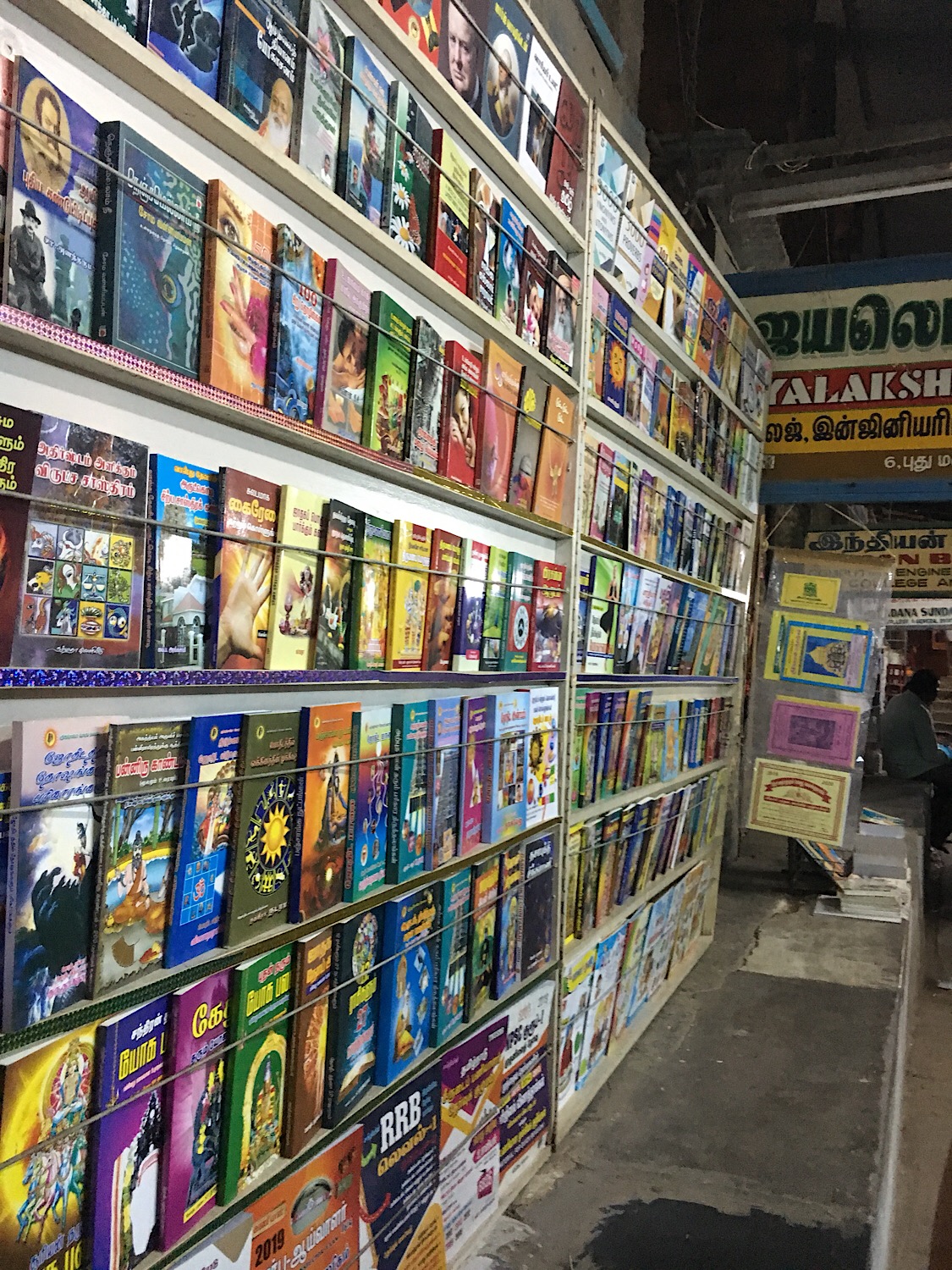
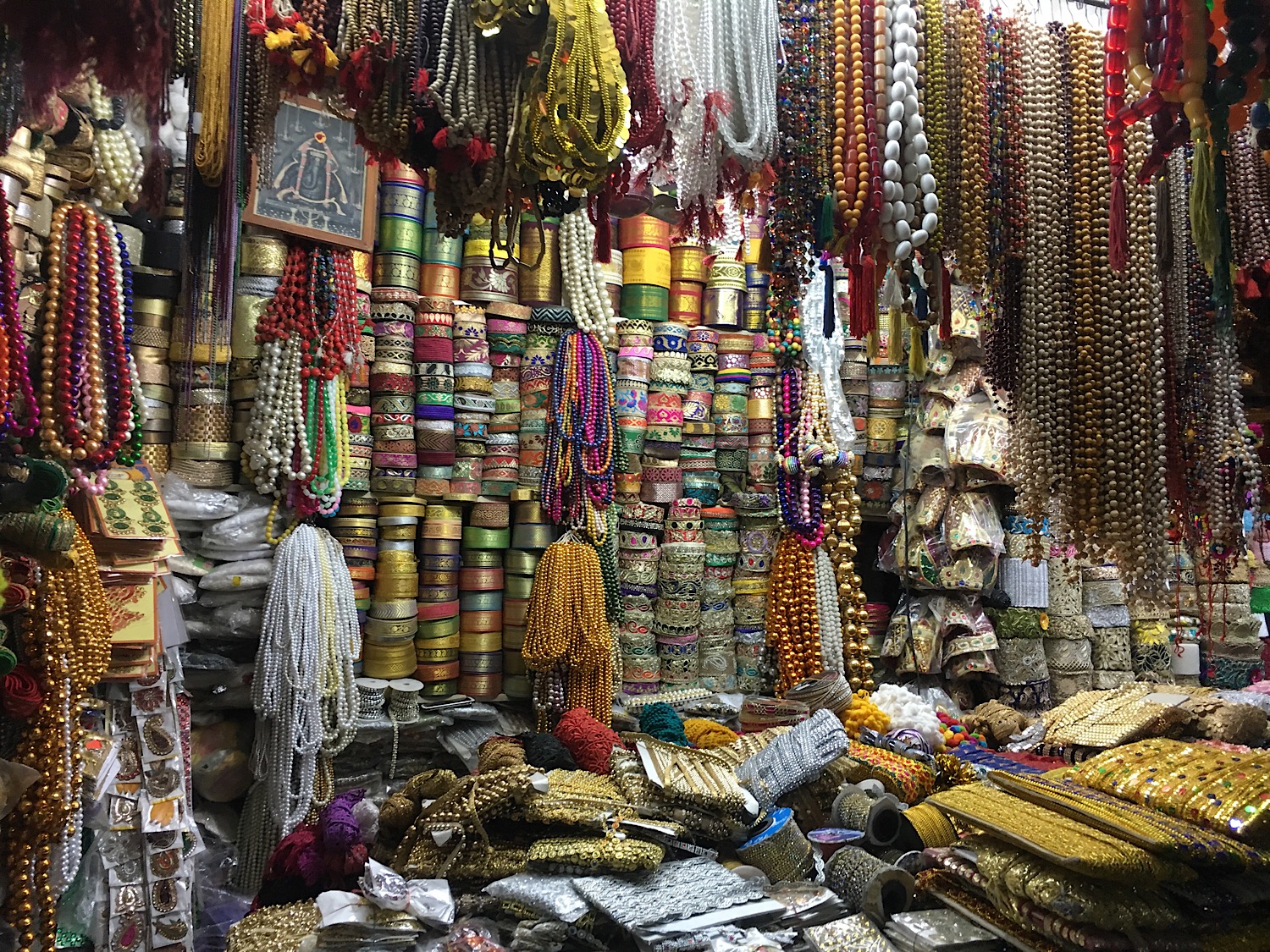
First up in this ancient part of town was the bazaar which was housed in almost certainly the grandest market place building I have ever seen. Divided into four quarters – religious paraphernalia; cookware; tailoring; and books – hundreds of stalls are wedged into a colonnaded, open sided hall. Each column was ornately engraved with gods and demons. It was as if it had once been part of the temple and then given over for use as a marketplace. We had a good mooch. Peahead played off a few of the tailors against each other, prices toppling to a fraction of the first offer, before deciding not to buy anything at all, which pissed them off but was quite pleasing to watch. We then hotfooted it across the road to the temple itself.

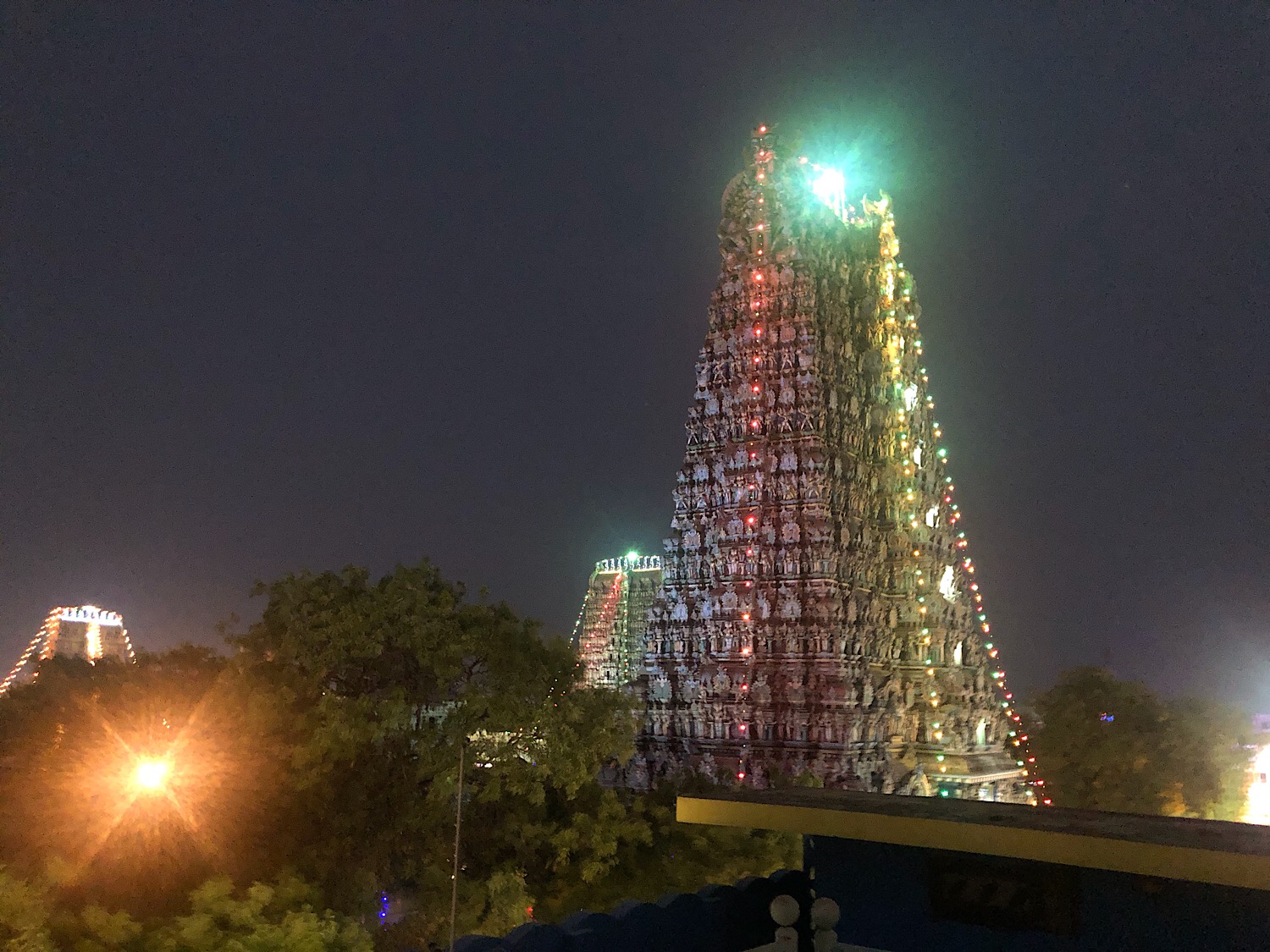
Dominating the Madurai skyline are at least four enormous pyramidal temple towers made up of thousands of painted statues of Hindu deities and demons. The detail is phenomenal and, when freshly painted (once every 12 years), it would be eye-popping. We were there at the end of a 12 year cycle, so it was looking a bit washed out but still a dramatic sight nonetheless. The inside of the temple was also grand, containing an enormous water tank which was very restful to sit beside. Elsewhere, there were extravagant shining gold statues of cows, lions and other animals as well as statues of the gods that are used for processions. To top it all off, the whole place was rigged up with chintzy festoon lights which climbed the height of each tower, flashing different colours. It was odd but lightened up (literally) what might have otherwise been a very solemn atmosphere. After about an hour, it was time for dinner (a delicious Chicken Tikka + beer for me) before hitting the hay.

‘Allo ‘Aloo: A little corner of France in India

Next morning we were up early to catch our first Indian train of our trip. Booking an Indian train online is a process I would not wish on anyone, not even Jacob Rees-Mogg, and if US Military Intelligence are looking for an upgrade on waterboarding for those detainees that are really hard to crack, this might well be just the ticket, if you will. I had strongly considered prematurely ending both the trip and my life due to Indian Railways’ website a few days earlier, but thanks to some help from a man named Raj Yadav, here we were bombing along to our next stop, Pondicherry. We sat in Third Class AC, where we each had a bunk. Despite it being around midday when we boarded, everyone in the carriage seemed intent on trying to out-sleep each other, so our six hour journey was spent mainly in the dark, playing scrabble and eating biscuits. 

Six hours flashed by surprisingly quickly before we alighted at Villupuram Junction and were whisked off to Pondicherry in a white knuckle taxi ride in which we nearly crashed at least three times. It was good to get to bed that night.

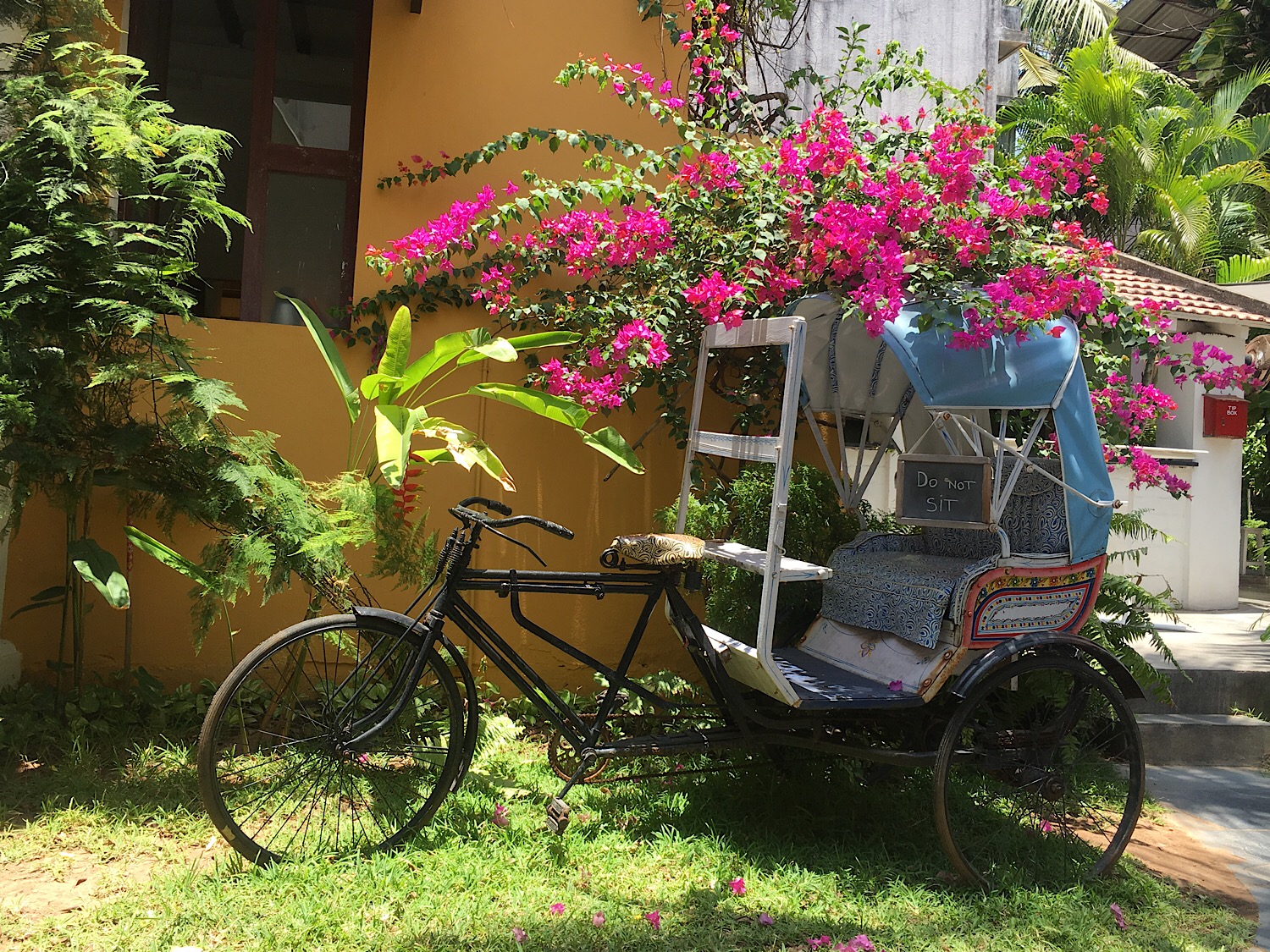
The next morning, we got out into the sun early and down to the French quarter. Pondicherry is located on the south eastern coast of India and was a French colony until 1954. Strolling down the seafront or the plain tree-lined avenues, it felt like we were in Nice. The less-than-exemplary driving on display only added to the sense of familiarity. We just ambled around for the day, having croissants and baguette for breakfast, popping in and out of very trendy, stylish boutiques and discussing whether we should just pack it all in and live somewhere sunny, possibly Barcelona, probably Ibiza. Bougainvillaea spilled everywhere, the sun shone and everything moved a little slower and was frankly very civilised. It made for a nice contrast from the madness of Madurai. A local wished Gaby “bonsoir” and with that, we headed to bed (not with the local).

Day 2 followed a similar pattern in the morning, with a visit to a local craft paper factory run by acolytes of Aurobindo (a sort of cult leader who had a local commune, Auroville, established in his honour). The real highlight was, however, our cooking class, run by the Franco-Indian cultural centre.

Asking a Muslim to buy Prawns 🦐

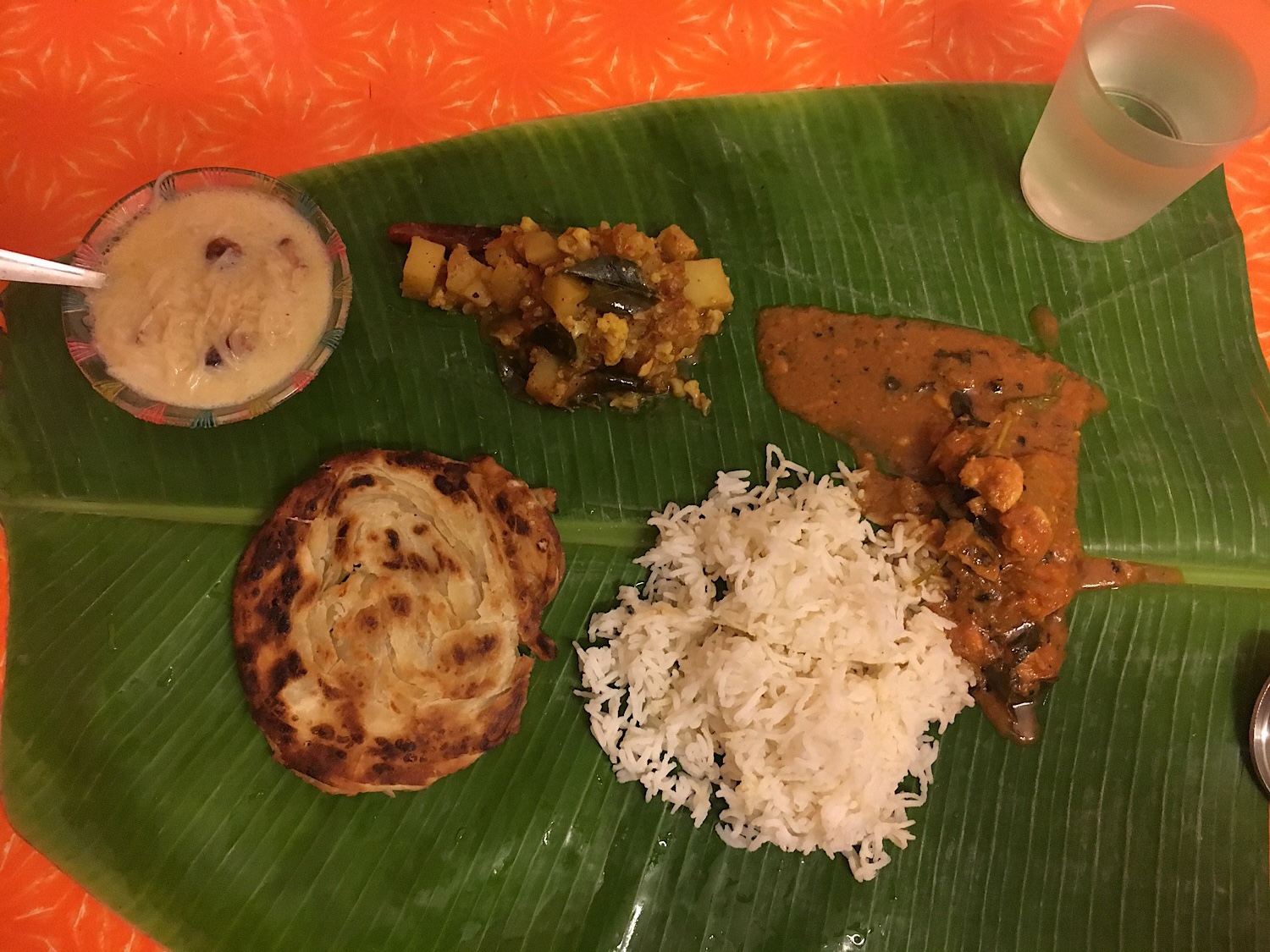
The second instalment in our cooking class series, this Indian edition was the one we were probably most excited about. Run by a lovely local lady, the first task was to choose our menu. Madurai, and especially Paratha bread,  was fresh in our minds. That went straight on the list. Alongside this were added a Chettinad Veg curry a milky sweet pudding then we had to choose what we wanted for the main dish. I pushed for Chicken tikka but was rebuffed. With Gabs not eating meat, it became a straight choice between fish and prawns – both great options since we were on the coast. There was only ever going to be one winner there: who doesn’t love a prawn ruby?!

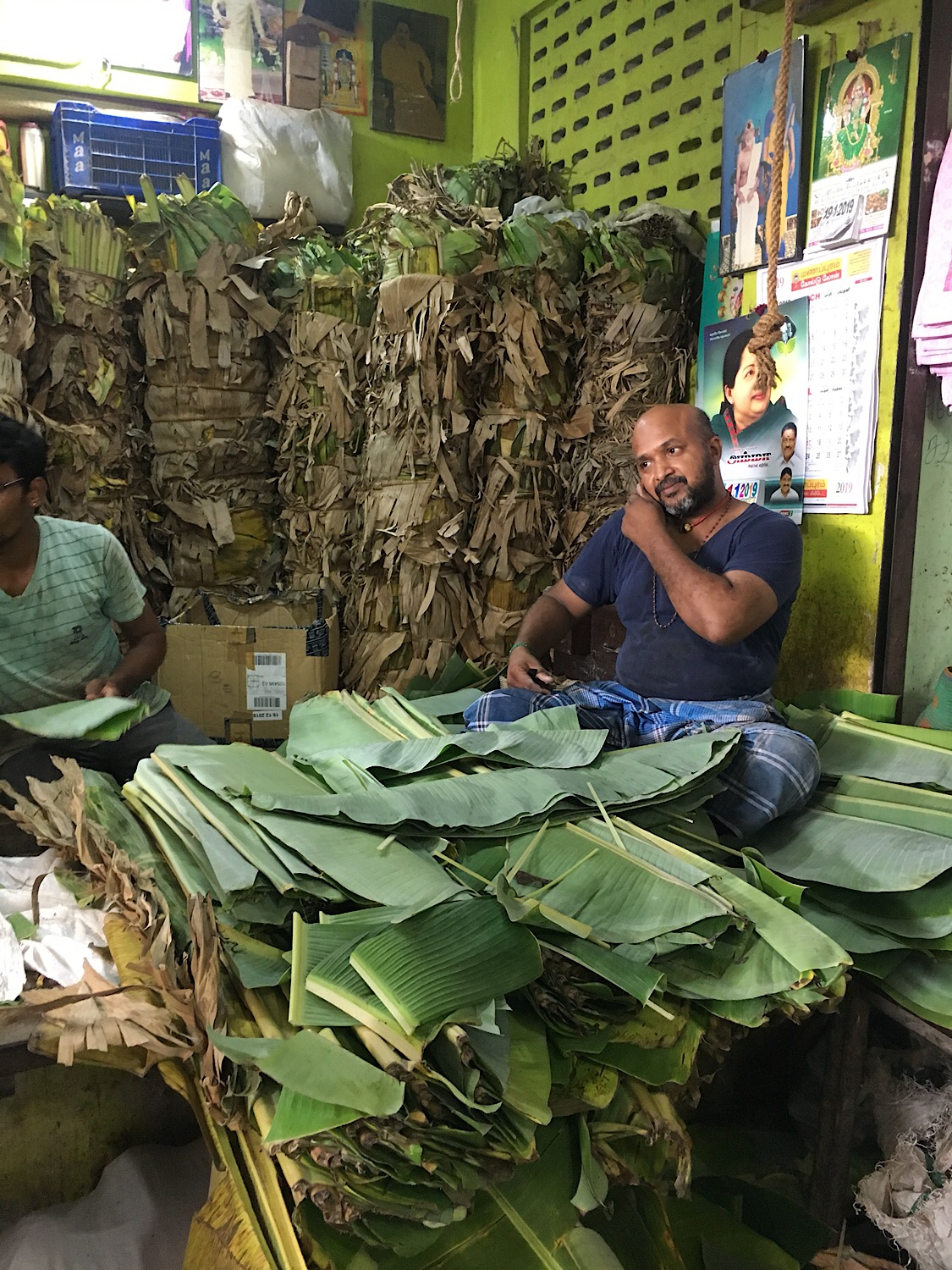
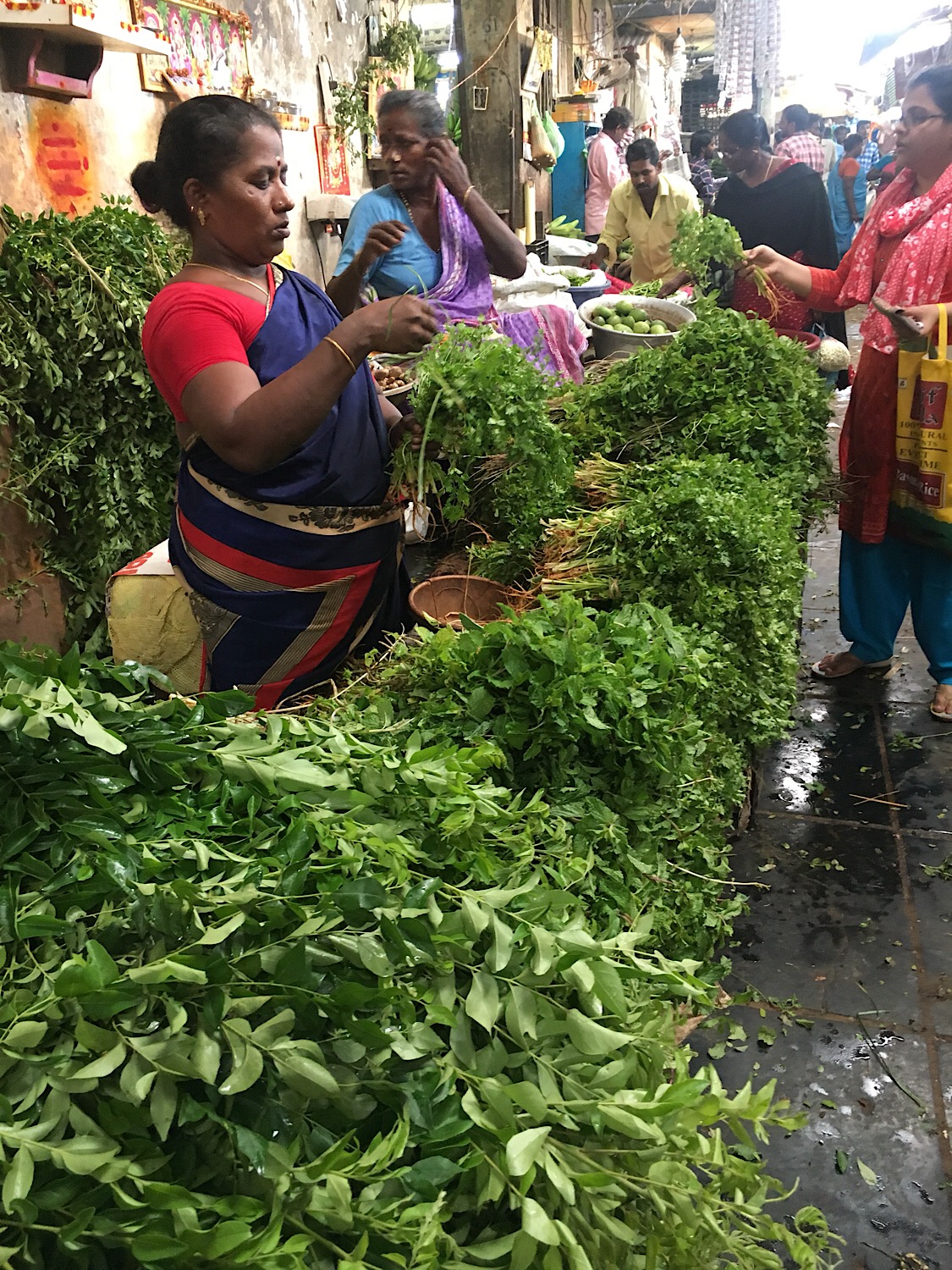
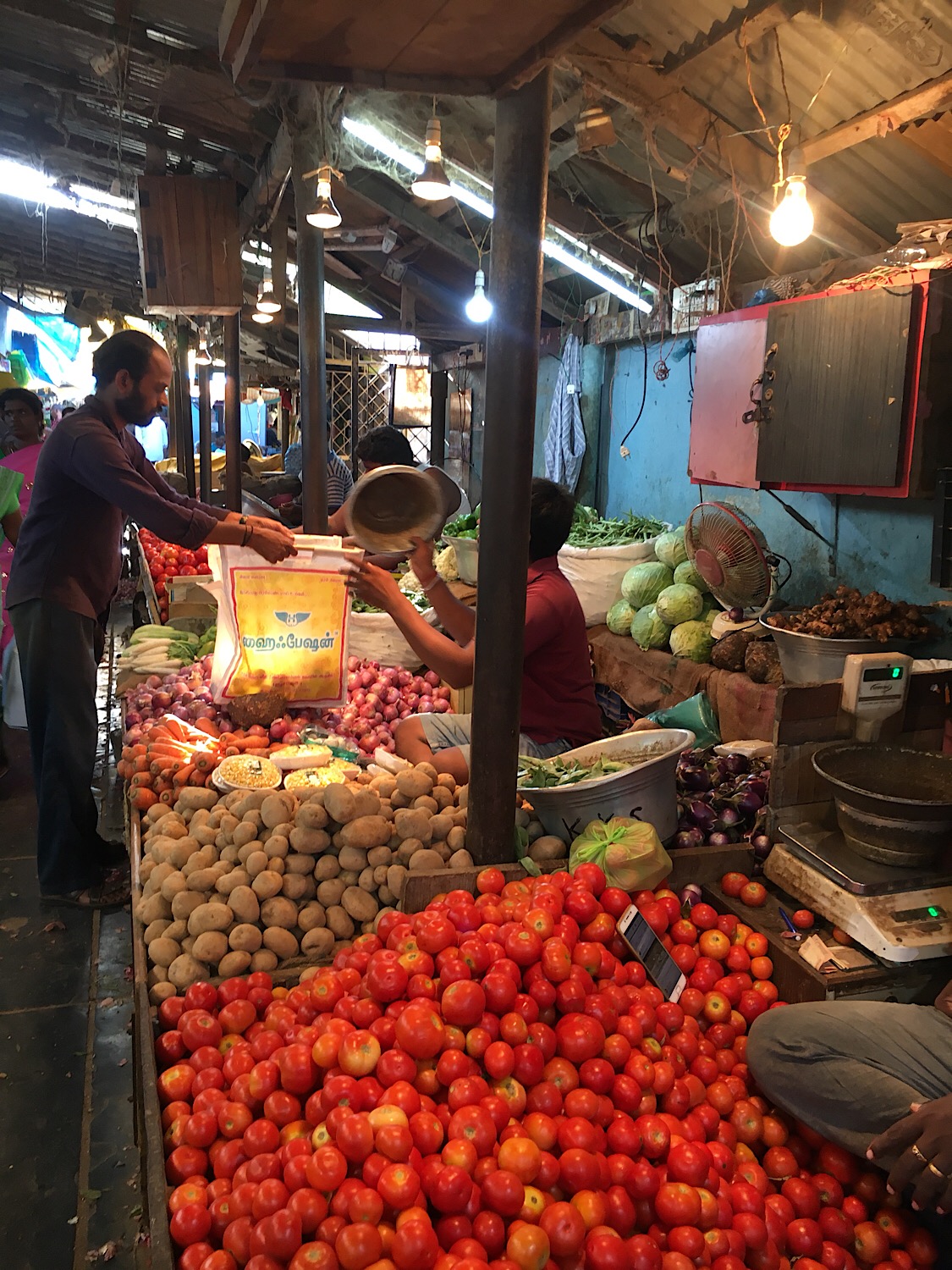
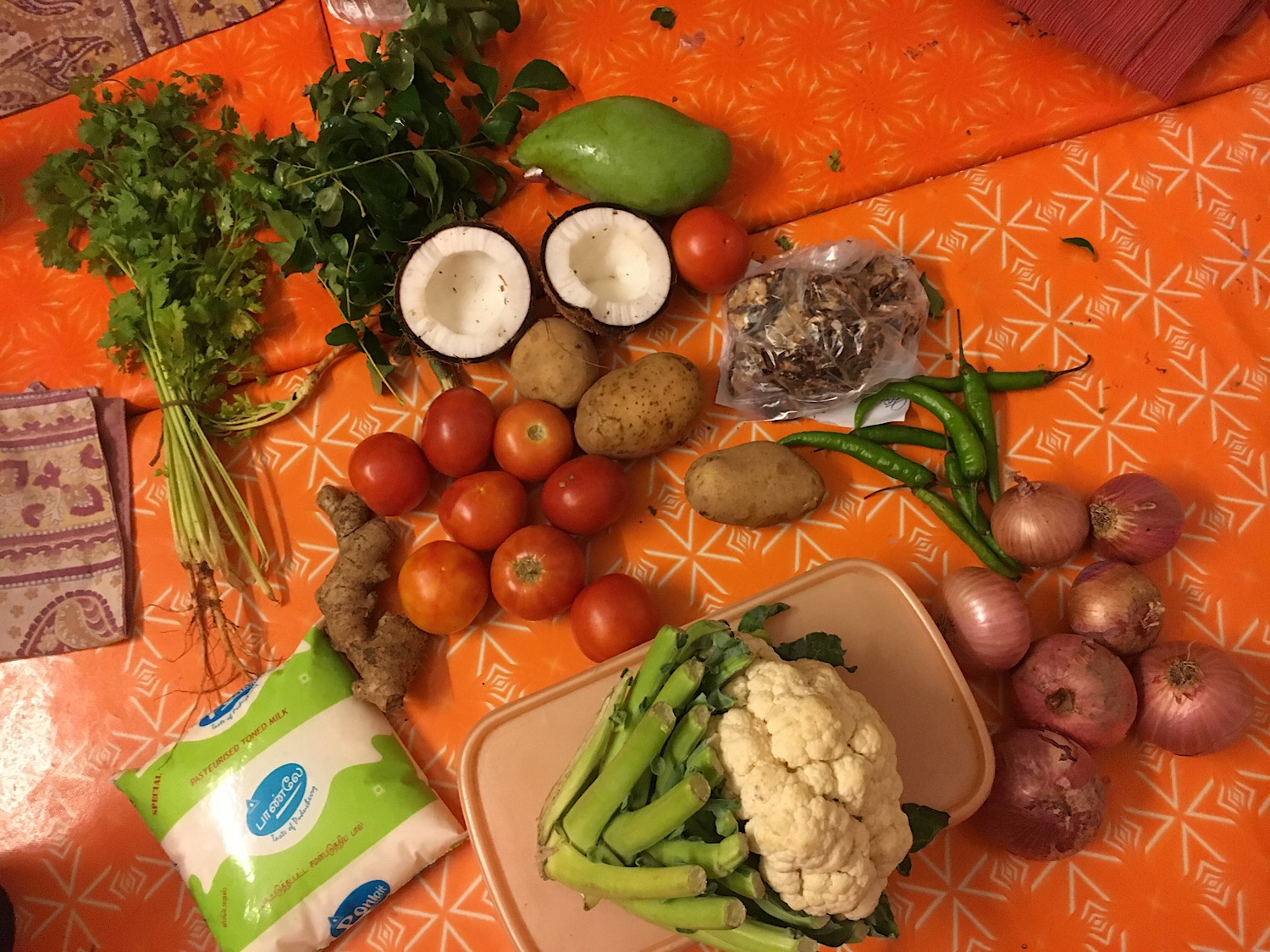
Shopping list complete, off we trotted to the market which was mad, brilliant, chaotic, smelly, overwhelming and everything you’d expect. Divided into sections for the different foodstuffs (meat, spices etc), we made straight for the fruit and veg quarter where we were greeted with an over-abundance of everything. Lots of produce we recognised and plenty more we didn’t. The stalls were often arranged into sub-sections, for example four or five tomato salesmen were placed in a line, each with a local lad sat in a mound of fruit watching YouTube. One guy was really digging some WWE. From their somewhat casual style, it seemed more likely they were engaged in a price fixing cartel rather than cut-throat competition with each other. No one seemed bothered though, and we grabbed some toms, coconut, un ripe mango, cauliflower, spuds, fresh chillis, coriander leaves, onions, fresh tamarind and banana leaves to eat off. 

Next we shot off to the fish quarter. Housed in a sizeable, high-ceilinged hall, it was eerily quiet and empty that afternoon, the morning market being the peak time. It was also crawling with cats on the lookout for a morsel or two. Sat around were a few old battle-axes pushing their last bit of stock of the day. These ladies did not seem to have reached the same sort of gentlemen’s agreement that their tomato-peddling compadres had and were shouting over each other in an attempt to win our business. Ideal conditions, you might think, for picking up some fresh juicy prawns at a very nice price. Not so much. In front of each of these bickering barterers was a small mound of scrawny, stinking prawns above which swirled a tornado of small flies who were absolutely loving it. Something of a “Hobson’s Choice” with little to differentiate the slimy mounds. One key difference we noticed, though, was that one of the mounds of prawns lay in a shaft of southern Indian sunlight and had turned pink, having slowly cooked during the day. All other things being equal, surely go for the fresher prawns that hadn’t been slowly warmed in the sun? 

Not so. Our lovely guide plumped for the pinker, warmer and presumably cheaper option. Peahead and I were dismayed. Food poisoning can be very serious, especially in a country without sit-down loos and bog roll. Surely we had to speak up?! Utterly bemused and utterly English, we gagged, smiled and said, “Looks great!” as we trotted out of the market back to the cooking school for our very own Last Supper.

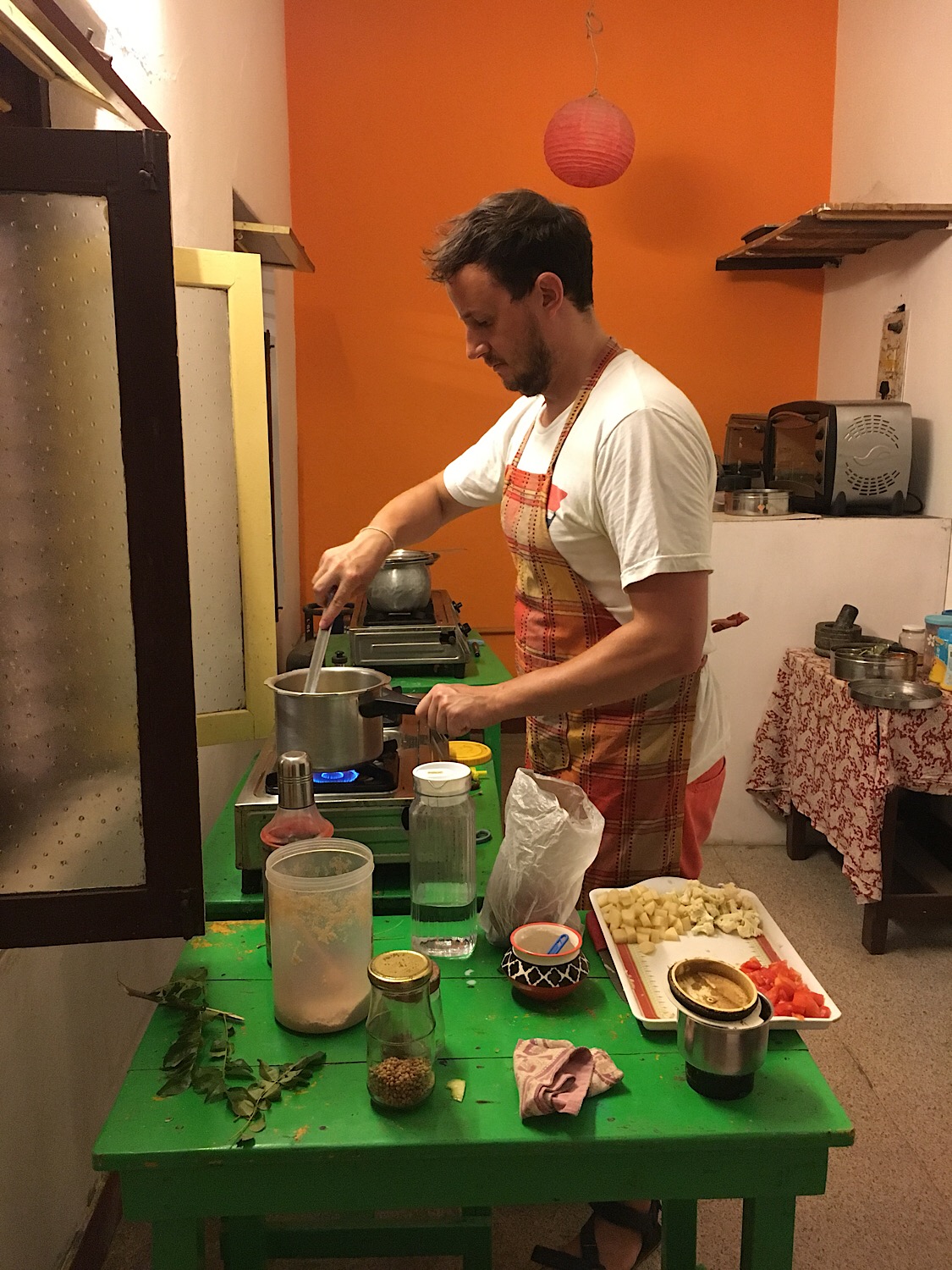
Back at the ranch, we set about chopping and dicing the veg. Mercifully, the prawns had been handed to the housekeeper to take care of. We focused on getting everything ready – it helped to keep our minds off the impending dysentery. The gas hob roared as we fired it up and chucked the ingredients into the pot. First up was the veg curry – a quick dry fry of the usual spices, then in went the cauliflower, potatoes, tomatoes and onions all into a pressure cooker. Quite a useful bit of kit that turned out super flavoursome, fully cooked curry in a fraction of the time it would normally take. You judge when it’s cooked by the number of whistles (or vizzes in Indian English). Next up was “Crustacean Roulette”   –  spicy, sour prawn curry, made using a blitzed up mix of tomatoes, shallot, garlic, ginger and fresh coconut to which you add chilli, fresh tamarind and unripe mango for added zing (perhaps her choice of prawns was also made on this basis). The prawns reappeared having been washed and peeled by ‘the housekeeper’, whom we never met. There were considerably fewer prawns than we’d started out with as apparently the HK had discarded ‘the bad ones’. We were unsure whether to feel reassured by this and were surprised there were any prawns left, but, in for a penny, in for a pound, we tried to put our fears out of our mind and chucked them into the pot.

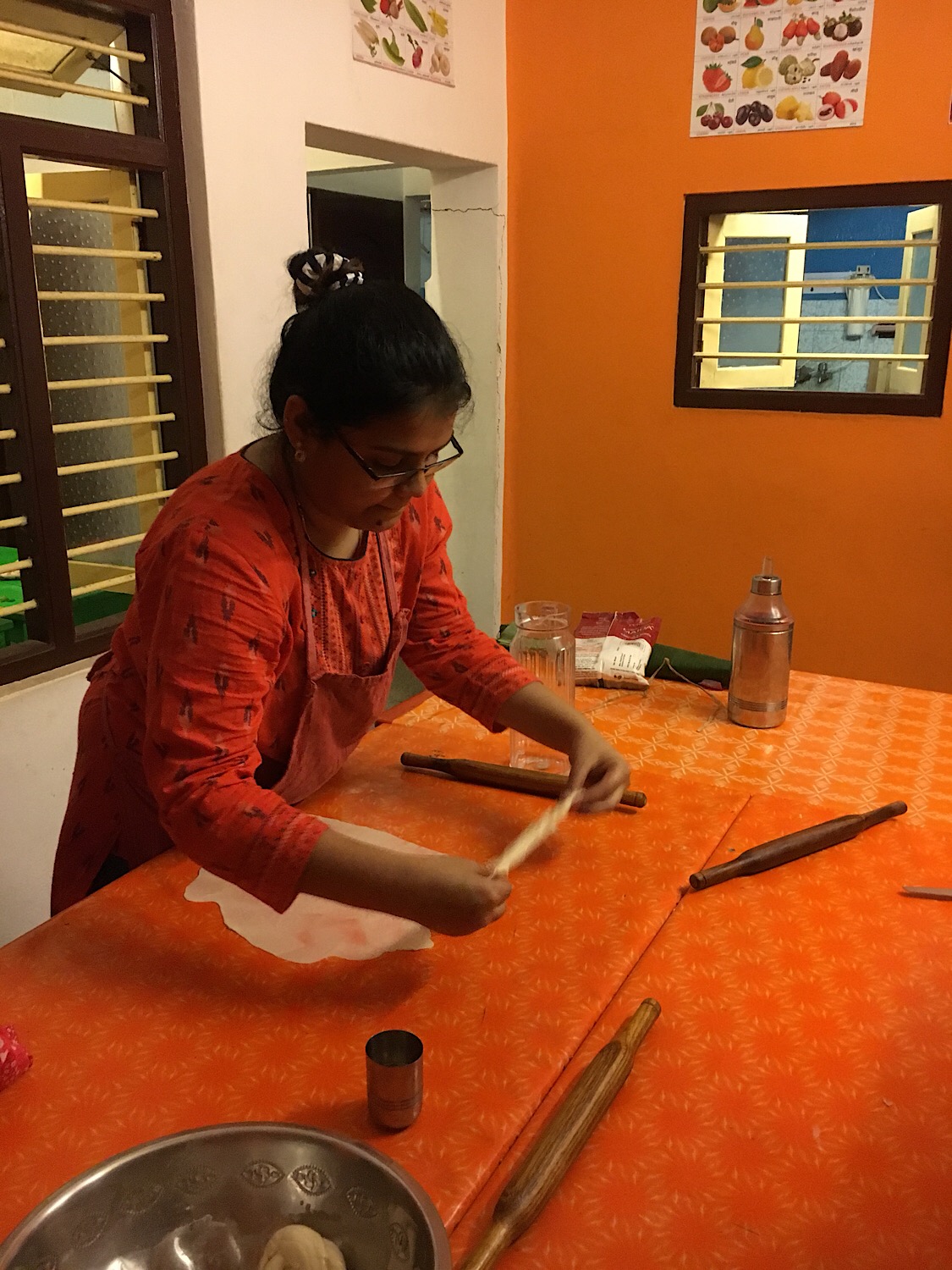
Then for the main event: home made paratha. One of the few disappointing things about making curry at home is the bread: making decent naan is tricky without your own tandoor, while  shop-bought stuff is usually too dense and lacks the freshness that is so crucial to these types of bread. More concerning, Peahead had been sleep talking about paratha ever since Madurai (at least I think that’s what she’d been saying), so wouldn’t it be just great if someone could teach us how to make delicious, fresh, crispy, light, buttery, multi-layered, moreish, delicious, fluffy, authentic delicious Indian paratha bread using just a frying pan, some plain flour and water? Luckily for us, our prawn procurer-extraordinaire had this particular trick up her sari. Making a basic flour and water dough (egg is only needed if making a large batch), we rolled out a ping-pong ball-sized bit of dough until it was almost paper thin. I was terrible at this and was mocked by our teacher (I decided not to raise her stellar performance at the fish market). We then folded the sheet of dough multiple times in a concertina from one end, before shaping it into a disc. This was then put into a hot frying pan with some oil for a couple of minutes until it crisped on one side, before flipping and repeating. 

Her technique was considerably better than ours!

Soon enough it was time to eat. We sat down in a heady mix of hunger, anticipation and trepidation. I’ve often considered curry as a contender for my “death row meal” and so I resolved to enjoy it, come what may. It was all delicious, with the prawns in particular standing out – fiery, zingy, sour but balanced and fresh. The Chettinad veg curry also delivered on its regal backstory – hearty and beautifully spiced. Prawns aside, the ingredients were the real stars here. The freshness really makes it. Alongside all this, we tucked into the Paratha/Parotta. This was simply lush and was all of the adjectives written above. Definitely one we will be bringing back home.

As we ate, we got to know more about our teacher and her life, her family and their recent trip to Thailand to go to IKEA (apparently the Hyderabad branch is “too full of Indians”). She also, sensibly but worryingly, was not tucking into the prawns, which suddenly all made sense (along with the rest of the ordeal) when she told us she was Muslim! She had never bought prawns before and really had no idea what to look for when buying them. We felt a bit bad for putting prawns onto the menu and putting her through this, and we hoped that these bad feelings would stay strictly emotional without developing into anything gastric. We headed off satisfied, full and having learned something golden with the bread. And there was no sting in the tail – the housekeeper had done a top job and we had no problems from the prawns at all. I believe the technical term for this scenario is: “a result”.

The Gorgeous, Americidal Andaman & Nicobar Islands🏝🐠🐊🇺🇸⚰️

This was especially welcome as we had a big day of travel ahead: we were off to the Andaman & Nicobar islands for our next adventure. 

The A&N islands are an archipelago of a few hundred islands way out in Bay of Bengal, much closer to Myanmar than they are to India, with paradisiacal white sand beaches and electric blue waters. We had originally wanted to visit when previously in India in 2016 but it was too far to get to, so we were really excited about this trip.

The islands also have an interesting history. During the glory days of the British Empire (no doubt soon to return), the Brits used the islands as a penal colony for Indian political dissidents and criminals. When independence came, the islands therefore reverted to India despite being nowhere near the mainland. For Indians, the islands represent the struggle for independence and so hold special significance, with moves underway to rename some of the islands to reflect the fight for freedom, rather than their somewhat dull current British names (one of them is simply called, ‘John Lawrence’,  who sounds like he might have been the landlord at the favourite local of whoever was in charge of the islands back in the 1800s). 

A number of the islands are also inhabited by indigenous tribes who date back to ancient times. Some are of Negrito heritage, linked to tribes in Africa many thousands of miles away. They still live a very basic, traditional existence and are not particularly receptive to outside contact. For this reason, tourists are not allowed to visit the islands and areas they inhabit, scattered across both the Andaman Islands in the North and the pleasingly-named Nicobars in the South. Recently the tribes were in the news when an American missionary, hellbent on converting these people to Christianity, was shot dead with a bow and arrow by a group who had had enough. He had been bribing local fishermen to take him to the islands and had been warned a number of times to stay away. He met with a suitably biblical end but he probably died believing he was a martyr so maybe like all successful negotiations, everyone came away thinking they’d won! Despite Gaby‘s strong sense of religious duty, we were staying away from that particular hornet’s nest and would be visiting Havelock Island and Neil Island (named after the governor’s plumber) for a week each.

Our journey began with a seamless 3 hr taxi from Pondicherry to Chennai, with the only wrinkle being our hostel-owner’s overweight son, who was hitching a free ride, trying to divert the car to his granny’s house in the middle of city as a priority ahead of us getting to the airport which was on our way into town. His pleas were thankfully ignored but I’m sure he got over it when granny presumably gave him a plate load of biscuits and Indian sweets. This was followed by a 2 hour flight to the capital Port Blair, where we had to stay for a night as they bizarrely don’t run any ferries to the other islands after around 4pm, despite a number of major flights arriving around then. Port Blair was listless and drab so I’m not going to waste any time writing about it.

Next morning we headed straight for Havelock, which is one of the larger and more popular islands. We checked in at a tiny seven-bed hotel near to the beach and immediately got down to the water’s edge. It was beautiful, pristine yet rugged (much like yours truly), with no development at all on the beach and hardly anyone around. The water was about knee deep for at least a hundred metres out, giving off an brilliant light and it really felt and looked every bit like we were on a remote desert island. The only downside to this was that the water was quite literally as warm as a bath, which would be great if you were on a surfing weekend in Croyd in November, camping next to your car in a lay-by, but perhaps didn’t provide the refreshing respite we needed at that point under a searingly hot sun. Despite this extremely unfortunate inconvenience, we managed to get over it.

Over the coming days, we hired mopeds so that we could explore the island’s other beaches and settled into a fairly standard beach life rhythm, getting up earlyish to get to a beach, flop down for the day, splash around a little and then come home. Each of the seven beaches on Havelock were beautiful, each in their own way, and all of them were very natural and untouched, with no bars, restaurants or other development nearby.

The only variable to really weigh up was the size of the crowds (to the extent that these existed at all). This really was not an issue at all: despite seeing many (predominantly Indian) tourists when driving around and a number of large hotels, there was hardly anyone on the beaches. The Indian tourists seemed to have no interest in swimming in the perfect, turquoise sea or lying on the luxuriously soft, white sand in the dappled shade of a verdant tropical forest under a nourishing, warm sun. Clearly we must be mad. They did like to briefly pitch up in jeans, shoes and polo shirts for some Insta shots but they would soon vanish never to be seen again. Whatever floats your boat.

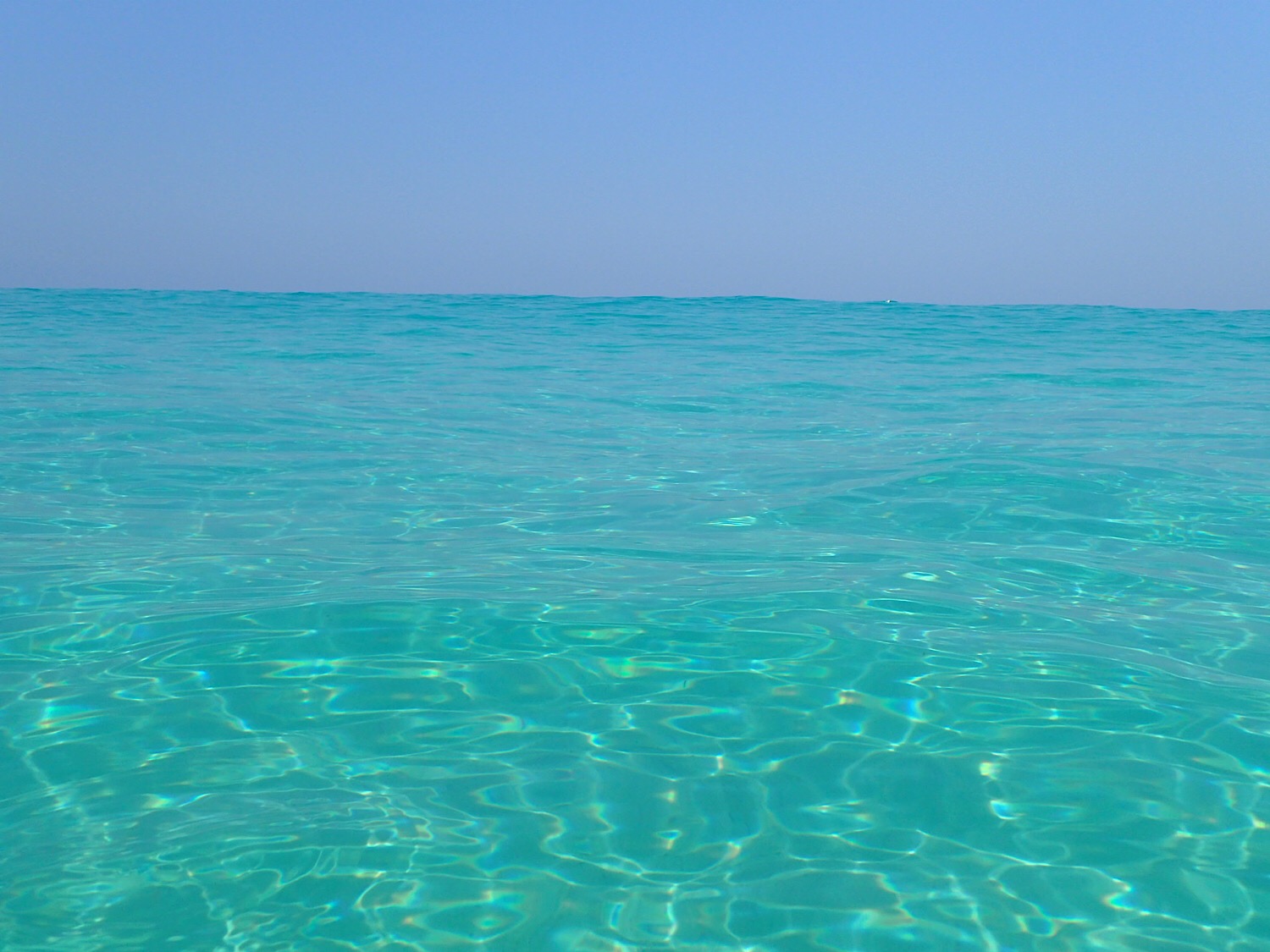
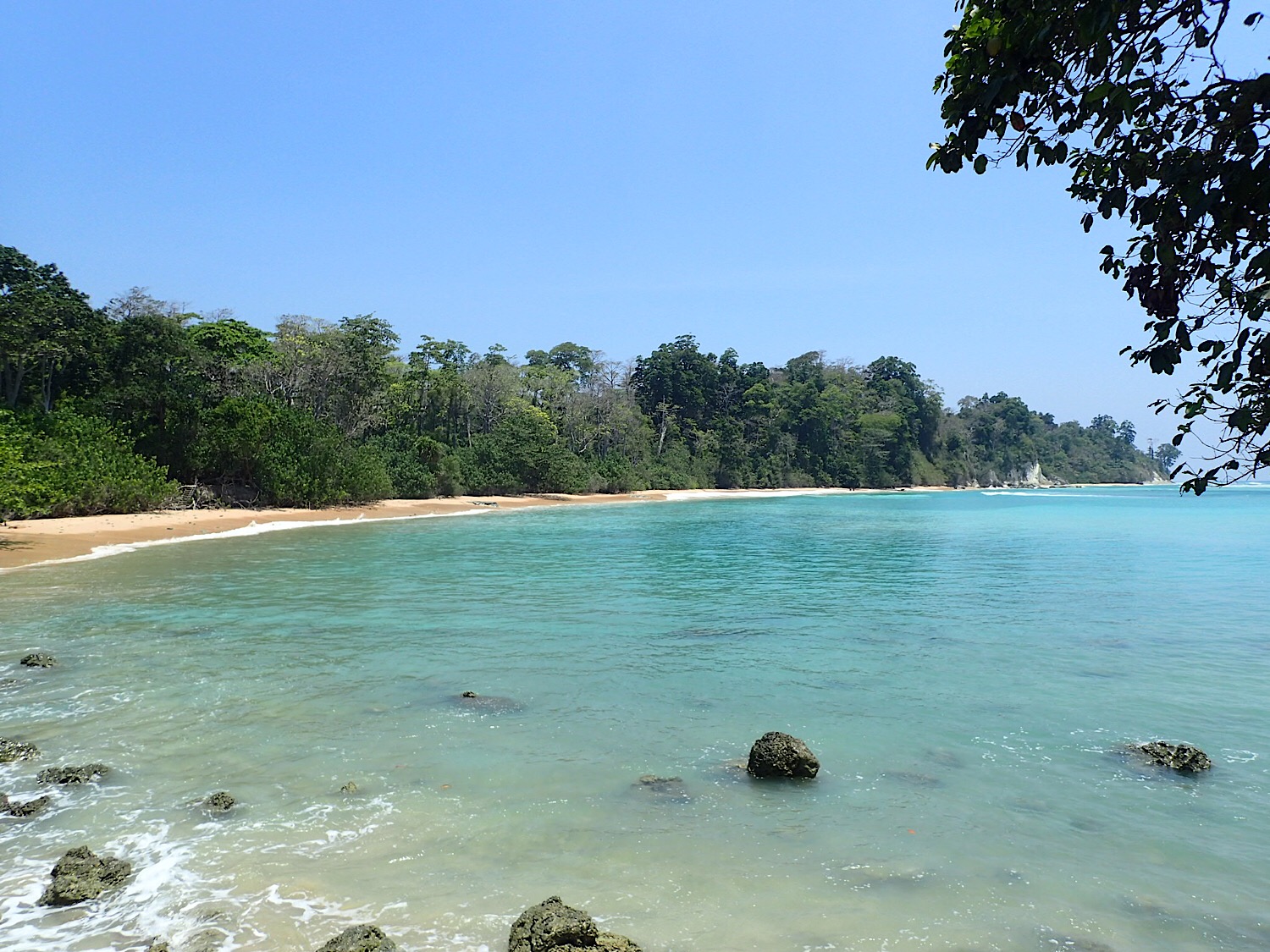
There was one beach that stood above the rest however: the romantically-named Beach No. 7 (all of the beaches are numbered, adding a slight Marxist flavour to the mix). This is arguably the most well-known beach in the entire of Andaman –  partly due to a recently deceased ocean-going elephant named Rajan – and it does not disappoint (apart from the lack of a resident ocean-going elephant). A large swoop of white sand sat within a national park, it was somehow even more untouched and “natural” than anywhere else we’d seen. It also had much deeper water than Beach 5 (next to where we were staying), which was lush, cool and crystalline. Even beyond standing depth, it was completely clear allowing you to look straight down at the white sand seabed. It was sapphire blue and coupled with the completely transparent water, it sometimes felt like you floating in a giant bath that had had blue food colouring added to it. It was hard to believe your eyes and to believe it was all natural. 

Except it obviously really was natural and in fact that “natural-ness” was probably the thing that made this place just so special. There are a number of places in the world where you can sit on a white beach in front of impossibly bright blue water, but many of those are manicured to within an inch of their lives. I have not been to the Maldives and I’m sure I would have a swell time there (no pun intended), but I have a sense I might find it a little bit fake. At Beach 7, however, it comes as it is. None of the sand is raked, there are many fallen leaves on the sand from the neighbouring tropical forest, there are no sun loungers nor anywhere to get a delicious cold beer. But it is because of all this that it feels so special and real. The raw visual ingredients are all here – white sand, blue waters, lush green forest and, crucially, somehow no plastic at all – but nothing has been done to it and as a result you are left with the feeling you have found an incredibly rare, unspoilt corner of the earth, like you’ve discovered a precious secret and it feels very good and smug to be there. 

Consequently, we spent a good couple of days there. The Indians liked to stand in a largeish group around the entrance to the beach but then leave the rest of the kilometre long crescent to us pale-skinned Goras. We just read, bobbed around, slept and had ridiculous conversations about what we would the menu would be on our ideal restaurant food and drinks experience with mates. It was sublime.

In search of greater beauty and greater adventure, one day we headed down the beach to a much-vaunted spot with an equally idyllic name: Neil’s Cove. Trudging for about 25 minutes through the perfect but inconvenient-for-trudging white sand, we passed a sign: no swimming under any circumstances. Salt water crocodiles in the water. 

Turning the corner, dripping with sweat, the cove was undeniably beautiful. Shimmering blue-green water filling a steep crescent of white sand backed with thick, bushy jungle. The water was in effect a large rock pool, with hundreds of tiny, craggy rocky peaks and ridges just nudging above the surface. It was also an undeniably risky place to take a dip. This was a place where, a few years before, an unsuspecting tourist had been serenely paddling around, congratulating himself on discovering this little corner of paradise, maybe whooping and hollering, perhaps high-fiving and shouting “YEAH BABY!”, before being unceremoniously devoured by one of the local sea-faring crocs. He was (the tourist, not the croc), if you hadn’t already guessed, American, just like our missionary friend mentioned above. 

The sign we had passed was a sort of a legacy from this unfortunate episode and, perhaps unsurprisingly, we didn’t meet any other of our friends from across the pond during the rest of our visit. Anyway, we had our own skin to watch out for, and the demise of the americorn plus the sign plus the plethora of very crocodilic (?) rocky noggins poking above the water was plenty enough for me to shit my pants and absolutely refuse to enter the water. Peahead, on the other hand, was already stripped off and ready to dive headlong into the tempting, dangerous waters. I informed her of my assessment and she laughed. After all, she is much harder than me, having done a brief stint as a pro crocodile wrestler during her summer in Tobago while at uni. There was a bit of debate and she rinsed me out more than once, but, interestingly, ultimately didn’t put her money where her mouth was. Big chat, not so big game. We trudged back towards the Indians and safer waters, whereupon we both threw ourselves into the lushest, coolest plunge. Much lusher than what old Neil could have offered. My plan all along, executed to a tee. 

Neil’s (🐊) Cove

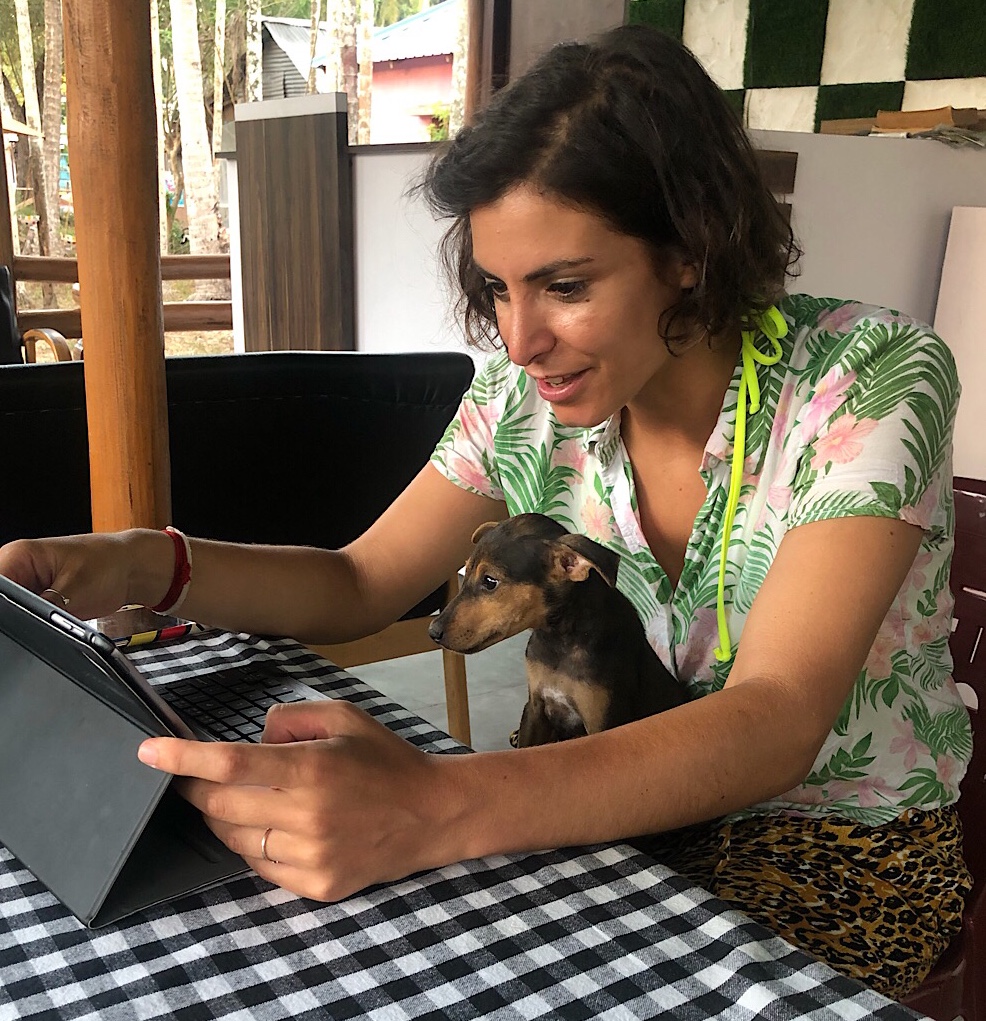
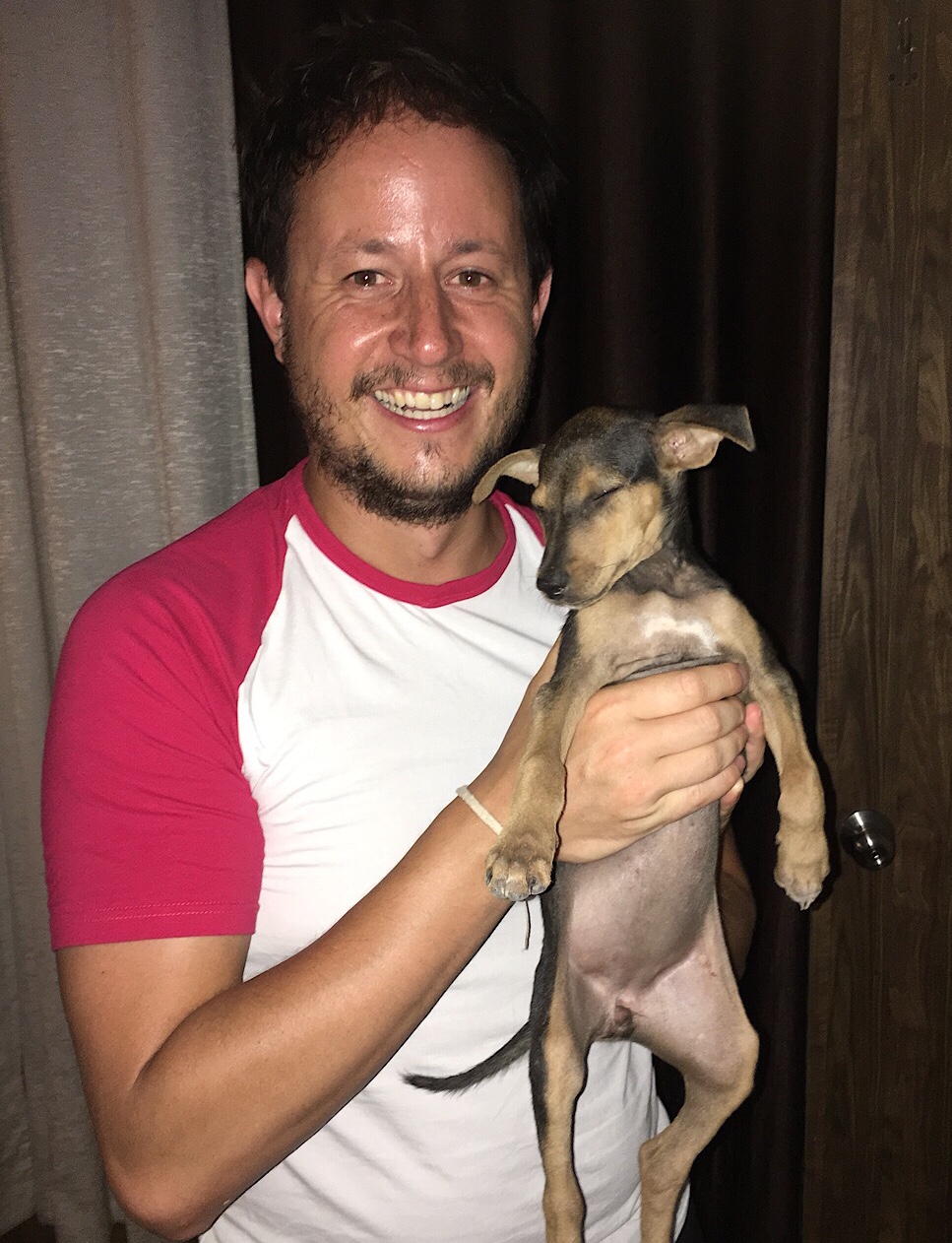
In the evenings, we’d normally enjoy a beer back at our gaff before heading out for food. This would normally include some time with a new canine friend. Early on, we had discovered a tiny puppy roaming around in the grass outside our room, no more than two months old. Peahead and I were instantly putty in its paws. It wasn’t clear who, if anyone, it belonged to so we assumed ownership and named it “Puplito” before quickly realising she was a little bitch, at which point she was renamed “Puplita”. She was adept at extracting food from Gaby, especially at breakfast where she would eat toast but only if buttered and served with egg. We were all getting along famously until one morning, Puplita vanished completely, never to be seen again. Conspiracies have abounded ever since, including that she was devoured by a saltwater croc, but we’ll never know. Maybe one day we will be reunited. The only lasting mark is from where she nibbled Gabs. We are waiting to see if she develops rabies, which kills around 25,000 people annually in India, so that’s keeping us on our toes. 

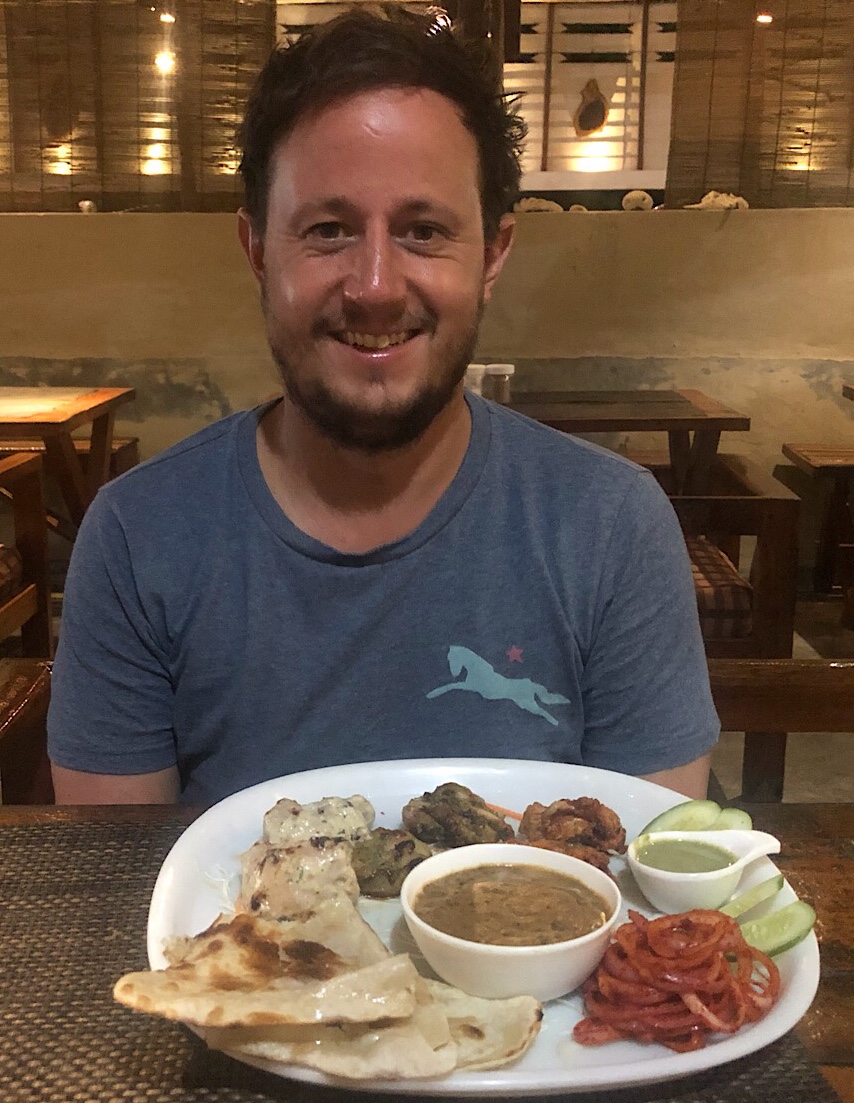
The local restaurants were surprisingly excellent and so we would reward ourselves for our hard day’s work with tasty food but sadly no beer – the island had run dry, apparently something to do with the Indian elections. But the food was lush and the real standout was Anju’s Coco Resto which served an amazing Tikka three ways: Malai (creamy, herby marinade), achari (hot and sour like lime pickle) and normal (normal). You could have it as fish or chicken (fish possibly shaded it) and it came with the essential fresh lemon, raw red onion and a slaw. We had paratha to cap it off. Utter lushness. 

Tikka three ways

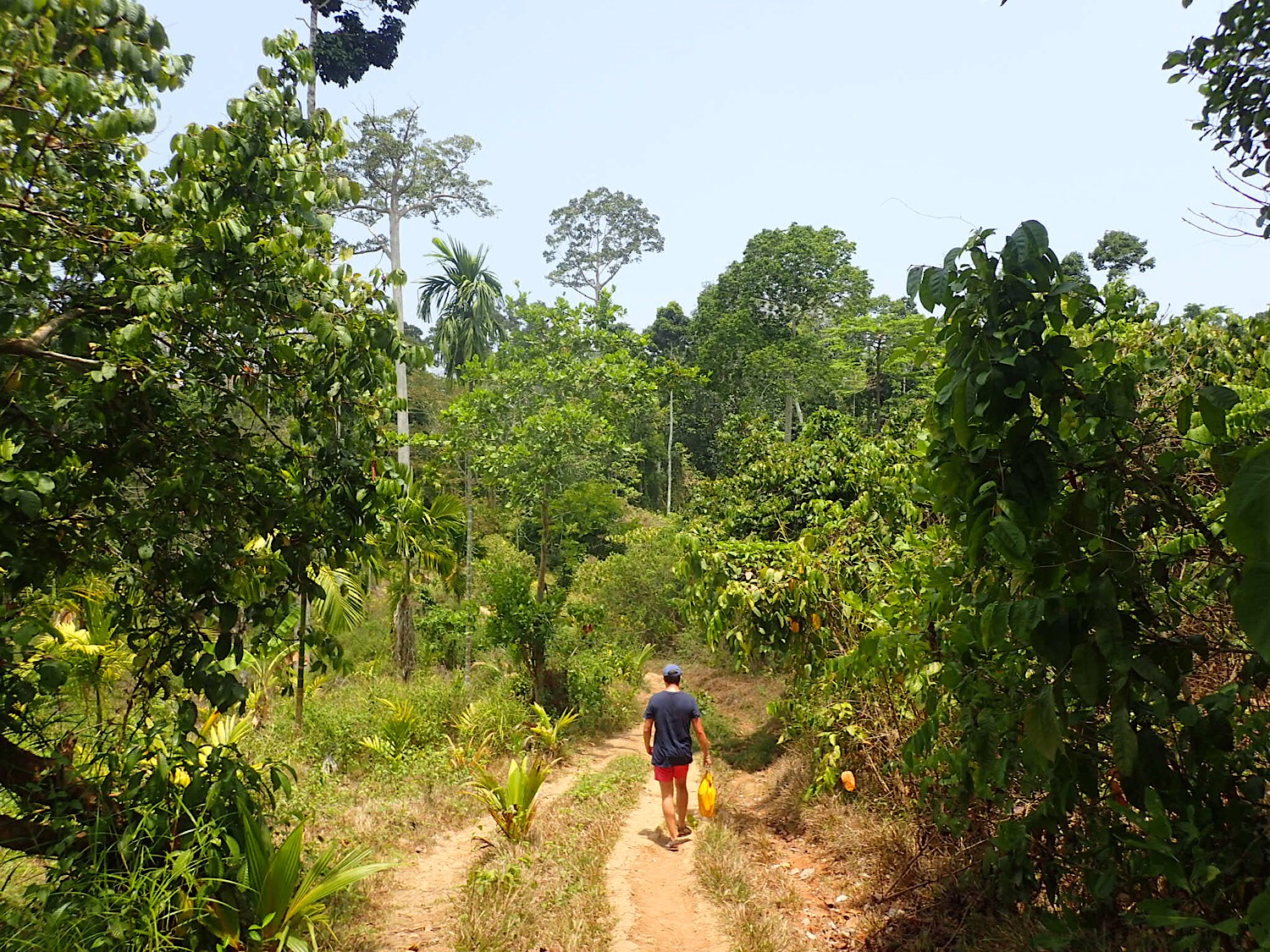
Days came and went, and after a bit we started to get a little bored as there are only 7 beaches, of which one was really stand-out, with the others being pretty but not really swimmable. So one day we decided to trek to Elephant Beach. Not being reachable by road, we thought we might be on to something special. So we drove our mopeds to the edge of a jungle and got our stomp on. Once used as a logging route (with elephants used to drag the timber), the walk took us through a lush, imposing rain forest where we encountered pineapple bushes, palms, vines and enormous trees (all the classics). Scampering up and down hills along the way in the morning sun, it was also extremely hot and sticky and I almost spontaneously combusted twice. At the foot of the jungle it opened up into a strange, otherworldly sparsely wooded, swampy beach, with black soil mixed in among the sand and quite literally millions of hermit crabs occupying thousands of mini pools. We could also hear a strange buzzing sound, which I presumed was some sort of killer hornet, but as we turned the corner, we were confronted by the sight of what seemed to be all of the Indian tourists on the island thronging on the beach while several jet skis rocketed around in the sea with whelping paying passengers on the back. This is where they all came, but on day boat trips rather than schlepping through the jungle like yours truly. Not quite the idyllic, remote island paradise we had been expecting but a beach nonetheless and with my temperature running at around 174 centigrade, it was time for a plunge. Or not. As we approached the water, a shrill whistle filled our ears followed by the coastguard telling us swimming was banned. Apparently a man had died from a heart attack while swimming a few weeks before and so, in a brilliant and inimitably Indian piece of logic, it had been concluded that swimming here should be banned until further notice, lest hundreds of tourists also suffered instant cardiac arrests on entering the water. Jet skiing at 1000 miles an hour whilst scarcely under control was fine though. After that, we crossed our fingers that, for the remainder of our time there, no one expired while on the can or eating or performing any other essential daily task. With little else to do, we turned around and walked back through the jungle, and I nearly caught fire again. 

The sweaty trek to Elephant Beach

After around five days, it was time to move island, so we jumped on a ferry to Neil Island where we would spend another four or so days. Substantially smaller than Havelock, little Neil felt less developed and more rugged. It was certainly less visited but still had a fair number of tourists and they seemed mainly to be western with fewer Indians around. We stayed in a lovely split-floor Cabana, rustically built out of palm fronds and wood. It was basic but comfortable and had a little sun terrace overlooking a farmer’s field with an extremely small but vocal cow. 

Our local beach (no.5 again) was, to me, initially a little disappointing. It was quite rocky and shallow in the water for some distance, unless the tide was in, in which case the entire beach was underwater. As with Havelock, there were no beach bars or restaurants around. Or any other people. But as we figured out the tide timings, I came to really enjoy this rocky cove, with it’s marooned desert-island feel, its handful of warring beach dogs (one of which could climb near-vertical faces on the rocky outcrops). We didn’t swim so much here – I was hooked on a good book (“This is Going to Hurt” by Adam Kay) but it was nice to let the day slip by with nothing else to do. We would sometimes go wallowing into the coral rock pools in the late afternoon, which were teeming with life: bright little fish either trying to defend their own or invade someone else’s patch at high speed, strange clam-like creatures embedded in the big rocks with big purple mouths that would occasionally burp out some air, and underwater crabs who would vanish like a ninja in a puff of sand if you got too close. Simple pleasures. 

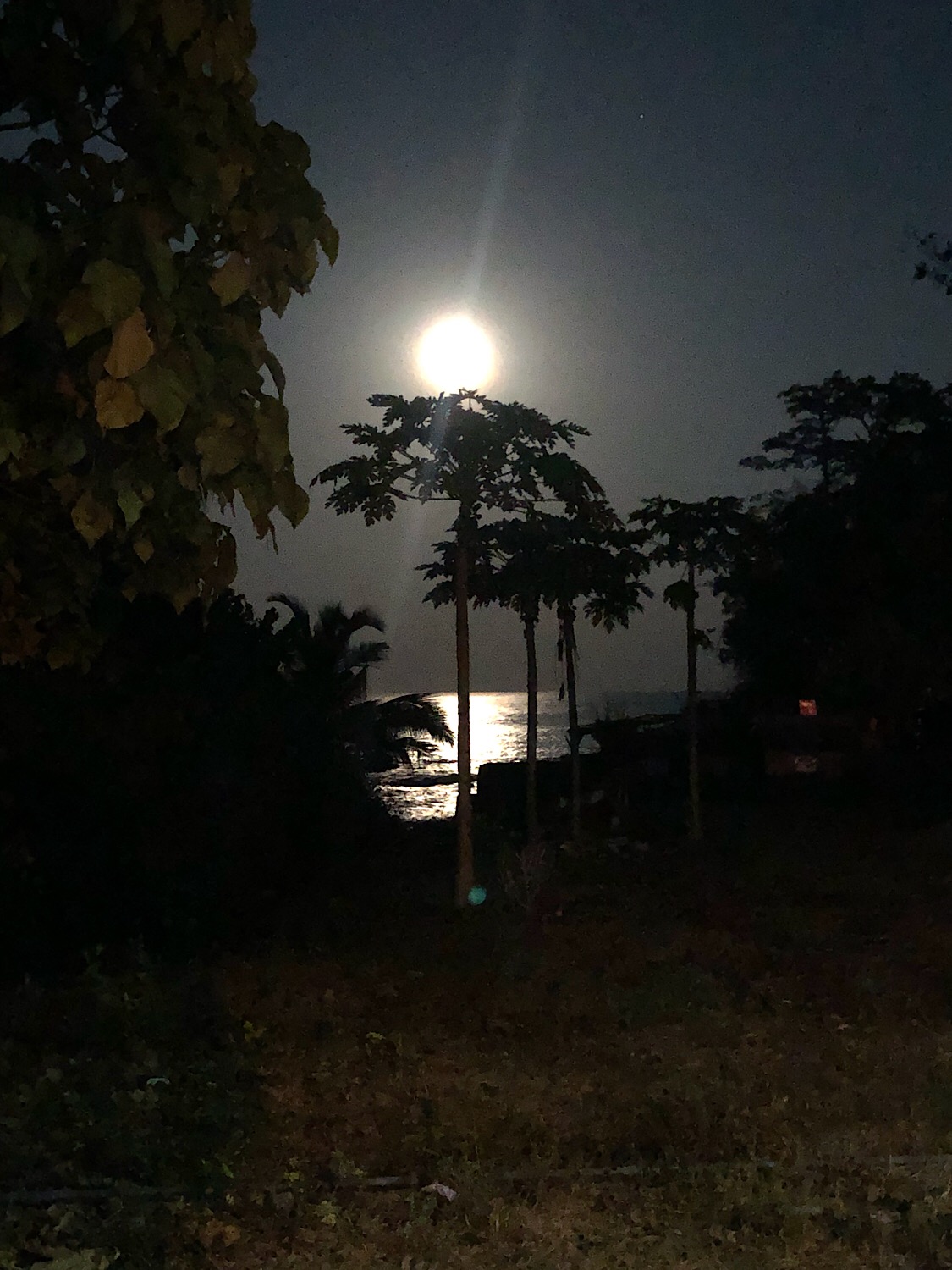
The moon on water

Owing to a moped shortage, we were largely confined to this beach though we did get a Tuk tuk to others on a couple of the days. One (beach 3 perhaps?) came highly recommended by the lonely planet but the tide was out when we got there and it was a bit of a muddy bank so we sacked that off, passing a bizarrely deserted restaurant on the way out. It was as if it had been left if a hurry, with ingredients and equipment all left out, like something out of Chernobyl! We checked out beach 1 which had more going on, small shops and restaurants, and you could swim more easily here, but it was also next to the port which took the sheen off a touch. Then we finally stumbled across a bit of a beauty (beach 2?!). Set around the corner from the port on the end of the island, this narrow strip was on the edge of a forest and, as was now becoming the norm, no one was around. It had a lot of small stalls which were boarded up, so maybe in peak season (December and Jan) it was a bit more happening, not that we cared much. Having lost all shade, we had to move around the corner where we discovered a pristine length of soft white sand, swimmable crystal blue water and not a soul in sight. I spent the day in the dappled shade of a tree while Peahead rotisseried herself in the hot sun, before trekking a couple of km to a rather swanky hotel and congratulating ourselves with a late slap-up lunch of Tikka + Kingfisher lager. Resplendent. 

And that was more or less it for the Andamans. Reflecting back, we had really enjoyed ourselves, even if it had been different from what we were expecting. It was unquestionably strikingly beautiful, and we had really been able to relax and switch off (with the one highly regrettable exception of following Arsenal’s fatal capitulation at home to Crystal Palace). It was also spookily quiet, with us often being the only people on the entire beach. This did give an end-of-the-earth, desert island feel, which I certainly hadn’t experienced before, but also sometimes we found ourselves wishing there was maybe a small bar we could grab a beer or some music in the air, just for a bit of company! If I had to choose, I’m not sure which I’d go for, but in the end we are on this trip to experience new things and so, perhaps, I would go for what we had – the deserted feel rather than another fun, busy beach – because I’ve never really been anywhere like that and I wonder whether we will ever encounter that again. Wistfully chewing this over, we boarded our plane bound for royal Rajasthan, which Peahead will cover in her next blockbuster edition of this epic adventure blog classic. 

Leg 2: North East to West Coast via Jaffna and an Ancient City

Beaches, bananagrams and beers 

Hello! PeaHead here. Now as Radio Fred mentioned I need regular hits of beach lounging and sunbathing to retain my wonderfully measured temperament and positive attitude so after all the culture we’d absorbed and exploring of ancient civilisations we’d done I was in need of some sand and sunshine so our journey took us to the North East Coast of Sri Lanka to a small coastal area North of Trincomalee called Uppuveli. 

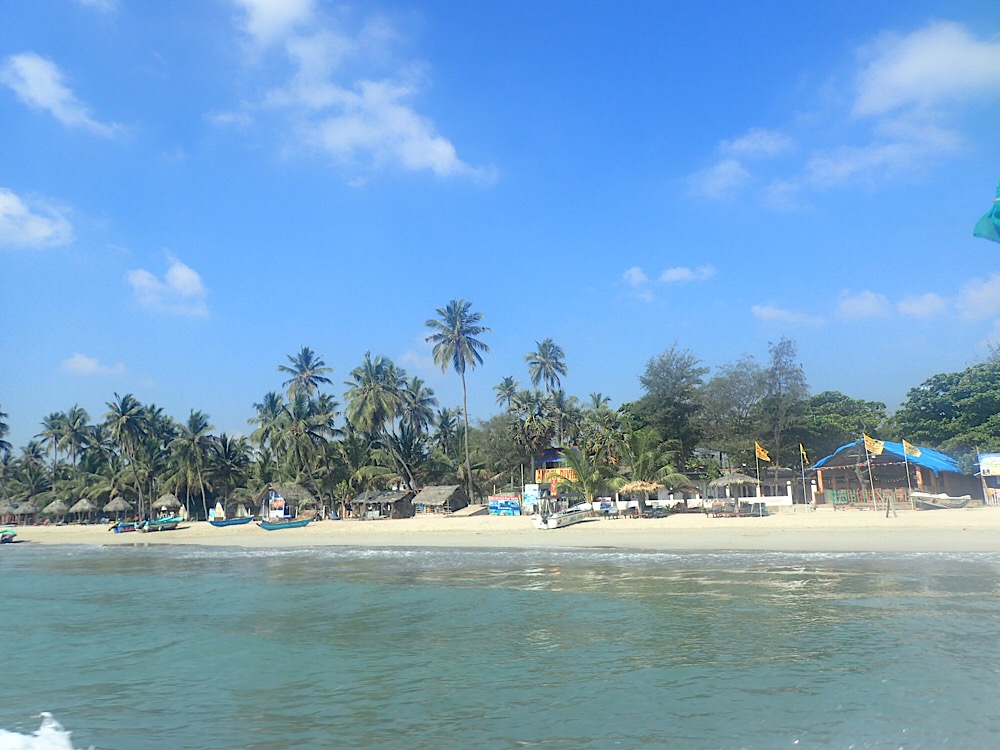
Debatably interesting fact: Trincomalee is home to the word’s largest natural harbour – which is much nicer than it sounds! We had a bit of a shaky start in Uppuveli as we’d unwittingly booked ourselves into some awful accommodation for four nights (cheers Lonely Planet) – but after making the decision that we weren’t going to stay there (the swarm of mosquitos in the room, dirty sheets and proximity of the bedroom window to the public/backyard shower were the last straw) we summoned our courage and walked out (which is always so difficult when it’s obviously a family run place) and found a much nicer (if a little resorty) hotel just round the corner. Once we’d settled in we headed off to explore the beach – which was a typically beautiful Sri Lankan treat – clean straw coloured sand, fringed with palm trees and a scattering of colourful fishing boats. 

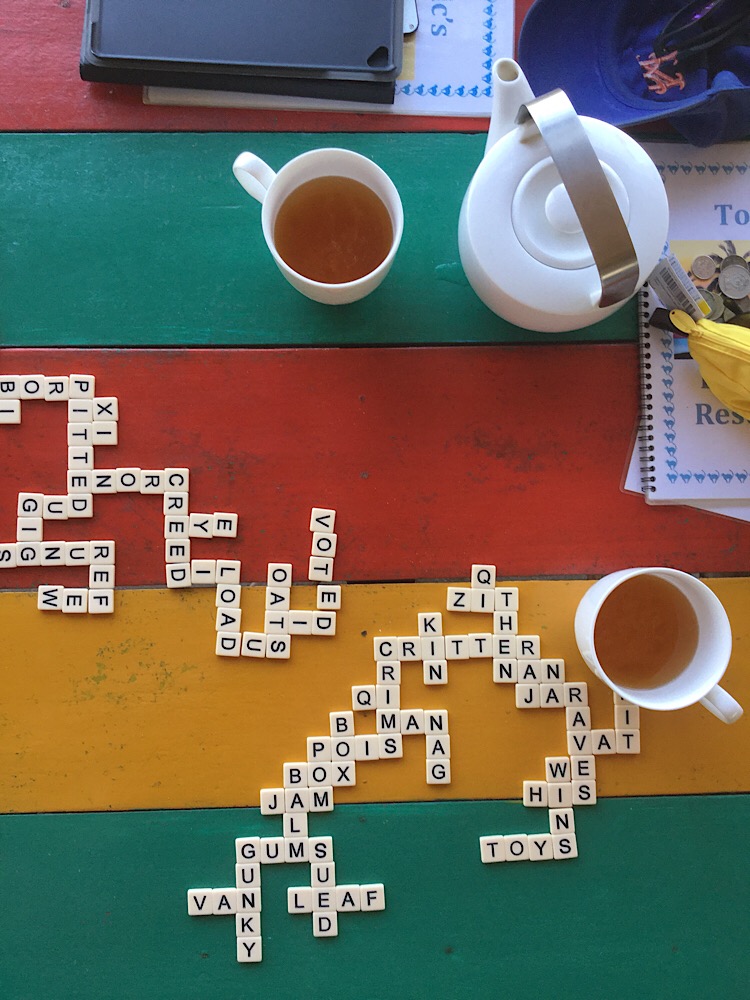
We spent a good few days relaxing on the beach, reading, swimming, playing fiercely contested games of banagrams, drinking beer out of mugs and teapots in the restaurants lacking licenses and wandering up and down the beach. Fred also got his creative juices flowing and wrote the first instalment of the blog here so you could almost view it as a (piss) artists retreat.

View of Uppuvelli beach from the whale watching boat

We had a majorly early dawn rise one morning to go out on a whale watching trip – apparently Sri Lanka is one of the best places in the world to spot a Blue Whale. This (sadly) is because as the civil war raged on for over 30 years they were left undisturbed off the island’s shore and no one was poaching them.  Unfortunately it wasn’t second time lucky for us (we didn’t see any on our first whale watching trip in Sri Lanka in 2012), but we had a lovely morning out on the boat and saw loads of Dolphins – I’m holding out for the third time round… 

We headed over to Trincomalee one late afternoon/early evening to see Fort Frederick (nothing to do with Radio Fred) which is set back from the coastal path near the port. It has a typical narrow gatehouse entrance and was originally built by the Portuguese in 1623 then changed hands loads of times between them, the Dutch, French, British, Dutch and back again which is a great reminder of the absurdity of colonial power grabs. The Fort (which is now a Sri Lankan Military Base) is a complex of impressive buildings set amongst massive gnarled trees around which roam loads of lovely spotted deer, surrounded by white picket fences, throw into the mix all the monkeys and peacocks and it feels more like a a zoo! 

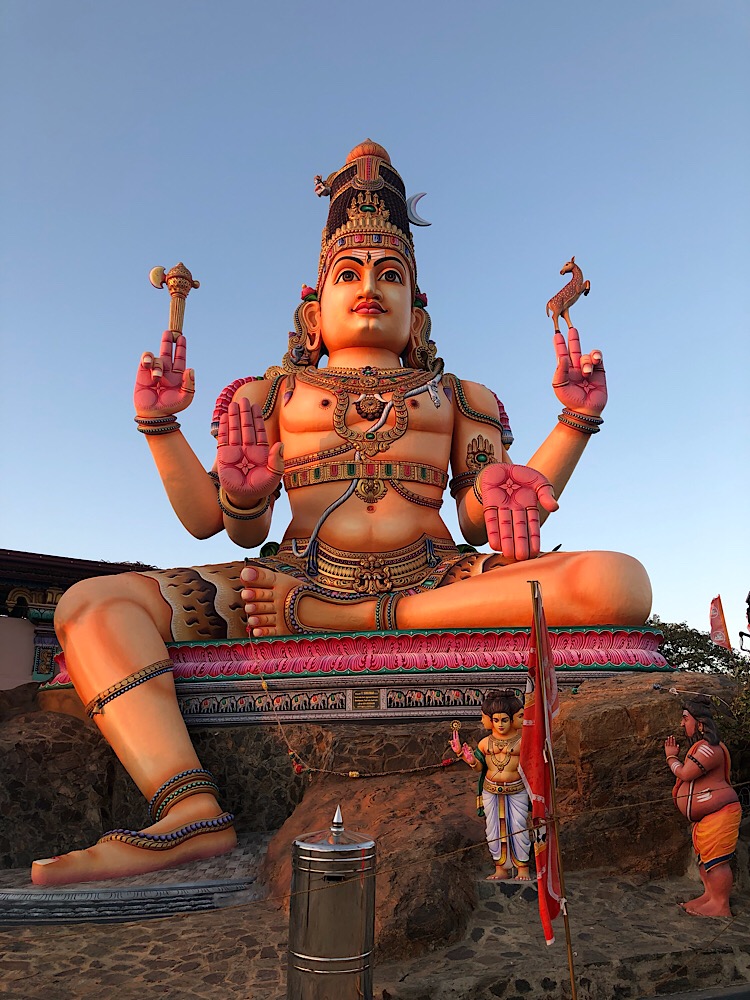
We meandered through the fort as dusk approached and up towards an awesome Hindu Temple – Kandasamy Kovil which sits at the summit of a rocky outcrop. Once you pass through the stall holders and the trees strung with strips of orange and red ribbons (which looked gorgeous in the evening sunlight) you are faced with a massive super colourful statue of Shiva – which is at least 15 metres high, perched upon a rock – it caught the light in the most magical way. Behind the statue was a typically “extra” Hindu Temple adorned with extremely intricate and colourful carvings. 

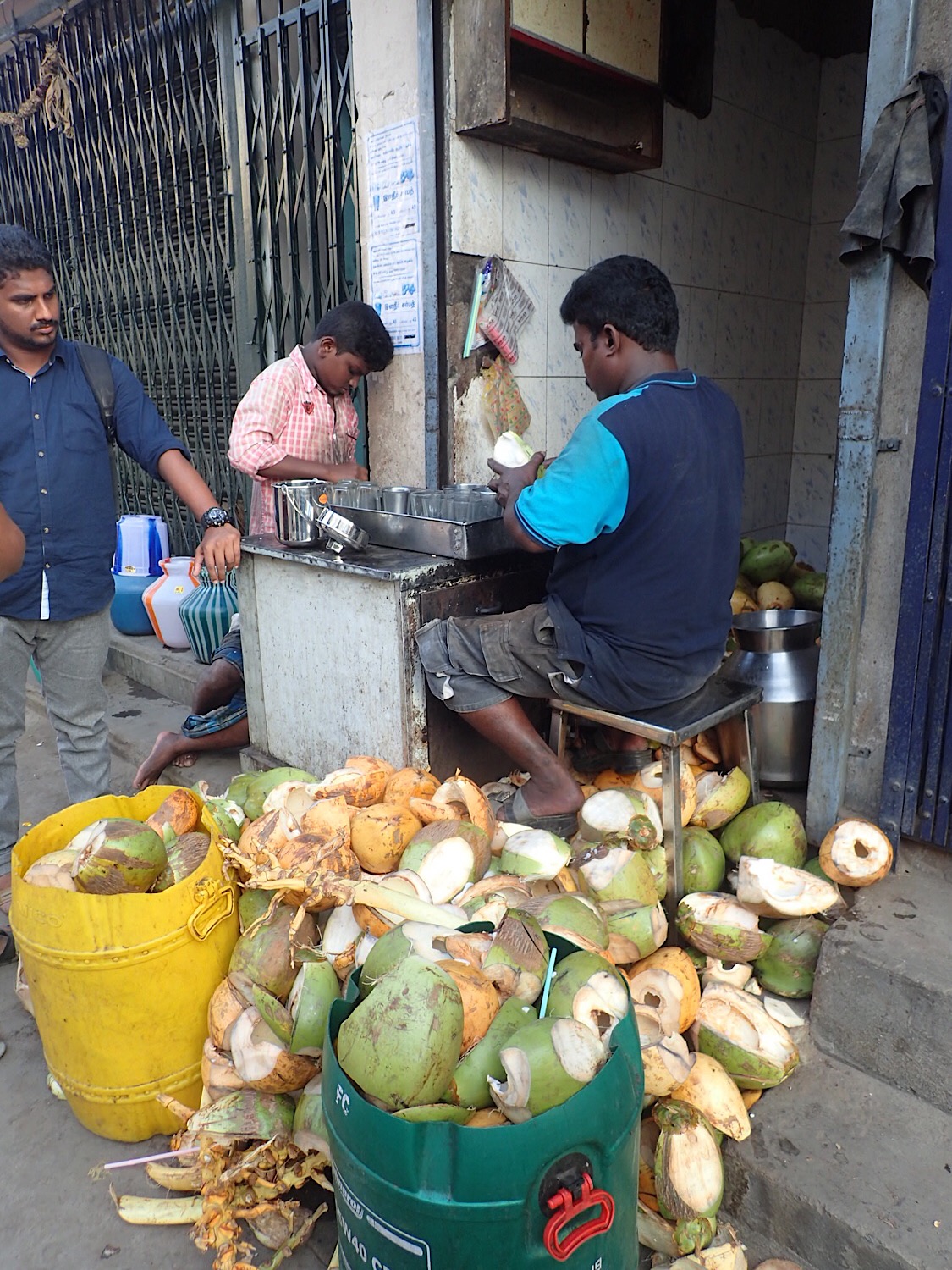
We arrived just before Puja which are prayer ceremonies that take place multiple times throughout the day. Inside the temple there were people playing lute-type instruments, drums and singing – which is piped through loud speakers on the outside of the temple. The Puja included bell ringing, loads of incense and waftings of lit candelabras. The whole thing was totally magical and enhanced by the beautiful orange low sun which when shining through the surrounding Palm trees whilst the religious music warbled through the speakers made it feel very exotic. I had a bit of a moment if I’m honest. Hindu temples are so up my street, the mega colour clash and general over the top decoration is awesome, with the dwindling Church attendance in the UK perhaps people would be more inclined to attend if we jazzed them up a bit? We followed the Temple visit by having a fresh coconut at a roadside fruit juice shack which just happened to have the most incredible view over the harbour for sunset. Dreamy. 

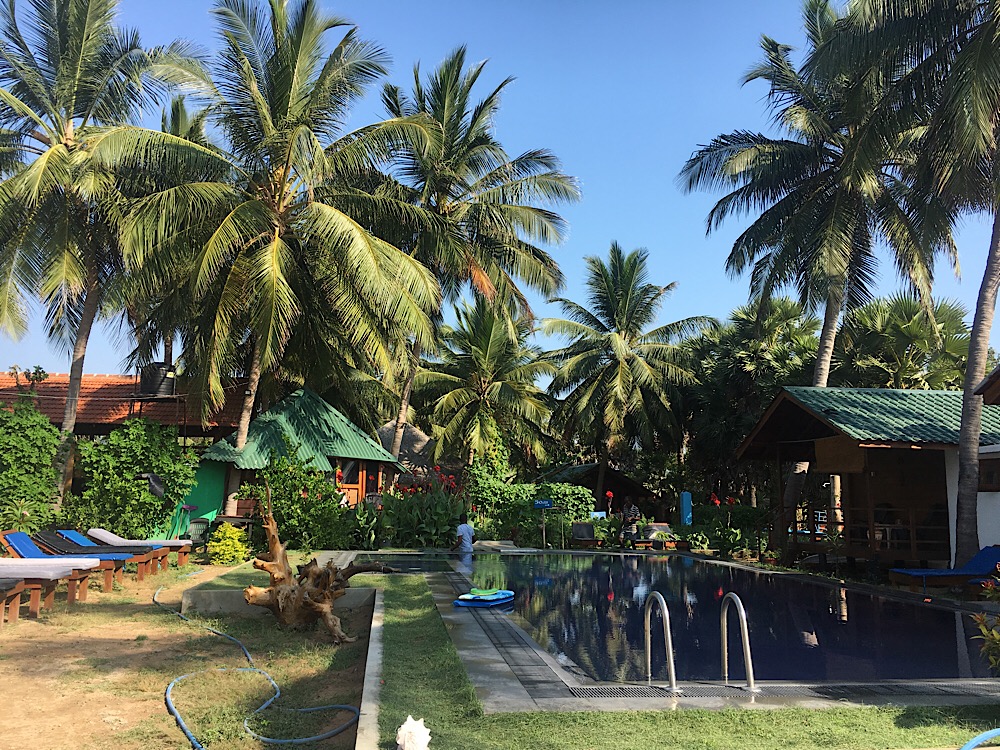
We upped sticks after a few days and travelled further north up the coast to Nilaveli to stay at a lovely little spot called Bella Nilaveli – run by Ana, an Italian woman, her Sri Lankan husband and their little boy Leo (although he was no Picolo Rosso, more Picolo Marrone!) It really is a lovely, peaceful spot – a handful of little cabins just set back from the beach around a refreshing pool, amongst swaying coconut trees and an epic veg patch with aubergines, chillies, beans, gourd and loads of parsley and mint. The beach in Nilaveli was unspoilt and largely empty apart from us and a few fishermen. 

The beautiful setting at Bella Nilaveli

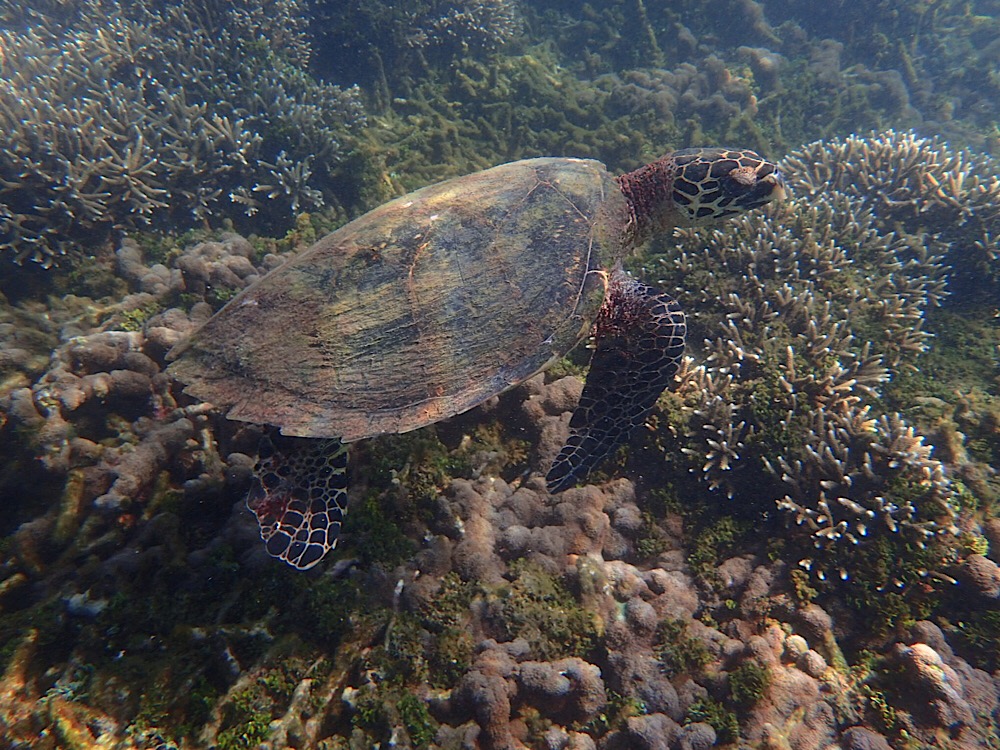
Just off the coast at Nilaveli is Pigeon Island which is a famed snorkelling spot. We were met after our breakfast at Bella’s and shown to a boat down on the beach by an ancient Sri Lankan gent in a lunghi – we weren’t really sure what to expect but we were introduced to our private guide who it turned out was a Sri Lankan dive master who does snorkelling trips off season, so was really knowledgable and spoke great English. The boat ride to the small island was about 20 minutes, it had lovely sandy beaches, a few rocky outcrops in the shallows and tonnes of coral skeleton washed up on the shore. Luckily we were the first to arrive which meant we had the first section of snorkelling to ourselves. The coral was a little bit worse for wear but we saw some huge black tip reef sharks (complete with remoras), a Green Turtle up-close which came up to the surface for air while we bobbed around, Moorish Idols, Coronet Fish and Clown Fish – lots of lovely underwater life. It made me remember quite how much I love the water and all the life that teems beneath it. 

Green Turtle guy

Uppuvelli and Nilaveli were all in all a lovely spot for some beachside R&R, leaving me fully charged on sunshine and ready for a city adventure in Jaffna.

Jaffna: pedal power and faded grandeur 

Being naive tourists we opted to take the coastal route for our drive up to Jaffna rather than the express way thinking it would be scenic drive along the lush coastline. Unfortunately there wasn’t much coastline to be seen and what it lacked in beauty it made up for in extremely bumpy and poorly maintained road surfaces. 

We were both really excited about visiting Jaffna and had regretted not making it here on our first trip to SL, it’s the most Northerly city in Sri Lanka and was the Tamil Tigers’ strong hold and epicentre of the increasingly vicious civil war – this meant that it wasn’t until 2012 that any tourists were allowed here. The people here are still largely Tamil so culturally it’s quite different to the rest of Sri Lanka. We also took a diversion on our bumpy drive to visit the hotly anticipated Sea Tigers Ship Yard which when we arrived had unfortunately been dismantled (much to Fred’s disappointment.) It used be be an area on the coast where the Tamil Tigers (or “LTTE”) built mad submarines and other seafaring weapons with parts smuggled in from all over the place including India, Russia and North Korea – but the current Government obviously didn’t want weird tourists like us looking at it I suppose. Never mind we (read Fred) carefully studied the Wikipedia page instead. 

We stayed in the Jaffna Heritage Hotel which was lovely but we were the only guests there so also a bit odd. Had a brilliant veg curry Thali for lunch at a restaurant called Mangoes (often Thali is the only option for lunch), lots of lovely little pots of curry, sambal, loads of rice, papadums, buttermilk and a sweet (which we think was some form of tapioca), so delicious and super cheap (about £3 for both). Followed by an explore around town and a sunset beer on the roof of the high rise Jetwing Hotel – which also gave us an awesome view across Jaffa – stretching from the peninsula and its islands to right out into across the ocean. The city is densely spread as far as the eye can see with clusters of buildings, thickets of palm trees and the requisite massive fruit bats circling around – it was nothing like the war torn, derelict city I’d imagined, but a bustling modern city with an incredibly interesting if very sad history.  

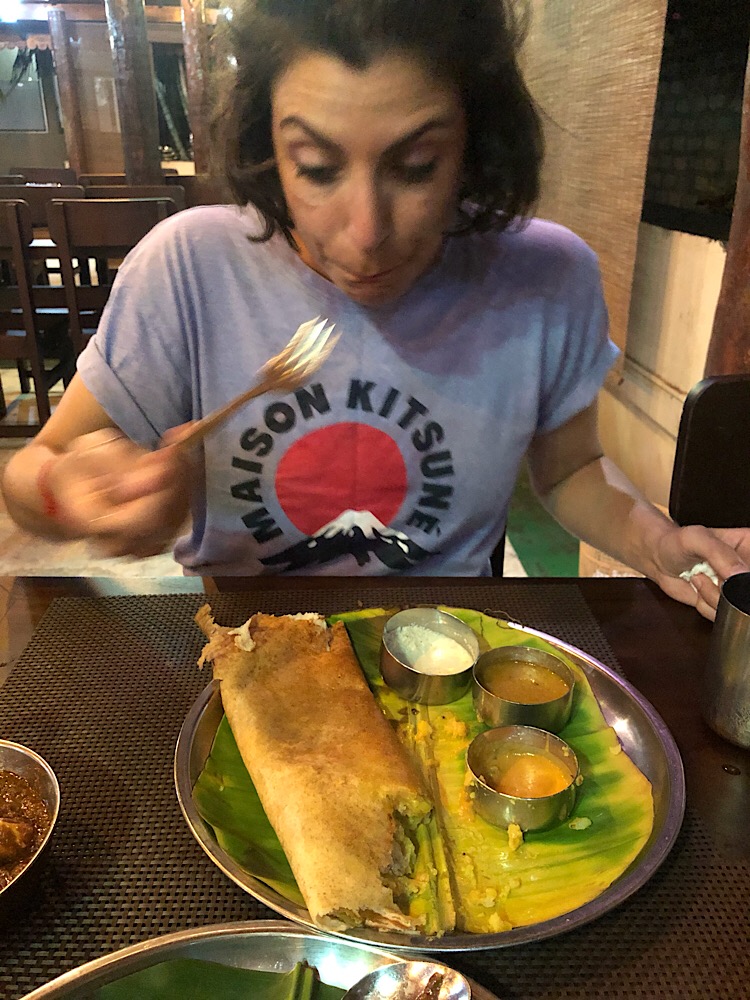
Back to Mangoes for dinner where we had an outrageously rich and tasty meal – Ghee Dosa which unsurprisingly is Dosa cooked in Ghee and stuffed with lightly spiced potatoes with loads of lovely side dippy bits, a chopped then deep fried roti with a spicy sauce plus an absolutely banging Paneer Tikka Masala. I’ve been maintaining a steady consumption of Paneer to ensure I get enough calcium… 

Ghee Dosa action
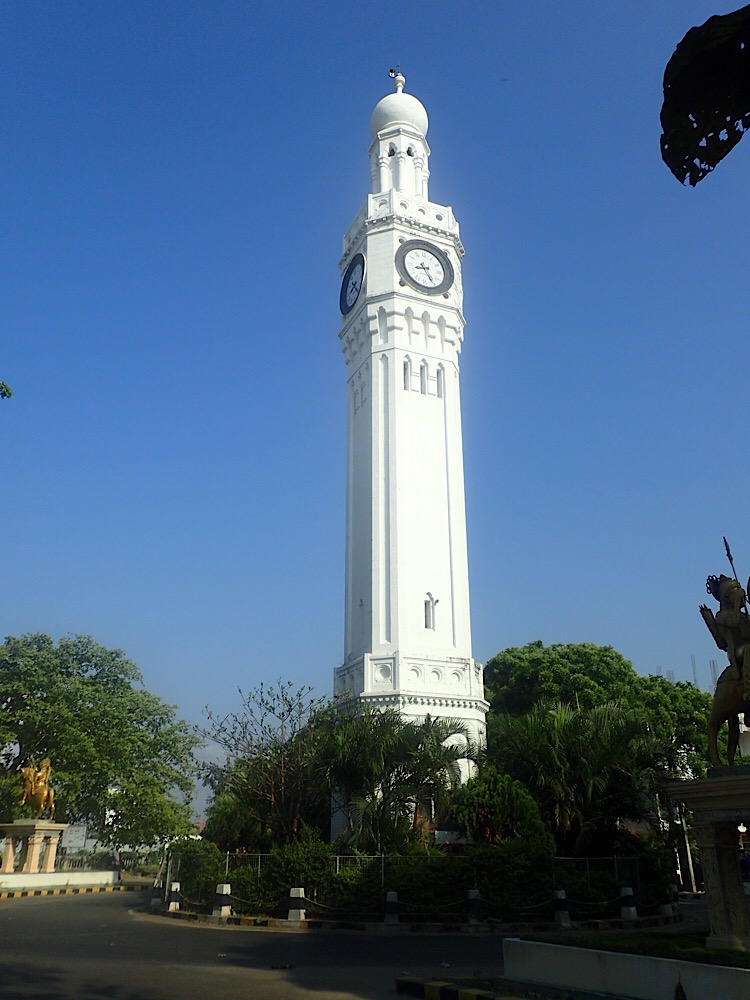
The Clocktower in Jaffna

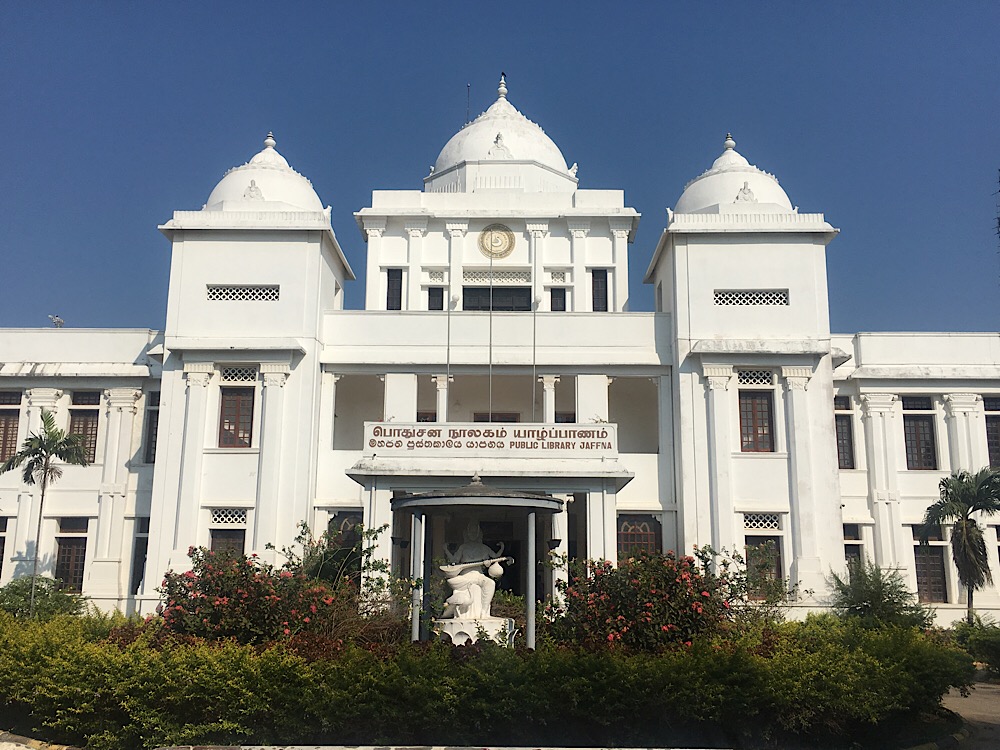
We did an excellent tour of the city by bicycle with our guide Mohan (who despite first impression was exceptionally knowledgeable and a fantastic person to show us around the city). We set off early but the dab-o-meter (the measure of how much we were sweating – 0 being a drought, 10 being a monsoon) was already off the scale. Our first stop was a picturesque white clock tower with a minaret style top – which was originally built in 1875 to honour a visit from the Prince of Wales, it was heavily damaged in fighting and the current PoW Prince Charles replaced the clocks within in 2000. We then cycled onto the Jaffna Public Library which was burnt down by Pro-Government rebels in 1981 and was a major factor in the build up to the civil war. The fire didn’t do much damage to the white Neo-Mughal building structurally but destroyed ancient Tamil scriptures and artifacts. The act was horrific and destroyed a large part of the physical history of Tamil people – exactly the objective of the perpetrators. 

Jaffna Public Library

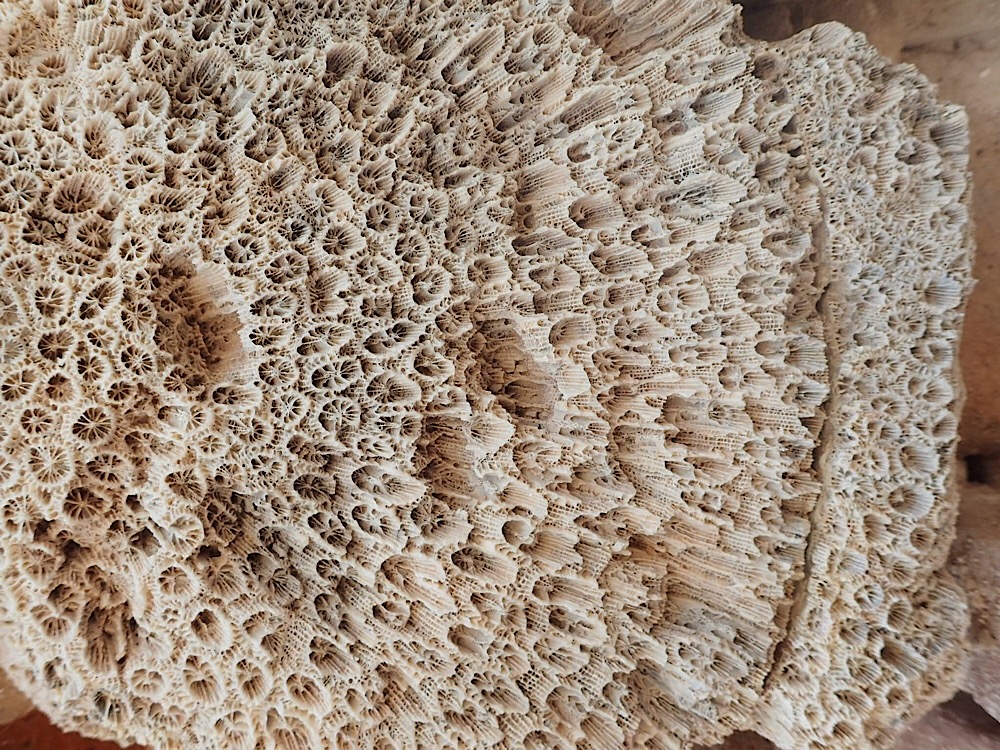
Next up: Jaffna’s impressive Fort. Once we’d wiped the sweat out of our eyes we had a good look around the huge Fort which is right on the coast – way back when it was originally a Sri Lankan religious site then the Portuguese Colonialists built the structure over the top, then in 1680 the Dutch built over that (sound familiar?) then various groups and colonialists fought over it right up until the 1990s when government forces and the LTTE battled it out there, unsurprisingly lots of it is destroyed but you can still see the walls, moats and some of the former buildings inside the Fort. The walls are a combination of limestone and coral bricks which have awesome coral features and patterns in them. 

A close up of a coral brick in the Jaffna Fort

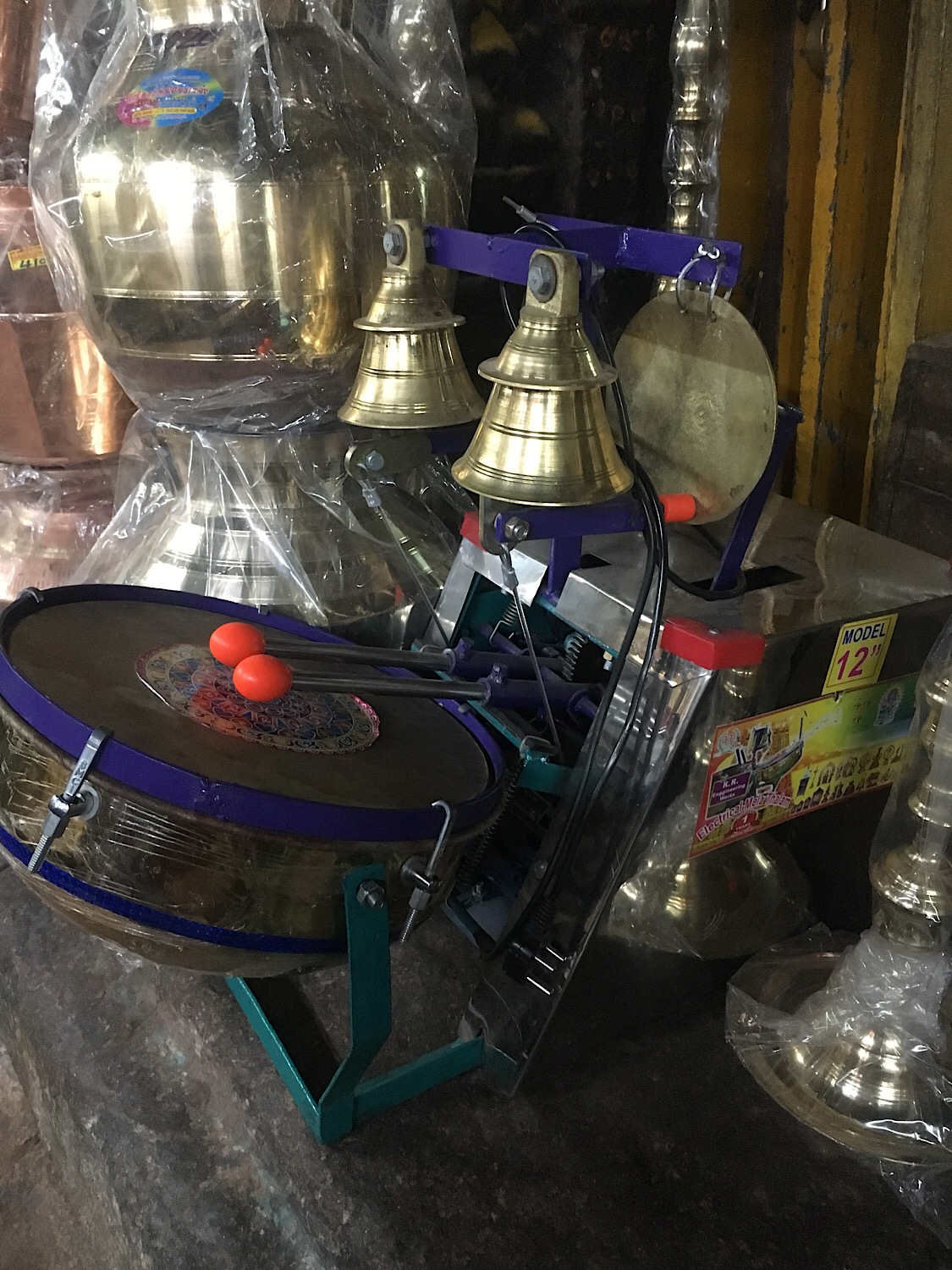
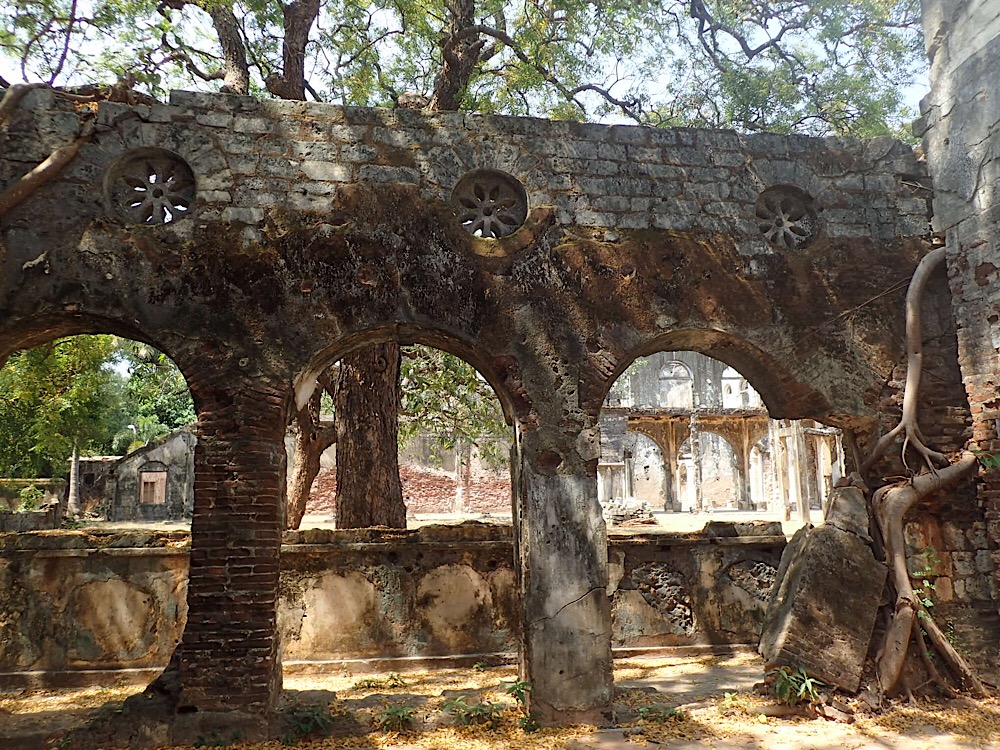
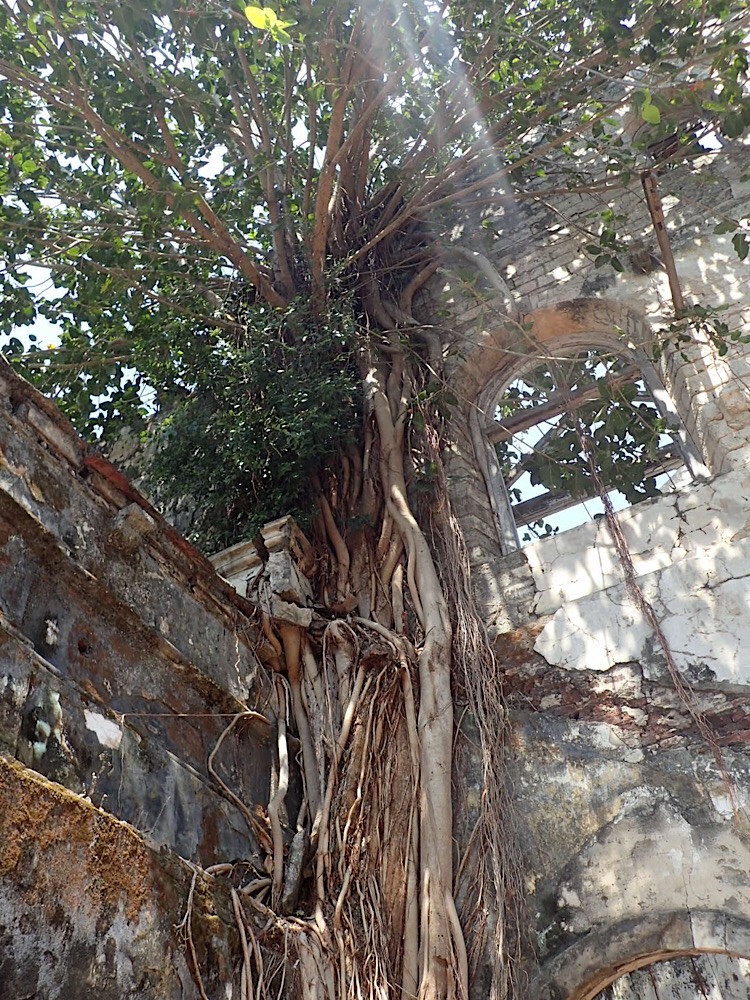
By this point we really were sweating profusely and weren’t that interested in a huge Catholic cathedral built by the Portuguese during their ‘convert to Catholicism or we’ll execute you’ phase. The ruined remains (due to the war) of a British Colonial-era Government office set in the grounds of the Old Park was really interesting, it was obviously once a seriously impressive building with curved walls, huge archways and a garden area in the centre. Now it’s being gradually engulfed by nature, the structure taken over by vines that are growing around and into the building, with eagles soaring overhead and lizards zipping around it was certainly one of my favourite parts of the tour. We had noticed there were no monkeys in Jaffna – unlike many other Sri Lankan cities – Mohan suggested this was because they’d all buggered off during the war with the humans and never come back. The final stop on the tour was Nallur Kandaswamy Kovil: a larger than life temple with towering god-encrusted gopuran (gateway towers). We timed it so we were there just ahead of noon prayers which involved going around to different points in the inner sanctum saying prayers and making offerings to different deities.  It was a brilliant way to see the city and we learnt so much. We also got our first sighting of an automated ceremonial drum machine which is a big metal box with drums and bells that’s hooked up to a mic and beats out the call to prayer automatically. Awesome bit of kit. 


A restaurant called Cosy’s (which we visited twice for dinner) is officially where Fred’s love affair with Chicken Tikka started. Cosy’s is a great little place that has an outdoor courtyard with views of the kitchen and outdoor Tandoor oven – we had some of the best and tastiest food of our trip so far there, delicious flaky and buttery Tandoori Paratha, a perfectly tender and spicy Jaffna special fish curry and the star of the show Fred’s Chicken Tikka – video report below: 

This is also the official start of the world Chicken Tandoor-nament – whereby Fred embarks on tasting and rating as many Chicken Tikka dishes as he can whilst in SL and India. Stay tuned for Tandoor-nament updates.  

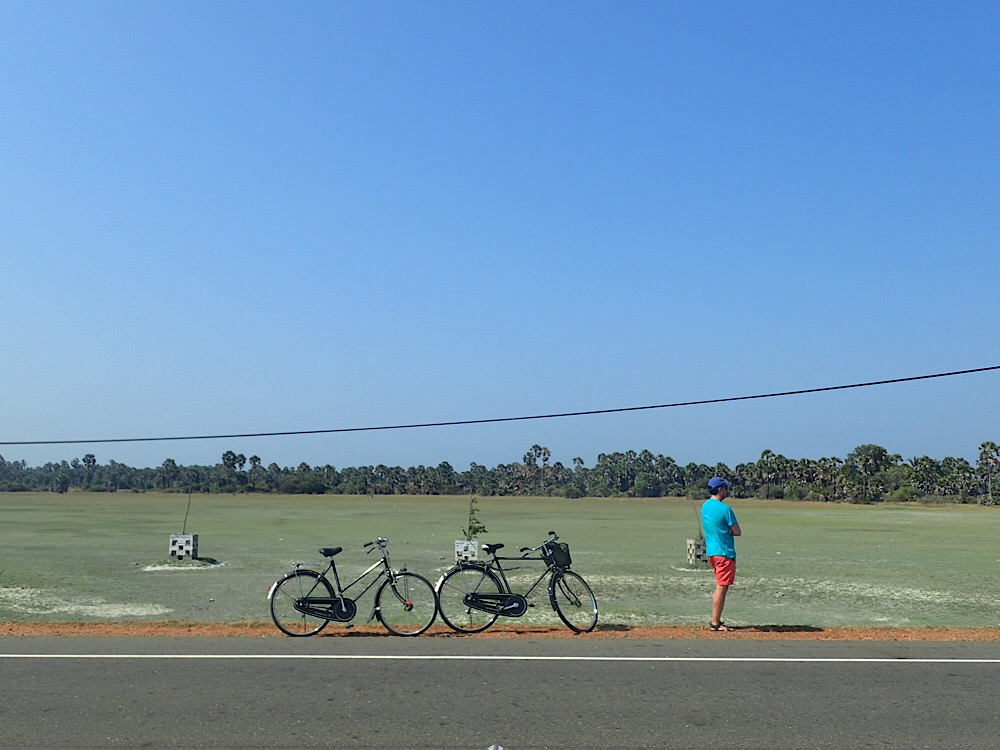
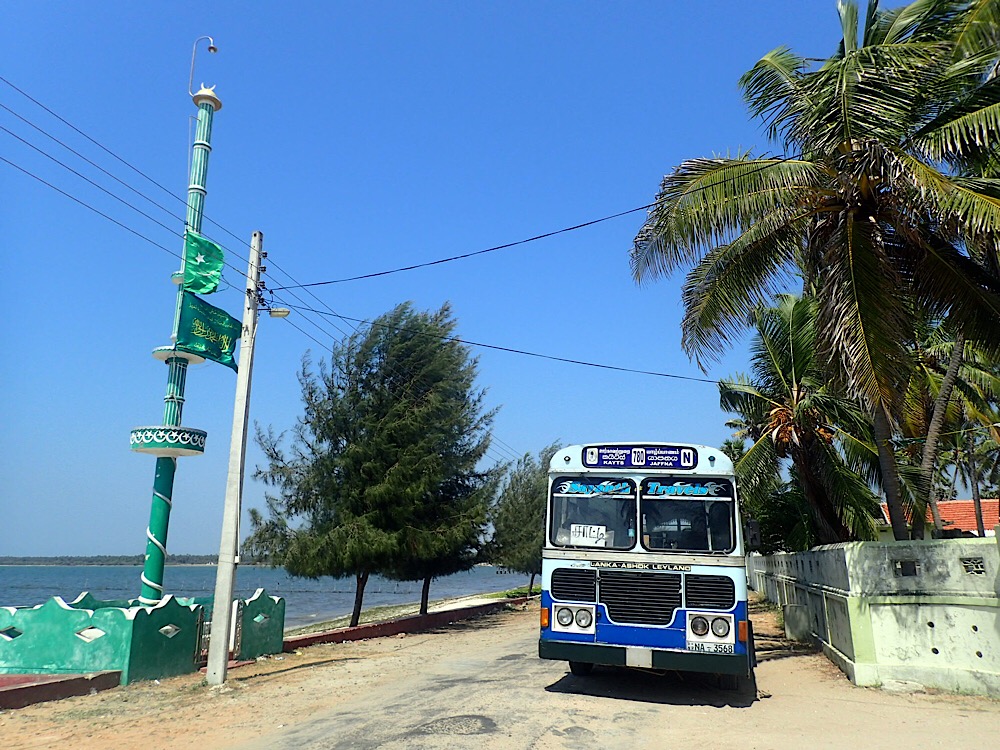
On our final day in Jaffna we decided to explore the peninsular comprising a scattering of islands joined to the mainland by causeways and ferries, jutting out into the Palk Strait off the Northwest of Sri Lanka – they are very remote and are supposed to have some beautiful beaches so we valiantly set off on our bone-rattler bikes to visit Chaatty Beach which was a long but manageable distance from where we were staying. When I say long it would’ve been around eight miles each way. However when we arrived Chaatty Beach after a hefty hot cycle over a mega causeway and seemingly deserted wetlands on one long road with only a few birds and the occasional cow or bus for company (dab-o-meter firmly at 7.5 the whole way, with a breeze), we decided it wasn’t up to our beach perfection standards. This left us in a bit of a predicament given that we’d already cycled eight miles and there weren’t any other beaches for quite some distance. But we summoned our sense of adventure and energy and pressed on aiming for a beach on another island. 

Contemplating the peninsula

We cycled the length of the island aiming for a beach that had had rave reviews – catching a ‘ferry’ (essentially a floating pontoon with a boat engine attached) which putt putted us and a handful of Sri Lankan’s across the short stretch of water separating us from neighbouring Karaitivu Island. 

Arriving at Chaatty Beach

(I should mention that throughout the entire day we only saw two other tourists – two Russian guys who certainly hadn’t been as stupid to cycle there on crap bikes in 30+ degree heat).

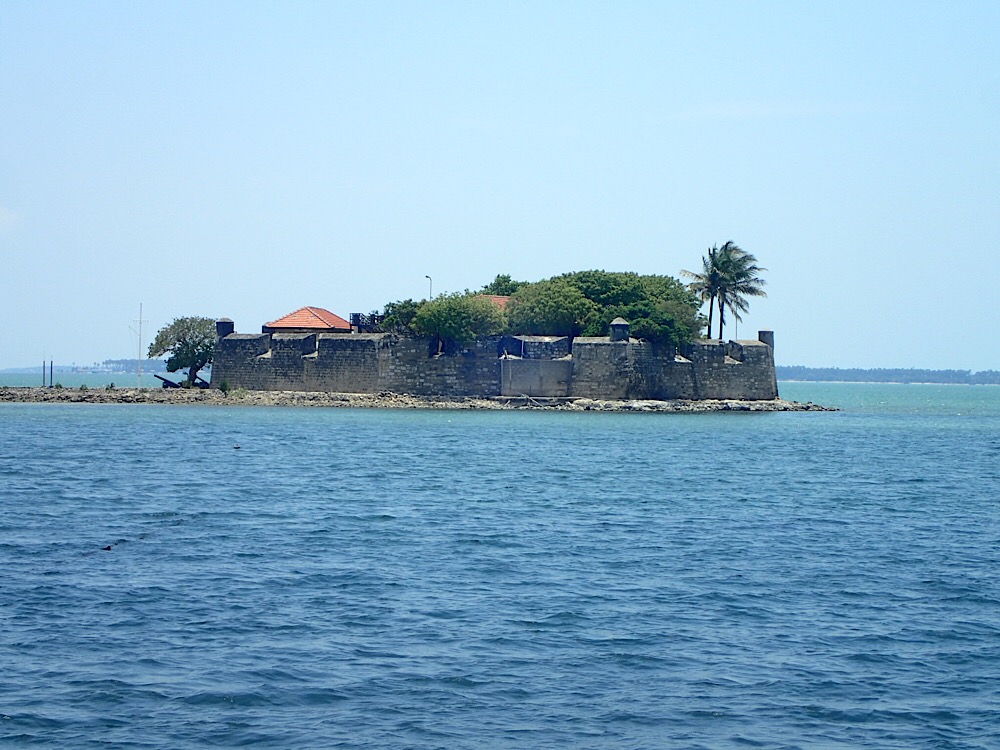
Anyway once we’d disembarked the ‘ferry’ onto Karaitivu we headed to Fort Hanmenhiel a small Portuguese-built bastion that now serves as a Sri Lankan Navy Butlin’s Style Holiday resort. Obviously we were the only people there! It felt like proper end-of-the-world vibes, it was so still and quiet that the only noise came from the birds and a few fish splashing around in the water. In other circumstances it may have been a bit creepy but the cold water, beer, food and a rest were very welcome.  

Fort Hanmenheil

But, our epic tour of the Jaffna Peninsula wasn’t over yet, by this point it was around 1pm and seriously hot – we forged on, cycling the length of the island along a single and thankfully pretty well surfaced rad – past palm trees, tiny villages, derelict houses and perplexed Sri Lankans. I can’t stress just how remote these islands are, each being home to a few thousand people and clearly very rarely receiving any white tourists – it’s a lovely feeling to be so far away from it all. Still everyone we passed although initially eyeing us with slight suspicion (or perhaps just confusion) immediately returned our smiles with their own beaming smiles or a nod and hello! 

We finally made it to Casuarina Beach – a lovely sandy spot just out from the pine forest and had a much needed ice cream and swim in the bath  temperature water. But we couldn’t stop for long since we had an epic cycle home (around 14 miles). The journey home was just as hot and bloody bumpy in parts, we somehow both avoided a sense of humour failure and just kept going – we joined the mainland by another causeway, the shallow water on one side strewn with fishing nets and wooden traps and cycled through miles and miles of farmland until we reached the outskirts of Jaffna and finally made it back to our hotel filthy, sweaty, with sore arses and knackered! When we worked it out we’d accidentally managed to cycle 40miles!

Ancient Anuradhapura: 

From Jaffna our penultimate stop in Sri Lanka was Anuradhapura – we almost missed our stop since there are no announcements on the train and unhelpfully the station signs face down the platform rather than outwards to the arriving train, making it useful to precisely no one, unless someone waiting on the platform momentarily develops amnesia and forgets where they are. Classic. Anyway somehow we miraculously managed to get ourselves and all our stuff off at the last minute. 

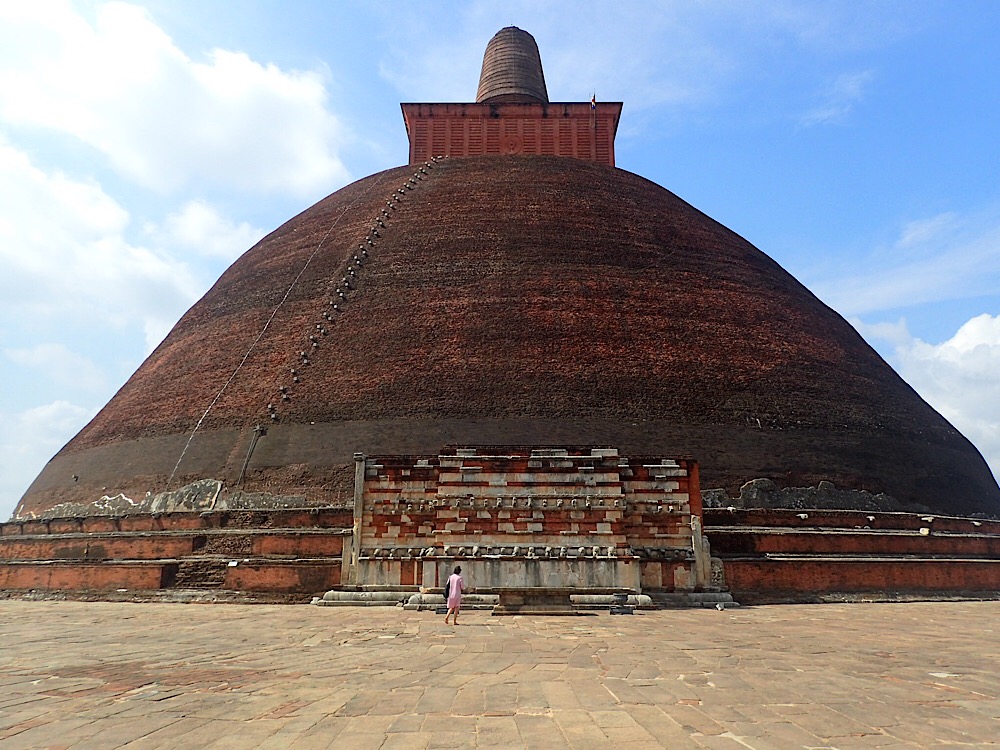
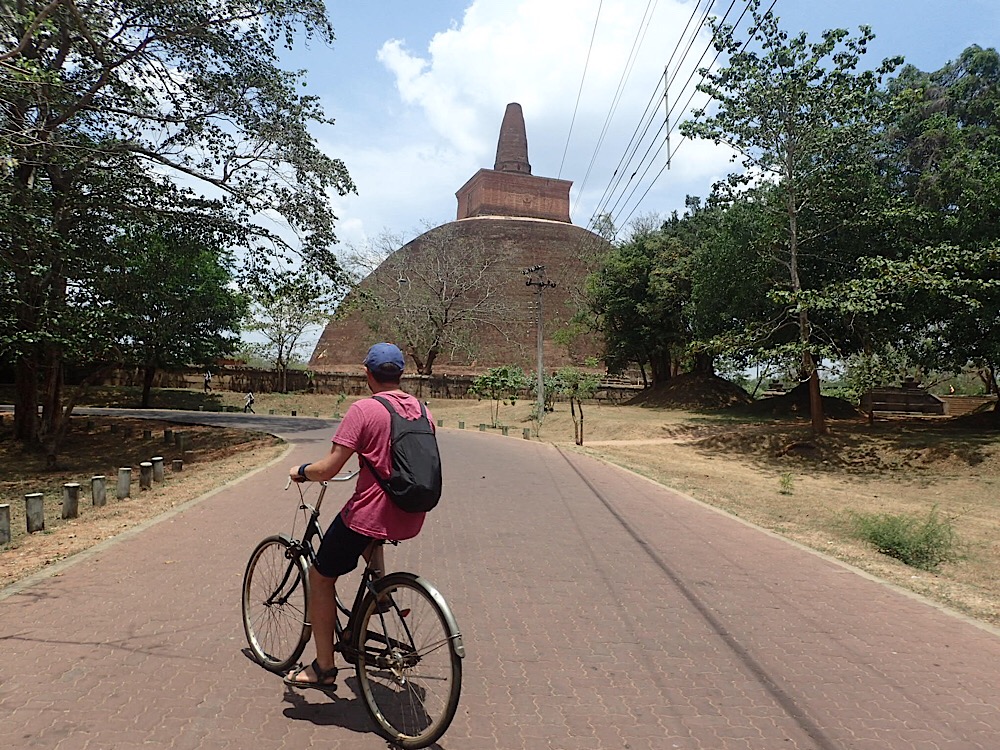
There have been lots of occasions where we’ve felt like the only tourists (or one of a handful of foreigners) and Anuradhapura was no exception despite being a UNESCO World Heritage site. We borrowed bikes from our guesthouse and set out after a lovely breakfast overlooking some rice paddies to explore the ancient ruins and temples of the city. Anuradhapura was the first capital of Sri Lanka and is said to be where Buddhism was introduced to the country, its ancient wonders encompass 2000 year old temples, water tanks and Dagobas that are all spread across a large forested area. We started at Jatavanarama Dagoba (a Dagoba is a solid hemisphere with a spire on top that’s part of a Buddhist temple complex). They are so visually pleasing and you spot them everywhere in S/L but these ones were next level. This one was built in the 3rd Century which means it’s around 1800 years old and originally reached a heady 120 metres which made it the 3rd tallest building in the world at that point (just behind the Egyptian Pyramids) today it’s still an impressive 70 metres and made of 93 million bricks! 

With PeaHead for scale

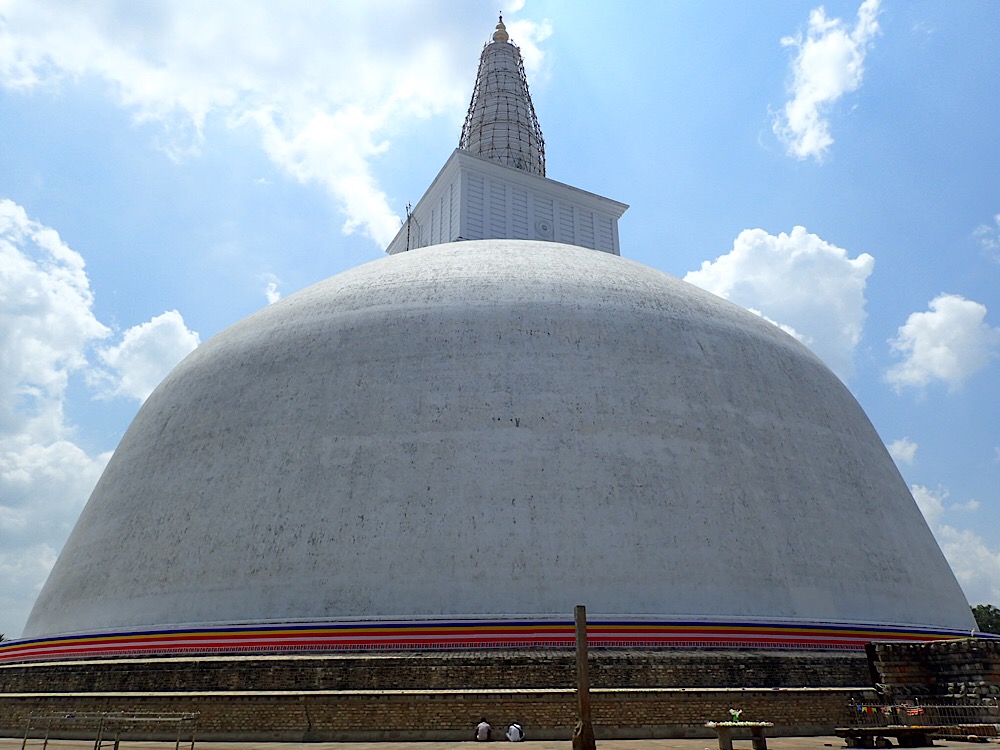
As Fred mentioned in the previous blog it’s customary to remove your shoes and cover your legs/shoulders before entering a Hindu or Buddhist temple. Usually this doesn’t pose a problem given most temples are indoors but A/pura is different because they are ancient archeological sites – to say the stone underfoot is hot is an understatement, it’s bloody scorching. Ruvanvelisaya is another temple Dagoba in the complex, a shining white 55 metre high structure, which had lots of people praying around the perimeter with designated areas for offerings of fresh flowers (signifying the temporary existence of natural life and mortality). We arrived here around 11am and despite the AstroTurf(?) and coir matting in places it was a real toe toasting, sole sizzling, heel heating, instep immolating experience… we were cats on the proverbial tin roof. 

There were more amazing ancient temples and ruins throughout the forest which we explored by bike including Sri Maha Bhodi, a scared tree that’s said to be the oldest historically authenticated tree in the world – with guardians having looked after it for the last 2000 years. It’s set in a serene white walled complex – surrounded by lots of colourful prayer flags fluttering in the breeze, it was a really peaceful setting with lots of tuneful birdsong in the background. We really ramped up the traveller vibes with another cotton bracelet applied by a real life holy man (for a small donation to the temple of course). 

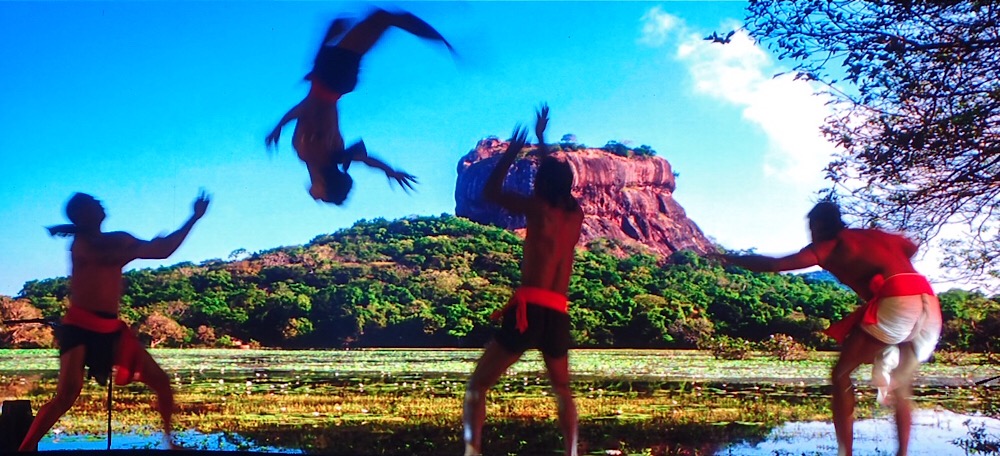
That night we were treated to an exclusive audience with the Sri Lankan Navy’s National Angampora display team (no us neither…) organised very kindly by our guesthouse owner who’d hooked us up with his mate Air Warrant Officer Sanereake. It turns our Angampora is a celebration of ancient S/L fighting techniques, martial arts and self defence and we had front row seats as guests of honour along with the families of S/L Naval Officers and other local dignitaries. The practice of Angampora was banned by British colonising forces when it was discovered as it was considered a threat to British law and order. In some places it was disguised as a dance that included religious stories acted out in elaborate dress and colourful masks. The S/L Navy is single-handedly bringing back the ancient tradition by adding it to their training curriculum with their performing troupe even appearing on ‘Sri Lanka’s Got Talent!’ The performance was awesome – a combination of dancing, drumming, singing, acrobatics and awesome martial art/Bruce Lee style fighting, hand to hand as well as with sticks, swords, axes and shields. The hectic finale included one guy smashing open a coconut with a machete that was resting on another guy’s neck! It was a brilliant insight into the ancient history of the country and something we’d never have had the chance to go along to had it not been for the kindness and hospitality of our hotel owner (and insistent nature – we didn’t really have a choice!) This scenario demonstrated the consistent hospitality we’d experienced all over the beautiful country that’s full of smiles, people who actively want to help you find your way and have an enormously welcoming attitude.

Angampora acrobatics

As I write this it’s a couple of weeks after the tragic terrorist incidents that happened across S/L over the Easter weekend. It’s so sad that this has just happened in a country that’s only recently come out of such a long period of war and unrest and that’s still recovering. It is such a beautiful place with it’s colourful temples, towns, unspoilt picture perfect beaches, dense jungle/forest and super welcoming people – I urge anyone who has never visited to not let this put you off. I can’t recommend Sri Lanka highly enough – it’s a truly magical place to explore. 

Our time in S/L was coming to an end and after a couple of days in a beach resort we were headed to Colombo for our flight to India. We’d had a lush first four weeks, we are still getting on like a house on fire and with no major tummy upsets! S/L was even more beautiful and exotic than the first time round. 

Feeling extremely fortunate that we are on this mega adventure and can’t wait to see, taste and experience more! 

Leg 1: South Coast to East Coast via the hills

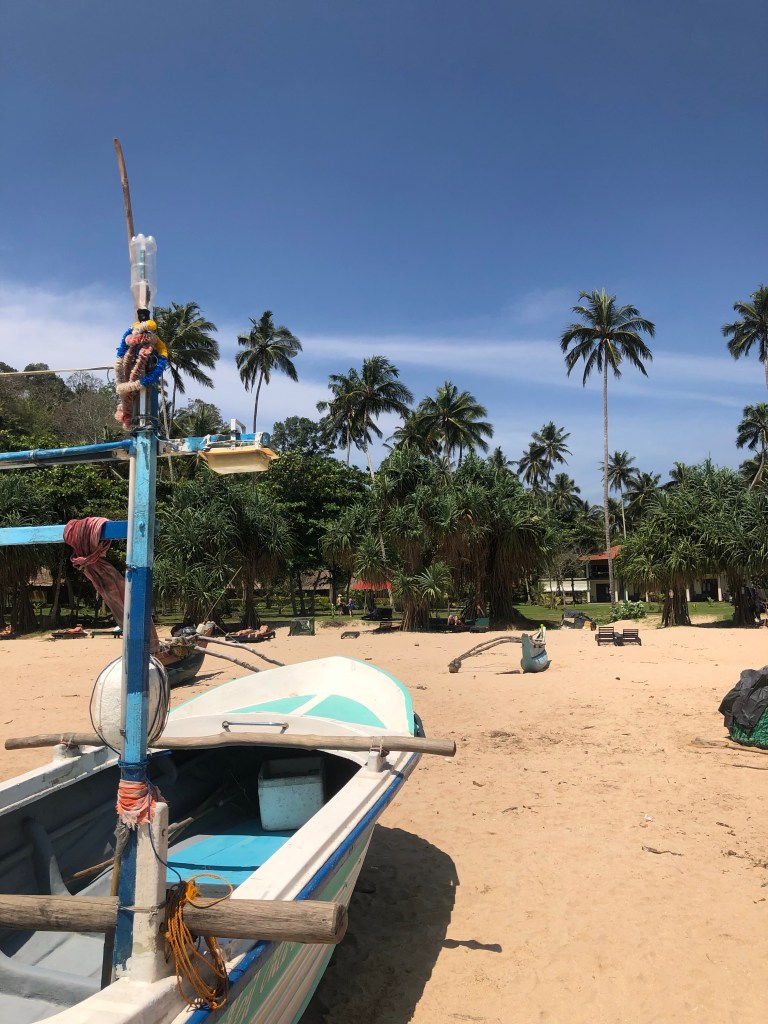
Talalla Beach🏝

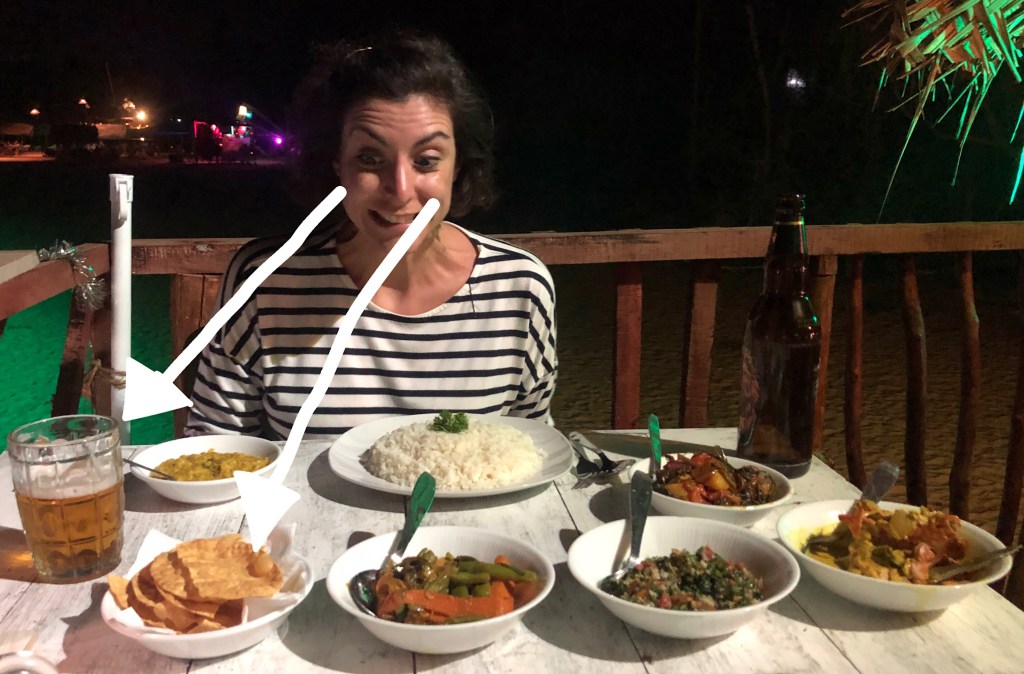
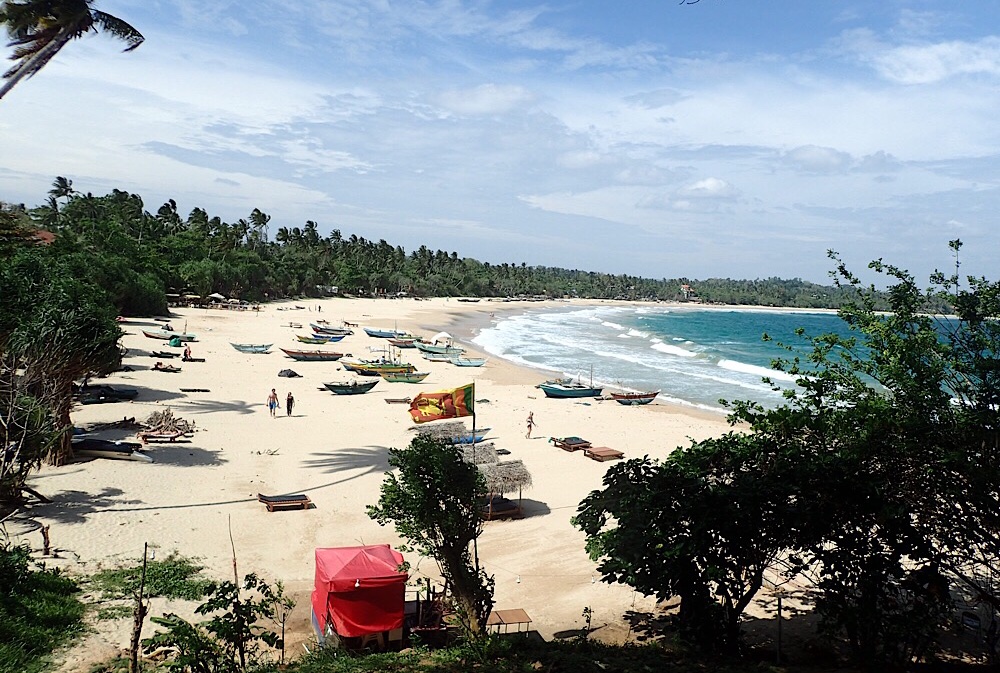
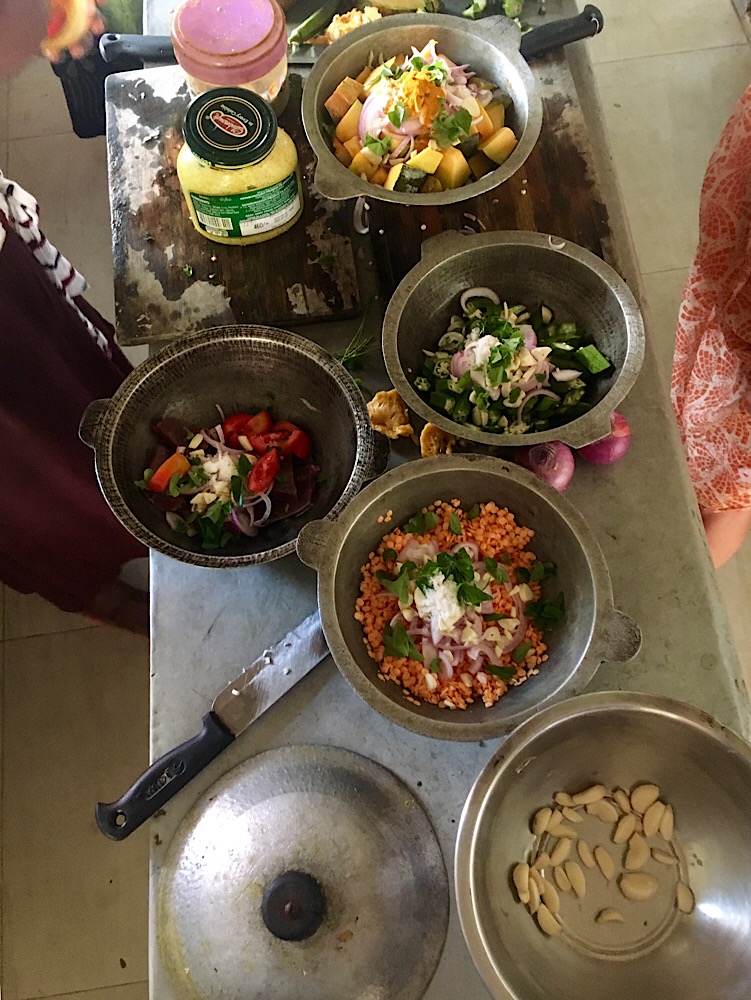
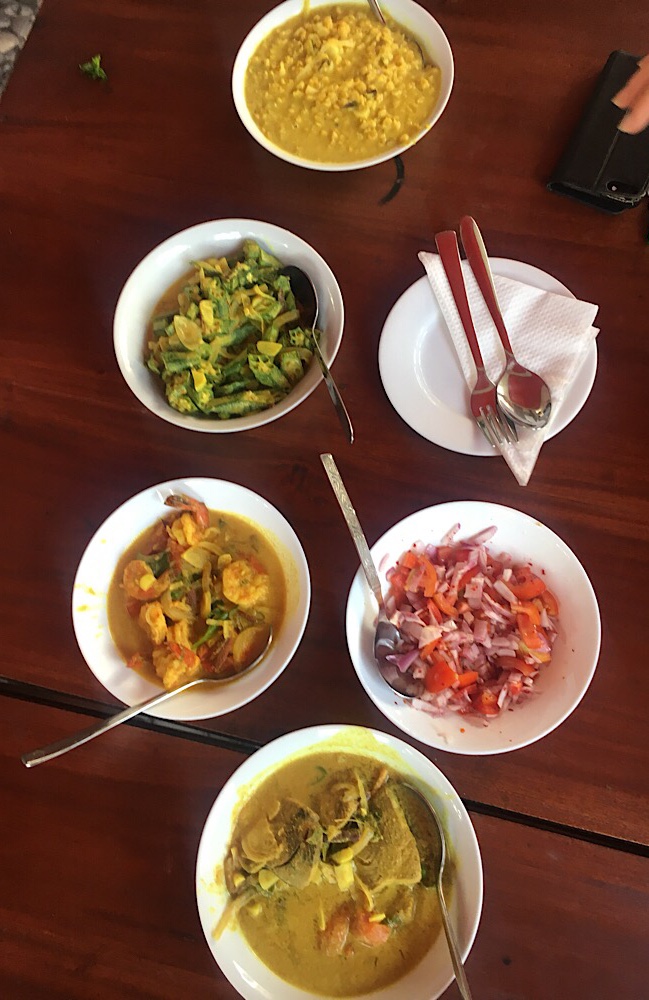
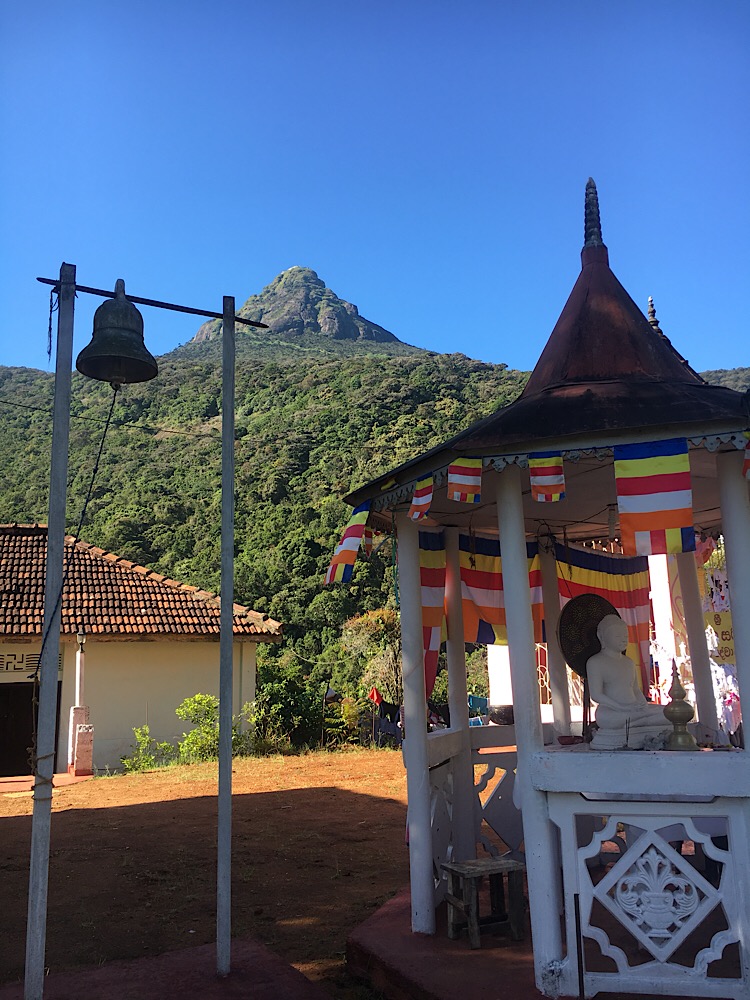
“If I was a Superhero, poppadoms would be my kryptonite”

How we laughed, how we cried! Following a brilliant farewell pub send-off and a resplendent Arsenal victory over Man U, we finally put our money where our mouth was and Brexited to our first stop, Talalla on the south coast of Sri Lanka. Despite spending nearly 13 hours of flight time catching flies, Peahead arrived ravenously hungry, as did I, and we immediately set about decimating a curry. It was at this point that Peahead revealed the golden insight above as to her real weakness – should make “date nights” a bit cheaper.   

Happy with Beer & Poppadoms in her line of vision

Talalla is a quiet, palm-fringed curve of golden sand near the town of Matara (around a 3.5hr drive from Colombo), nestled in amongst the booming, ever-expanding tourist resorts of the South but, by contrast, is almost completely undeveloped. With its warm, turquoise waters and nothing but a clutch of fishing boats scattered across the beach, it’s a picture-postcard view of a tropical Indian Ocean cove. We knew all of this because we came here on our previous trip to Sri Lanka in 2012 and loved it – it’s beautiful, there’s not much to do because there’s not much there and that was fine by us for our first stop as we looked to get our bearings and our heads around the fact that we were going to be away for six months.

As before, we stayed at Talalla Retreat. Back in 2012, we were blown away by this place – an idyllic set of well-finished, open-sided two up-two down bedroom blocks centred around a refreshingly cool swimming pool set amongst lush tropical forest, complete with monkeys, palm squirrels and all manner of birdsong. Owing to the open sides, you showered in an open air bathroom under the palms and as you lay in bed, you could look up at the stars – lush. Fast-forward to 2019, it had expanded somewhat with more bedroom blocks, including some cheaper options further out from the centre where yours truly settled down for six nights. Despite this, Talalla Retreat remained an extremely pleasant and relaxing place to hole ourselves away for our first week.

The beach at Talalla

One other change we noticed was that yoga had now become the main event here, and after a day or two of furiously inhaling poppadoms, the deliciously refrescante Lion Lager and intense Bananagrams battles, we decided to get physical, taking daily Pilates and yoga classes for the rest of our stay – ticking off our first backpacker cliché along the way. And it was really good, despite some low-level initial cynicism on my part. Good to get into doing some daily exercise – a commitment we’ve made for the six months – and great to find new ways of exercising, with it being much more physically intensive than I expected. 

The meditative/“spiritual” side was also edifying for the most part, especially when sessions were led by an intriguing Kiwi character (maybe Aussie… splitting hairs) who became known as “Brother Blau”. At once a caricature of himself as a zen, blissed-out spiritualist strumming a guitar along the traveller circuit, and yet also incredibly knowledgeable, persuasive, even inspirational at points. Initially mocked by the Peahead for his acoustic rendition of “Brown Sugar” at breakfast on our first day, we soon fell under his spell and levitated out of the shala full of love, harmony and decrying individualistic western constructs. 

Having re-aligned our chakras, [in between more Lion Lagers and increasingly fierce bananagrams], we tried our hand at Sri Lankan cookery – cooking courses in each country being another objective for our trip. Our teacher was Nisha, a local lady in her late 30s/early 40s who took us into her kitchen and got us to knock out four curries in around 30 minutes: prawn, okra, pumpkin and tuna fish. As expected, the ingredients were market-fresh and included a number of delicate spices, with fresh curry leaves by the dozen, turmeric and garam masala featuring prominently. What was more surprising was the use of “mustard cream” – a hybrid between Dijon, wholegrain, mayo and American yellow mustard – out of a pot. Mustard is an important flavour in local cooking and this felt like a shortcut for the purpose of our lesson. 

Before
After

More interesting was the lack of any cooking oil. Nisha just chucks it all in a hot pan, covers it and cooks on a gas burner, adding a little watered-down coconut milk as it goes, before finishing the curry with a thicker coconut cream more like what we use out of a tin back home. The outcome is a pleasingly grease-free, tropical-tasting dish and that combination of curry leaves, coconut (and kaffir lime leaves) really gives a distinctively Sri Lankan flavour. It was a fun experience and we certainly learned a few things, especially on not cooking with oil. There were clearly a few shortcuts taken for the purposes of a short cooking lesson and so we’d like to test out marinating the food for longer and also adding more heat (Nisha told us at the end that she’d dumbed down the chilli for us philistine westerners, and we now ask for “Sri Lankan style” when eating out as a result). 

That pretty much brought the curtain down on Talalla for us as we forayed into the hills the next morning. Bouncing around in the back of a Toyota Hi-Ace for 6.5 hours, we reflected on a sunny first week, where, in different ways, we had at once got more than, less than and exactly what we had expected. Talalla was the same blissful place we’d known from years before, we’d made new discoveries as to Pilates and yoga in particular, yet the hotel seemed to have lost some of its sheen. It had switched from being a relaxing bolt-hole where you could do some yoga if you wanted to, to being a yoga retreat where you could opt out of the yoga and kick back and have a normal holiday, if you wanted to. This meant big groups on week-long courses, buffet dinners in the evening and generally gave a slightly timetabled, resorty feel at points. It is nonetheless a very special place to stay, especially if you can stay in the nicer rooms, and we were glad we came. We’d still heartily recommend it for a few days for anyone on a shorter holiday.

In pursuit of enlightenment

The Peak of Sri Pada

Our next engagement was to climb Sri Pada, aka Adam’s Peak – a holy mountain in the southern hill country, around 70 miles north of Talalla. Various religions attach significance to this place. It is said that this was where Adam first set foot on earth following expulsion from Eden for various misdemeanours. For Buddhists, this is where the Buddha left earth to enter Paradise and so is the site of mass-pilgrimage. 

To access it, we weaved through mile upon mile of emerald tea plantations to a listless dust-town called Dalhousie and having settled down for some early shut-eye, we jumped out of bed at 2am to start our ascent in the relative cool of the night. Described as “moderately tough” by the somewhat hit-and-miss Lonely Planet, we soon discovered that the 5000+ steep stone steps were going to pose more of a challenge than we’d bargained for. Powered on by Lemon Puff biscuits and a couple of litres of water, we hauled ourselves up the seemingly endless staircase passing hundreds of locals and tourists along the way. Among these were countless little old Sri Lankan women, which put me and my incessant groaning and sweating into context. There were also strings of tea shops, shrines and stacks of locals sleeping piled on top of each other in shelters having presumably decide to split the climb either side of a fairly average-looking kip.

Arriving at the top at around 5am, we took off our shoes as we entered the temple perched on the crest of the hill and huddled together to keep warm as we waited for sun to rise. After an hour, people started jostling around and we found ourselves staring out into the darkness towards the East. Slowly, faint hues of red and orange started to colour the sky before the sun exploded onto the horizon. Cue mass photo-taking and more jostling from the tourists. One Irish chap who clearly knew his onions and had taken up a prime position was rather unfairly criticised for being too tall by some shorter German girls. Still – an otherwise beautiful scene and once the sun had come up further, we could see for miles all the way to Colombo more than 60 miles away and all the way out to sea. Below us the lower mountains in the range were shrouded in cloud, giving the feeling we were floating on a sea of our own. Adam’s Peak has a very pointed top and this results in a giant, mystical pyramidal shadow being projected into the distant clouds as the sun comes up. Add to this the ringing of bells and rituals carried out by the monks at the top and it makes for a really atmospheric, spell-binding experience. 


Having upped our karma from climbing up, we soon started to head down in the heat – thankfully much easier, especially upon getting a free foot massage at the bottom from some sales reps who successfully persuade us to purchase the balm they were peddling. Peahead also bought a Buddhist friendship bracelet and may now be Buddhist – it’s hard to tell for sure – but either way, cliché #2 was in the bag.

The descent

As far as the eye can tea:

About two hours by train to the East of Adam’s Peak is the town of Nuwara Eliya, nicknamed “Little England” due to its cool, cloudy climate up in the hills combined with its Victorian English village architecture and feel. It is in the heart of tea country and comes complete with red post boxes, a golf course, race course and a number of old school hotels that resemble either Alpine lodges or Faux Tudor manners. Since Gaby is a fervent colonialist and I like a cup of tea, we decided to stop by for a couple of days.

First, though, we needed to take the train. Sri Lanka’s railways were originally installed by the Brits back in the 1800s and it appears no upgrades have taken place ever since, much like National Rail in the UK, which made it comfortingly familiar. Where it does differ, and how, is in terms of scenery. Instead of trudging through innumerable post-Brexit model towns such as Walsall or Newport, you get to rumble across some of the most breath-taking, eye-popping landscapes you are ever like to see, certainly on a train: an endless carpet of bright green tea estates and burnt orange soil, set on dramatic mountain scenery under bright sunny blue skies, pot-marked with remote villages and technicolour temples (mainly Hindu). 

The train clings perilously to the cliff edge that the rails were somehow squeezed onto, and with the carriage doors open and it being standing room only, tourists are especially keen to sit in the doorways with their legs dangling down the side of train and the breeze in their hair. Very pleasant, until the train passes a raging trackside bonfire at which point their pins are almost instantaneously incinerated, as very nearly happened to some (Aussies I think – karma in the land of the Buddha?).

Upon arrival, we immediately threw ourselves into ticking off the various colonial sights, including strolling through the rather beautiful golf course, the bizarre and dishevelled Royal Turf Club and their very own Victoria Park before the main event: afternoon tea at The Grand. This hotel is probably what you’d expect: set on its own driveway with lawns and manicured gardens, it is kind of grand with its high ceilings, wood panels and billiards room, but also a bit dated and forced with sort of mock-Tudor architecture and 60s film posters on the wall in the bar. It doesn’t quite come together but the absurdity of it, especially in the middle of Sri Lanka, makes it a fun place to be. 

Tea was served and we guttled a tiered cake stand of bite-size treats: smoked salmon and cucumber sandwiches, handmade pastry cups filled with sweet and savoury fillings (crabstick with chilli sauce, or strawberries and cream) and other cakes, washed down with very fine Sri Lankan tea (local Orange Pekoe black tea for Peahead, Superior Ceylon for me). Sri Lanka is the fourth biggest producer of tea but is higher quality and attracts a higher market price than that of its rivals. Taken on its own without milk (or sugar), it is delicate and delicious.

Taking the opportunity to make use of the superior-grade facilities on offer before leaving (a throwback to my student days and the Saturday morning coffee at the Charlotte Street Hotel), we spotted the vintage cocktail lounge and vowed to return the next day.

The following day, after a hike through the tea fields to the pleasant Lover’s Leap waterfall and a nice but fairly unremarkable tour of the Pedro Tea Estate factory (still using Victorian-era machinery), we found ourselves in the 19th Hole pub at the Glendower hotel, whereupon we embarked on a mini-pub crawl from one English-themed hotel pub to the next, taking in an Indian for dinner along the way. Delicious and disgracefully British, but when in Rome…

A typically colourful Hindu procession we bumped into

Royal & Ancient: Kandy & Sigirya

Having exhausted all of our colonial options in Nuwara Eliya, it was time to go. We had had fun but frankly much of the original village has been absorbed by the new town, which is fairly dusty and unpleasant, and a lot of the original features and character are now lost. The chocolate box English village we expected isn’t really there to see anymore and I probably wouldn’t go back.

So, we jumped back on the train for four hours, heading northwest to Kandy – Sri Lanka’s second city. To keep Peahead at bay, I invested in a selection of “short eats” at the station. These are hand-sized snacks to be eaten on-the-go (almost the Sri Lankan equivalent of a sandwich). They include samosas, dosas and various other forms of what is essentially potato curry (usually veg) wrapped in roti or pastry. Tasty, cheap and typically Sri Lankan. The fun thing with these is you never know how spicy they are going to be until you take a bite – ranging from a light tickle of chilli to taste-bud tingling. 

Eventually we lurched into Kandy and headed straight for the main sight: The Temple of the Sacred Tooth Relic. This is where one of Buddha’s teeth is supposedly kept and it is said that whoever holds the tooth has the power to rule the country. It is a very holy site for Buddhists and Sri Lankan Buddhists are meant to make at least one pilgrimage to here in their lifetimes. Following Gaby’s tabletop-dancing at the 19th Hole, we were also in need of some karmic redemption.

The outside of The Temple of the Sacred Tooth Relic at dusk

Entering shoeless just before sunset, the temple is an imposing, fortress-like building which is fairly plain and whitewashed on the outside, but beautifully decorated on the inside, with colourful ceramic walls and ceilings, gold and ivory ornaments, natural, unfinished wood and low lighting. The inner temple, where the tooth is kept, is striking with a traditional oriental architecture that is classically associate with a Buddhist temple and a beautiful gold roof donated by Japan. In the outer wings there are gardens and a museum full of donated Buddha statues and other artefacts which was fairly interesting. 

All in all, an atmospheric and mystical place which we would have hung around longer in (especially as the Buddha tooth is only viewable at certain points in the day when the monks make an offering) – but the place was rammed with Sri Lankan schoolchildren who were more interested in repeatedly asking our names than in the big man’s gnasher, and with little chance of seeing it ourselves, we left the building. It was now dark and the temple was beautifully lit, while the skies were filled with hundreds of enormous fruit bats, slowly flapping their wings as they menacingly moved above us. It was a nice surprise to walk back out into a completely changed environment and we will make sure to visit more places just before sunset in future.

Despite its size, big, bustling Kandy does not have a huge amount of sights and didn’t seem the sort of place to hang out for a few days – so we left the next day, but not before visiting one other very fine spot: the Royal Botanic Gardens. Frankly, Kew Gardens is being given the run-around by this place. It is best described by photos, but these gardens are exploding with tropical life and kept beautifully. There are palms of all sorts everywhere, extraordinarily bright flowers, grasses, spice plants, cacti and orchids. Added to this is amazing birdsong, stacks of monkeys and thousands of fruit bats hanging asleep in the trees. If the Queen had a tropical residence, the grounds would look like this. Well worth a visit. 

Alas, onwards to Sigiriya, a couple of hours northeast of Kandy and home to Sri Lanka’s #1 tourist attraction: Sigiriya Rock. This is a vast chunk of red rock dramatically rising from the plains which was the site of an ancient palace and/or monastery depending on who you believe. All quite Indiana Jones and even more so due to Sigiriya being in the heart of the country in a jungle at lower altitude than Kandy – hot and sweaty. This was not helped by the fact that, after a couple of weeks abroad, my stomach had appeared to have joined UKIP and was instantly deporting anything foreign. I thought that lot loved a curry?

Lion Rock – Sigiriya

Starting early the next day to beat the crowds, we strolled through what had once been the pleasure gardens of the palace, made up of symmetrical water features most of which were now dried out. Then a clamber up the rock itself via a cave full of ancient frescoes of nymphs (possibly as old as 5th century), in amazing condition – the colours still vivid. Equally impressive was the very Sri Lankan tour guide in front of us who was rattling off fluent Italian to his clients. We’ve since seen this in Russian and French and while there’s no reason a Sri Lankan tour guide shouldn’t be able to do this, it is a bit bonkers at first sight and it’s very impressive. They may well be self-taught and it demonstrates how tourism is evolving quickly here.

The next stage up we encountered the legendary, enormous stone lion paws carved out of the rock. There had once been a vast, entire lion statue here that served as the entrance to the main palace at the top of the rock – you would enter through its mouth, but only the paws remain. A final climb up another set of stairs and we make it to the very top of the rock, where the original palace/monastery once stood. 

A relief to feel the breeze and to see the 360 degree view of the beautiful surrounding jungle countryside, which extends as far as the eye can see from this lofty perch a couple of hundred metres up. Up there, we also have a nose around the ruins of the former palace, including an immense reservoir and a few other bits and bobs. It probably was a stunning complex, but there actually isn’t much to see now – the view is the main thing. 

Which is just as well as my stomach was definitely not feeling strong and stable, and there were no facilities – ancient or otherwise – on the top of the rock (which apparently is a key fact for those who argue it must have been a monastery rather than a palace)! Time to get down, get sorted and move on to our next destination. One little known fact about Gabs is that she is part-lizard. Not only does this explain her small head, but it also means she requires regular, intense sun-bathing sessions, ideally in a sandy environment. It had been a week since the beach and she was starting to wane, so it was back to the beach…

With two weeks under our belts, we’ve done, seen and learned a lot – obviously we’ve loved it. It definitely hasn’t sunk in yet that we are away for six months. It feels more like we are on an adventurous holiday. I’m hopeful this realisation comes soon as it will not only feel absolutely lush (!) but also will help me to fully relax and clear my head. Putting my phone away is something I need to do to disconnect and also enjoying each day as it comes, rather than always thinking ahead. Perhaps this is part of being institutionalised in an office worker job over 10 years, or maybe just in my nature, but I’m sure it will happen at some stage and it will feel great!

Stay tuned for the next post, coming in hot from Peahead!